
Institutional Crypto Prime Margin
Negative-Balance Non-Existence Proofs & Hidden Collateral Encumbrance Risk
Without strict 64-bit unsigned range proofs and off-chain encumbrance audits, a bankrupt exchange can inject a -$2B house account—or borrow tokens overnight—to spoof a 100% Proof-of-Reserves badge.
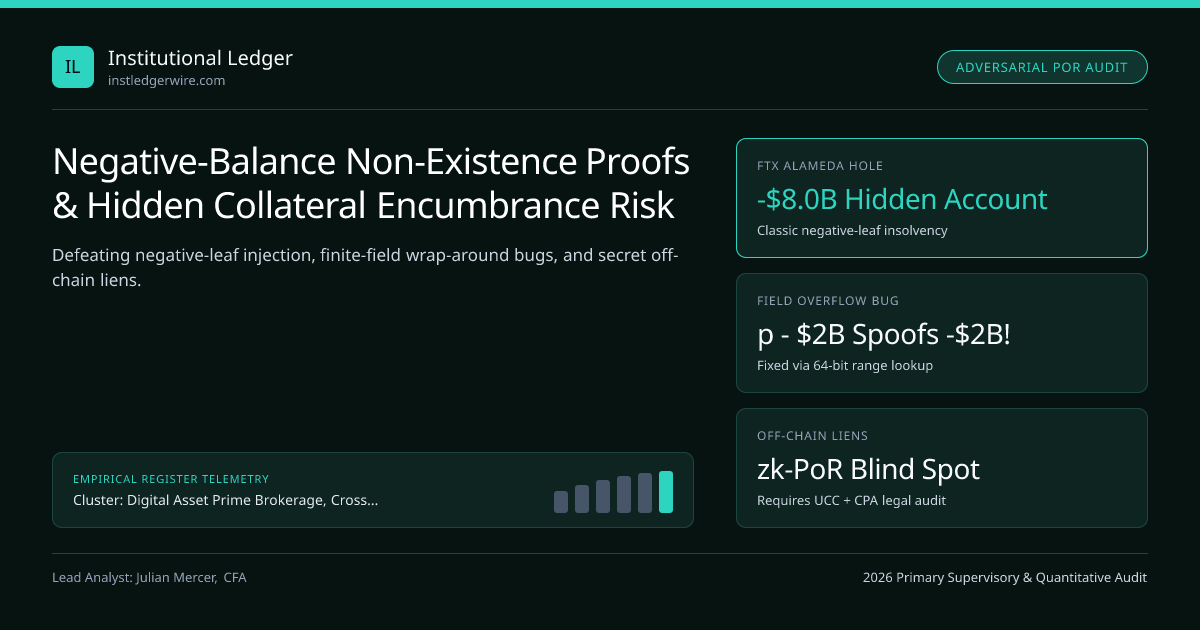
Inside FTX's PostgreSQL database sat a single boolean column on Alameda Research's account record—allow_negative = true—that silently absorbed -$8 billion of customer deposits while every retail user dashboard still displayed normal balances. When the industry turned to cryptographic Proof-of-Reserves to make another hidden negative account mathematically impossible, cryptographers uncovered an equally subtle second trap: without strict 64-bit bit-decomposition range proofs and off-chain encumbrance checks, finite-field math and secret paper liens can still spoof solvency.
Anatomy of Finite-Field Wrap-Around: Why >= 0 Doesn’t Exist Natively in F_p#
In C++ or Rust, checking if (balance < 0) reject; takes one CPU instruction. Inside a zk-SNARK arithmetic circuit, all addition and multiplication occurs modulo a 254-bit prime p (such as the BN254 scalar field or Plonky2's 64-bit Goldilocks extension)—where every element is an unsigned residue 0, 1, ..., p - 1!
As demonstrated in the formula block above, if a circuit developer forgets to constrain the bit-length of either a leaf's net equity or an internal node's running sum:
- Setting a fake account balance to
p - 4,000,000,000wraps around modulopduring parent-node addition, subtracting $4 billion from the root liability sum! - That exact bug class was caught in the wild by zk-security auditors in early 2023. Institutional ODD teams reviewing zk-SNARK Merkle-Sum Tree Proof-of-Reserves demand published third-party cryptographic circuit audit reports confirming 64-bit
Plookuprange gates on every leaf valuation and every internal tree summation!
Defeating the "FTT Collateral Trick": Auditing the Oracle Haircut Vector#
Even with bulletproof 64-bit range gates, how could a shady venue hide a bad margin loan inside a multi-asset zk-PoR circuit? Suppose a captive market maker owes the exchange -$500M USDC, and posts 500 million units of an illiquid insider token allegedly "worth $1.20 each ($600M)"!
- If the zk-PoR circuit values that insider token at
$1.20with a0%haircut, the market maker's net leaf equity reads+$100M >= 0—passing the non-negativity gate even though liquidating the token on an actual orderbook would yield$5M! - Institutional Countermeasure: Transparent zk-PoR implementations (BitMEX, Backpack Exchange) publish the exact public-input vector of asset prices and collateral haircuts alongside the Merkle root! If an exchange assigns >0% collateral weight to its own native token or illiquid micro-caps (violating stressed VaR liquidity add-on standards), institutional risk scripts reject the proof immediately!
| Insolvency Spoofing Vector | Historical Precedent / Bug Class | Pure zk-PoR Detection? | Required Institutional Defense |
|---|---|---|---|
| Hidden Negative House Account | FTX hidden -$8B Alameda allow_negative flag | Yes (100%) | Per-leaf Net_Equity >= 0 constraint in zk-SNARK MST |
Modular Field Overflow (mod p) | 2023 under-constrained BN254 PoR circuit bug | Yes (with audit) | Mandatory [0, 2^64) lookup range gates + formal circuit verification |
| Inflated Illiquid House Token | Counting $5B of illiquid exchange token as margin equity | Yes (transparent) | Public oracle price & collateral haircut vector committed in proof header |
| 24-Hour Borrowed Snapshot Coins | Pre-snapshot OTC whale transfer returned at T + 2h | Partial | Continuous wallet-age analytics + daily/hourly automated PoR |
| Secret Off-Chain Pledge / Lien | Side-letter pledging cold wallet to offshore lender | No (Legal Blind Spot) | GAAP financial audit + UCC searches + off-exchange tri-party custody |
The Legal Blind Spot: Secret Off-Chain Liens & Flash-Borrowed Snapshots#
As emphasized in our institutional crypto prime brokerage cornerstone guide and the SEC Office of the Chief Accountant's warnings alongside SEC SAB 122, cryptography sees the blockchain—it cannot read a secret Cayman Islands loan agreement!
- Unrecorded Senior Pledges: If an exchange signs an off-chain security agreement granting a lender a senior charge over its cold wallet, the blockchain shows zero encumbrance until default! ODD teams run Delaware / Washington D.C. UCC-1 financing-statement searches, Cayman/BVI company-charge registry checks, and require annual audited GAAP financial statements plus SOC 1 Type II custody audits.
- Pre-Snapshot Flash Borrowing: Public on-chain analytics platforms track exchange cold wallets 24/7/365; any venue whose cold-wallet balances spike 2 hours before
00:00 UTCand flow back out 2 hours later is immediately flagged for window-dressing!
- Suppose Prime Modulus p = 21888242871839275222246405745257275088548364400416034343698204186575808495617 (BN254 Scalar Field)
- 1. Dishonest Exchange Owes Real Customers: +10,000,000,000 USDC
- 2. Dishonest Exchange Injects Fake Leaf L_fake = p - 4,000,000,000
- Notice: As a raw field element, L_fake is a HUGE positive integer (~2.188 * 10^76), NOT a "negative symbol"!
- Yet in modular addition: (10,000,000,000 + L_fake) mod p === 6,000,000,000 USDC (-$4B vanished!)
- 3. Mandatory Fix — 64-Bit Unsigned Decomposition Gate:
- Circuit forces Li === Sum{j=0..3} ( Limb{i,j} * 2^(16*j) ) where every Limb{i,j} in LookupTable[0..65535]!
- Max representable value = 2^64 - 1 (~1.84 * 10^19) <<< p/2 -> Impossible to reach p - 4,000,000,000!
Why PoR Complements—Never Replaces—Off-Exchange Tri-Party Custody#
Even a daily, formally verified zk-PoR only tells you an exchange was solvent at midnight last night. Rather than leaving $50M of idle equity exposed to intraday counterparty risk, institutional prime funds hold 90%+ of principal inside NYDFS, BaFin, or FINMA segregated vaults and trade via off-exchange pledges—using zk-PoR strictly to police the 5%–10% unsettled variation-margin tail!
Solvency & Encumbrance ODD Checklist for Allocators#
Operational due diligence teams active in our Digital Asset Prime Brokerage & PoR hub verify audited 64-bit range constraints under the SEC SAB 122 2026 Benchmark Standard, inspect public collateral-haircut vectors, and cross-check venue regulatory standing via our verification portal.
Frequently asked questions
Did a real-world zk-SNARK Proof-of-Reserves circuit actually suffer a finite-field overflow vulnerability?
Yes! In February 2023, security researchers disclosed a critical under-constrained bug in an early open-source zk-SNARK Proof-of-Reserves repository: while individual user asset balances checked non-negativity, net USD equity calculation lacked a modular overflow bound—allowing a malicious prover to craft overflow values modulo p that canceled billions in real liabilities! It was immediately patched with 64-bit range gates.
How do modern zk-PoR circuits handle legitimate institutional margin accounts that carry negative token balances?
If an institutional basis trader holds +$50M BTC collateral and borrowed -$30M USDT on margin, their USDT leaf balance is legitimately negative (-$30M)! Modern zk-PoR circuits solve this by proving two facts simultaneously: (1) each user’s haircutted net USD equity across all assets is >= $0, AND (2) the exchange’s aggregate house + customer on-chain holdings cover 100%+ of every net positive token obligation!
Why can’t pure cryptography detect a "hidden off-chain encumbrance" or overnight window-dressed loan?
Suppose an insolvent exchange borrows 20,000 BTC for 24 hours from a friendly OTC whale via an unrecorded Cayman side-letter promising to return the BTC tomorrow. On the blockchain at 00:00 UTC, the exchange holds the private keys and passes both wallet signing AND zk-SNARK liabilities! Detecting borrowed/encumbered assets requires continuous multi-day monitoring plus CPA audit inspection of debt ledgers and UCC filings.
Why did the SEC warn CPA firms in 2023 not to mislabel narrow Proof-of-Reserves snapshots as "financial statement audits"?
In March 2023, SEC Acting Chief Accountant Paul Munter warned investors that a point-in-time PoR procedures engagement does NOT examine off-balance-sheet liabilities, legal contingencies, corporate debt covenants, or internal controls—requiring institutions to pair cryptographic zk-PoR with full GAAP financial audits and SOC 1 Type II reports.
Publication record
- Published
- November 13, 2026
- Updated
- November 15, 2026
- Author
- Julian Mercer, CFA
- Review
- Review not recorded
- Automated fact check
- Passed in the stored pipeline record
- Source URLs
- 3 recorded
AI assistance recorded: anthropic/claude-opus-4.6. This field does not establish human review or source verification.
Academic & Institutional Attribution
Cite This Research & Embed Live Data Card
Standard academic & institutional research paper citation format.
Julian Mercer, CFA. (2026, November 15). Negative-Balance Non-Existence Proofs & Hidden Collateral Encumbrance Risk. Institutional Ledger. https://instledgerwire.com/stories/negative-balance-non-existence-proofs-hidden-encumbrance-riskRegulatory Directory Cross-Reference
Referenced Institutions & Regulatory Registries
Top Regulated Institutions in This Coverage Slice
Referenced Supervisory Authorities
Related Institutional Crypto Prime Margin & Institutional Briefings
Explore Institutional Crypto Prime Margin Hub (20) →Institutional Crypto Prime Margin
Institutional Crypto Prime Brokerage, Cross-Venue Netting & zk-PoR Guide (2026)Institutional Crypto Prime Margin
Cross-Exchange Delta-Neutral Cash-and-Carry Basis Margining MechanicsInstitutional Crypto Prime Margin
Institutional ETH Staking Slashing Insurance & Correlated Penalty MathInstitutional Crypto Prime Margin
Validator Exit Churn Limits, Unbonding Queues & Liquidity DiscountsInstitutional Crypto Prime Margin
Prime Broker Cross-Margining: Spot ETFs, CME Futures & Perp OffsetsInstitutional Crypto Prime Margin
Liquid Staking Tokens (LST) Collateral Haircuts & Depeg Cascade ModelsInstitutional Crypto Prime Margin
Principal vs Agency Prime Execution & Institutional Smart Order RoutingInstitutional Crypto Prime Margin
Crypto Securities Lending: Open-Term Recall SLAs, GMSLA & Borrow RatesRegulatory Compliance
South Korea to permit crypto withdrawal freezes during hacking threatsMarket Insights
Stablecoin supply falls $14.2B in biggest 30-day drop since June 2022Cryptocurrency Markets
Crypto hack losses equal 57 cents per $1 earned onchain: Ark’s ValenteRegulatory Compliance
European Union Presses the Button for Tokenized Assets: Common Standards Are Coming - Cryptonews.net
Institutional Ledger Data, Benchmarks & Contributor Records
CC BY 4.0 Open Data
Open Institutional Datasets (CSV / JSON) →
Download desk-compiled quantitative series & schemas.
2026 Reference Matrix
2026 Institutional Benchmarks & Thresholds →
Statutory capital, clearing, margin & rate conventions.
Editorial Records
Authors & Review Records →
View named contributors where those records are available.
Complete Index
Master Research & Dossier Archive →
Browse all published briefings by topic pillar & date.