
Institutional Crypto Prime Margin
zk-SNARK Merkle-Sum Tree Proof-of-Reserves: Auditing Exchange Liabilities
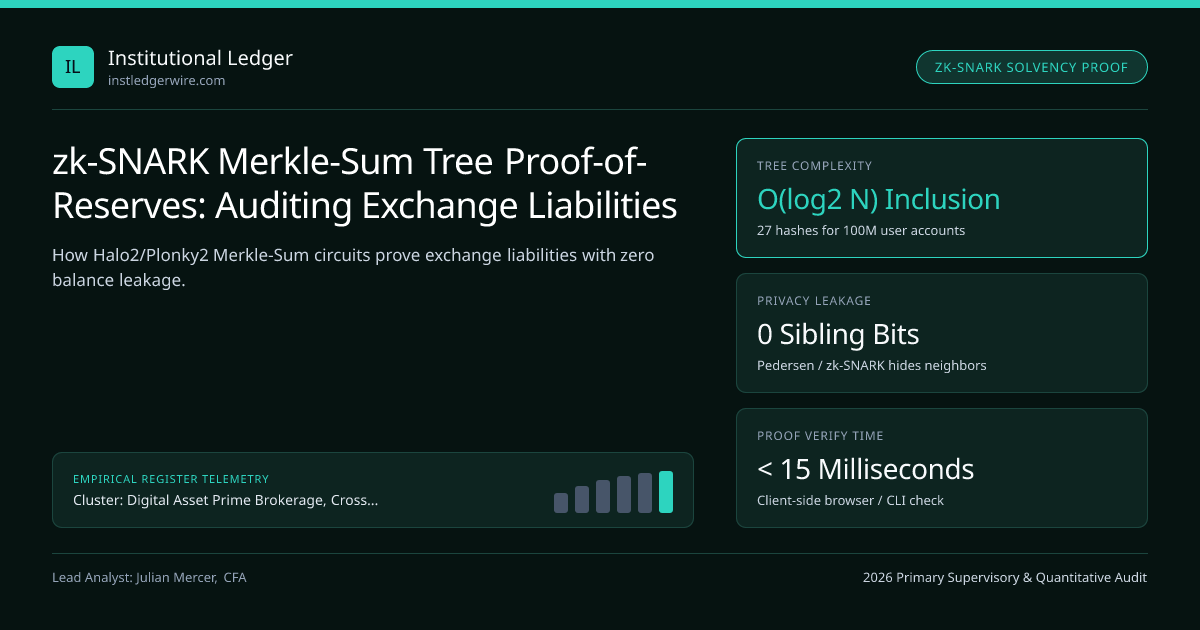
Standard Merkle trees leak sibling balances or remain vulnerable to injected negative accounts. Combining Merkle-Sum Trees with Halo2/Plonky2 zk-SNARK circuits proves complete exchange solvency with zero privacy leakage.
Within seventy-two hours of FTX's November 2022 collapse, half a dozen crypto exchanges rushed to publish lists of cold-wallet addresses containing billions of dollars in Bitcoin and Ether—calling them "Proof of Reserves." Vitalik Buterin and institutional cryptographers immediately pointed out why an asset list alone proves nothing: knowing a bank has $8 billion in its vault tells you zero about its solvency if it secretly owes depositors $14 billion! Solving the liabilities side without exposing confidential institutional account sizes required marrying Merkle-Sum Trees with zk-SNARK zero-knowledge circuits.
Why Plain Merkle Trees Fail—and Plain Merkle-Sum Trees Leak Alpha#
In our institutional crypto prime brokerage cornerstone guide, we define two non-negotiable properties of an institutional liabilities audit: soundness (the venue cannot understate total liabilities) and zero-knowledge privacy (a competitor cannot deduce your fund's $75M BTC position).
Why did earlier designs struggle to achieve both at once?
- Standard Hash-Only Merkle Trees: If each leaf only hashes
H(UID, Balance)without summing balances upward, the root contains no aggregate liability number—the exchange can claim total liabilities are $1B when the leaves actually add up to $5B! - Unblinded Maxwell Merkle-Sum Trees (2014): Greg Maxwell solved soundness by tagging every node with
(Hash, Balance_Sum), championed early in production by BitMEX. However, to verify the path from your leaf to the root, the exchange had to hand you theBalance_Sumof your sibling leaf and sibling subtrees—leaking proprietary institutional balance sizes unless accounts were randomly sharded into thousands of tiny virtual leaves!
Inside a Halo2 / Plonky2 zk-SNARK Proof-of-Reserves Circuit#
In late 2022, Vitalik Buterin formalized how zk-SNARKs eliminate every privacy leak while strengthening multi-asset margin soundness:
- Poseidon Algebraic Hashing: Traditional SHA-256 costs ~25,000 R1CS constraints per hash inside a SNARK circuit; Poseidon or Rescue-Prime operates natively over the prime field
F_p, requiring fewer than 300 constraints per hash—letting prover clusters digest 50 million user accounts in minutes! - Two-Layer Verification:
- Global Batch Circuit Proof (
pi_root): A single Halo2/Plonky2 proof proves to the entire world that the Merkle tree was constructed honestly fromNuser leaves, every internal sum conserved exact token quantities without field overflow, and no user had negative net account equity! - Zero-Knowledge User Inclusion Proof: Each user downloads a compact Merkle path of blinded commitments—verifying in
< 15 msinside their browser or institutional Python script that their exactUID,Nonce, and 300+ asset balances (spot + perpetual unrealized PnL) were locked intoRootHash!
| PoR Dimension | Asset-Only Wallet Dashboard | Plaintext Merkle-Sum Tree | zk-SNARK Merkle-Sum Tree (2026) |
|---|---|---|---|
| Liabilities Included? | No — shows assets only | Yes — sums user leaves | Yes — sums multi-asset leaves + perp PnL |
| Blocks Negative Leaves? | N/A | Partial (if siblings inspect path) | Mathematically Enforced (0 <= v < 2^64) |
| Protects Whale Privacy? | Yes | No — leaks sibling subtree totals | 100% Zero-Knowledge — zero sibling data |
| Multi-Asset Margin Support | None | Single-asset per tree | Unified cross-margin equity constraint |
| Institutional Examples | Early CEX dashboards | BitMEX open-source MST pioneer | Modern Halo2/Plonky2 verifiers (Backpack) |
Timestamp Synchronization: Locking Block Heights Across 20+ Chains#
A subtle attack vector against naive Proof-of-Reserves is inter-chain window-dressing ("musical chairs"): moving $100M of BTC at 11:55 UTC for the BTC snapshot, swapping or borrowing ETH at 12:05 UTC for the ETH snapshot!
Rigorous zk-PoR protocols (implemented across venues like Backpack Exchange and audited alongside SEC SAB 122 and FASB ASC 350-60 reconciliations) enforce an atomic UTC cut timestamp (e.g., 00:00:00 UTC): mapping that exact second to deterministic block heights across Bitcoin, Ethereum, Solana, and Arbitrum, and pairing liabilities with cryptographic cold-wallet signature challenges.
- 1. Leaf Equity Constraint (for user i across assets k = 1..M):
- Sum{k=1..M} ( Balance{i,k} *ConservativeHaircutPrice_k ) >= 0 [Enforced via 64-bit lookup table!]
- 2. Internal Node Conservation (for parent P with children L, R and asset k):
- P.Sum[k] === L.Sum[k] + R.Sum[k] AND P.Hash === Poseidon(L.Hash, L.SumCommit, R.Hash, R.SumCommit)
- 3. Global Solvency Invariant at Snapshot Block Timestamp T_0:
- For EVERY asset k: VerifiedOnChainUnencumberedWalletSum[k] >= Root.Sum[k] * (1 + SafetyBufferk)
Automating Daily Inclusion-Proof Bots on Institutional Prime Desks#
Remember the golden rule of zk-PoR: a Merkle tree only catches an omitted account if the owner of that account checks their leaf! Institutional ODD teams run an automated cron job after every published snapshot on Bitstamp, Bitfinex, or Backpack Exchange that queries the fund's internal sub-ledger balance at T_0, recomputes the salted leaf hash, and asserts cryptographic inclusion against the public Merkle root—alerting risk officers if any discrepancy exceeds $0.01 (see also negative-balance non-existence proofs).
Cryptographic Audit Checklist for Institutional ODD Teams#
Due diligence officers active in our Digital Asset Prime Brokerage & PoR hub require open-source verifier code (never closed-source web widgets!), confirm transparent Plonky2/Halo2 proving systems under ESMA and SFC custodial transparency expectations, and validate venue records via our verification portal.
Frequently asked questions
What information leak plagued early 2014 Maxwell Merkle-Sum Tree Proof-of-Reserves implementations?
In a raw unblinded Merkle-Sum Tree, verifying that your leaf L_0 ($50k) sums upward to the root requires handing you the balance of your immediate sibling L_1 ($42M whale!), plus every aunt/uncle subtree sum up to the root! Institutional funds refused to let random retail neighbors inspect subtree balances—solved completely by zk-SNARKs or Pedersen commitments (Provisions).
How does a zk-SNARK Halo2 or Plonky2 circuit eliminate trusted-setup risks in Proof-of-Reserves?
Early Groth16 zk-SNARKs required a circuit-specific "trusted setup ceremony"—where compromised toxic waste could forge fake solvency proofs! Transparent polynomial commitment schemes like Halo2 (IPA) and Plonky2 (FRI-based STARK/SNARK) require zero trusted setup or universal updatable KZG, eliminating cryptographic backdoor risk.
What happens if an exchange simply omits a $200M whale account from the Merkle-Sum Tree altogether?
Zero-knowledge math proves the sum of included leaves—it cannot stop an exchange from omitting a leaf UNLESS users verify inclusion! That is why institutional prime desks run automated hourly bots checking that their exact API balance and unique account salt appear inside every published Merkle root—any omission triggers an instant global cryptographic whistle-blow!
How often do top institutional venues generate zk-PoR snapshots in 2026?
While legacy monthly CPA snapshots took 30–45 days and massive GPU clusters, optimized Plonky2/Halo2 circuits prove 20M–100M multi-asset user leaves in under 25 minutes on commodity cloud GPUs—enabling monthly, weekly, or even daily automated solvency proofs (e.g., Backpack Exchange, BitMEX, OKX, Binance).
Publication record
- Published
- November 13, 2026
- Updated
- November 14, 2026
- Author
- Julian Mercer, CFA
- Review
- Review not recorded
- Automated fact check
- Passed in the stored pipeline record
- Source URLs
- 3 recorded
AI assistance recorded: anthropic/claude-opus-4.6. This field does not establish human review or source verification.
Academic & Institutional Attribution
Cite This Research & Embed Live Data Card
Standard academic & institutional research paper citation format.
Julian Mercer, CFA. (2026, November 14). zk-SNARK Merkle-Sum Tree Proof-of-Reserves: Auditing Exchange Liabilities. Institutional Ledger. https://instledgerwire.com/stories/zk-snark-merkle-sum-tree-proof-of-reserves-liabilities-auditRegulatory Directory Cross-Reference
Referenced Institutions & Regulatory Registries
Mentioned Regulated Institutions
Related Institutional Crypto Prime Margin & Institutional Briefings
Explore Institutional Crypto Prime Margin Hub (20) →Institutional Crypto Prime Margin
Institutional Crypto Prime Brokerage, Cross-Venue Netting & zk-PoR Guide (2026)Institutional Crypto Prime Margin
Negative-Balance Non-Existence Proofs & Hidden Collateral Encumbrance RiskInstitutional Crypto Prime Margin
Cross-Exchange Delta-Neutral Cash-and-Carry Basis Margining MechanicsInstitutional Crypto Prime Margin
Institutional ETH Staking Slashing Insurance & Correlated Penalty MathInstitutional Crypto Prime Margin
Validator Exit Churn Limits, Unbonding Queues & Liquidity DiscountsInstitutional Crypto Prime Margin
Prime Broker Cross-Margining: Spot ETFs, CME Futures & Perp OffsetsInstitutional Crypto Prime Margin
Liquid Staking Tokens (LST) Collateral Haircuts & Depeg Cascade ModelsInstitutional Crypto Prime Margin
Principal vs Agency Prime Execution & Institutional Smart Order RoutingRegulatory Compliance
Uncalled US House races could send more crypto allies to CongressRegulatory Compliance
South Korea to permit crypto withdrawal freezes during hacking threatsMarket Insights
Stablecoin supply falls $14.2B in biggest 30-day drop since June 2022Cryptocurrency Markets
Crypto hack losses equal 57 cents per $1 earned onchain: Ark’s Valente
Institutional Ledger Data, Benchmarks & Contributor Records
CC BY 4.0 Open Data
Open Institutional Datasets (CSV / JSON) →
Download desk-compiled quantitative series & schemas.
2026 Reference Matrix
2026 Institutional Benchmarks & Thresholds →
Statutory capital, clearing, margin & rate conventions.
Editorial Records
Authors & Review Records →
View named contributors where those records are available.
Complete Index
Master Research & Dossier Archive →
Browse all published briefings by topic pillar & date.