
Stablecoin Reserve Attestation Audit
Stablecoin Redemption Gate Fees, Minimum Burn Thresholds & Run Dynamics
Hidden deep inside stablecoin Terms of Service sit the clauses that govern crisis survival: $100,000 minimum burn gates, tiered redemption fees, T+5 delay rights, and offshore in-kind asset distribution disclaimers.
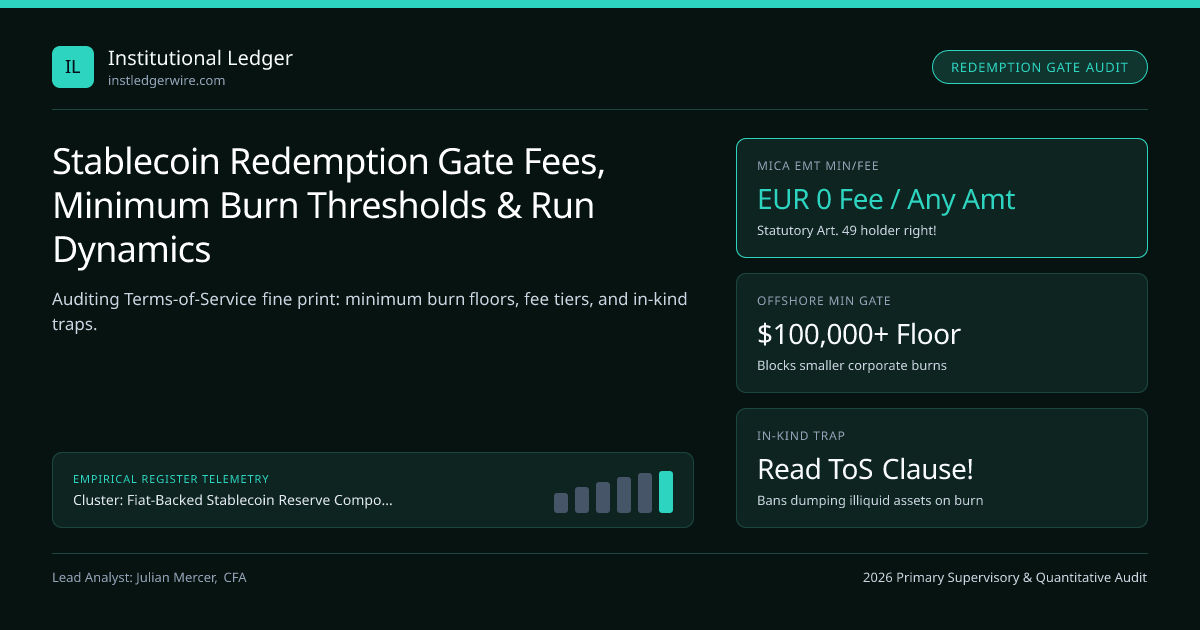
Here is the most expensive operational oversight in institutional crypto treasury management: a US-domiciled hedge fund holds $50 million of an offshore stablecoin—without realizing that Paragraph 4 of the issuer's Terms of Service explicitly prohibits US persons and US-managed funds from ever opening a primary redemption account! When a market panic strikes, that fund has zero legal claim on the underlying Treasury bills and is forced to dump into secondary orderbook discounts.
Legal Privity Trap #1: Do You Actually Have a Contractual Right to Redeem?#
In our fiat-backed stablecoin reserve cornerstone guide, we stress a legal distinction that surprises many portfolio managers: outside of EU MiCA Article 49, merely holding an ERC-20 token in a self-custody wallet does NOT automatically make you a direct contractual customer of the issuer!
- Offshore Exclusion Clauses: Major offshore USD stablecoins expressly bar U.S. Persons, citizens/residents of multiple jurisdictions, and entities controlled by U.S. investment managers from direct primary minting or burning! If secondary liquidity freezes or APs widen bids to
$0.97, a barred US fund has no standing to knock on the issuer's door for $1.00! - EU MiCA Article 49 Breakthrough: Inside the European Union (ESMA, AMF, BaFin), MiCA Article 49(2)–(4) confers a statutory direct par redemption right upon ALL holders of an E-Money Token against the issuer at any moment and free of fee!
- US Institutional Solution: Pre-onboard your exact fund legal entity for active, tested primary KYB redemption accounts at regulated onshore issuers (regulated USDC via Circle Mint and at least one NYDFS Trust issuer) before allocating a dollar!
Legal Trap #2: Scrutinizing "In-Kind" & "Extraordinary Delay" Clauses#
General counsels redlining stablecoin Terms of Service search immediately for three keywords: in kind, suspend, and sole discretion:
- In-Kind Property Disclaimers: Unregulated offshore terms historically included clauses allowing the issuer—if bank rails freeze or reserves prove illiquid—to transfer "a pro-rata share of reserve assets in kind" (imagine a crypto hedge fund being handed illiquid offshore commercial paper or locked repo participations!). Regulated NYDFS, MAS SCS, and MiCA EMT frameworks prohibit in-kind substitutions, requiring par fiat settlement.
- Volume-Tiered Instant Burn Fees: Even on reputable onshore platforms, verify the daily free burn threshold! Some enterprise schedules process standard next-day/intraday redemptions 100% free while levying a
3–10 bpsliquidity fee only if a single entity demands instant automated settlement above e.g.$15M/day—easily navigated by selecting standard T+0/T+1 Fedwire payout.
| Terms-of-Service Clause | EU MiCA EMT (ESMA) | NYDFS / Onshore Regulated (USDC) | Unregulated Offshore Issuer |
|---|---|---|---|
| Who Has Legal Par Claim? | Every tokenholder (statutory Art. 49 right!) | KYB-onboarded primary account holders (+ trust beneficiaries) | Strictly offshore KYB primary accounts (US entities barred!) |
| Minimum Burn Ticket | None / De minimis | $100 – $1,000 | $100,000 minimum |
| Redemption Fee | 0.0 bps (free by statute!) | 0.0 bps standard wire (optional instant-tier fee above high daily cap) | 10.0 bps ($1,000 or 0.10%) |
| In-Kind Bond/Loan Payout? | Strictly Illegal — must pay fiat par | Strictly Illegal — must pay USD | Historically reserved in crisis ToS! |
| Dispute Governing Law | Paris / Frankfurt / EU Courts | New York State / SDNY Federal Courts | Offshore BVI / Cayman mandatory arbitration |
Game Theory of Gates: Why High Minimums & Burn Fees Destabilize Pegs#
Under Nobel Prize-winning Diamond-Dybvig (1983) bank-run game theory, redemption friction creates strategic complementarity among panicked sellers:
- When holders know primary redemption is 0 bps, $100 minimum, and backed by NY Fed Overnight RRP (SEC Rule 2a-7 reserve wrappers), nobody dumps at
$0.992on Curve—they simply click "Redeem $1.00"! - Conversely, when holders face a $100,000 minimum gate, 10-bps fees, and discretionary multi-day delays, secondary market makers demand steeper risk premiums (AP arbitrage spreads), amplifying secondary depegs.
- Variables & $50,000,000 US Hedge Fund Emergency Liquidity Exit Comparison During Banking Scare:
- 1. US Fund Holding Offshore Stablecoin Whose ToS Explicitly Bars US Persons From Direct Primary Burn:
- Fund CANNOT burn at $1.00 par! Forced to dump $50M onto stressed secondary Curve/Bitfinex pool @ $0.9860 + 4 bps fee:
- Realized Cash = $49,280,000 (-$720,000 instant friction loss!).
- 2. US Fund Pre-Onboarded With Direct Primary Burn Account at NYDFS Trust / Circle Mint (Intrabank BNY Mellon Linked):
- Submits on-chain burn -> Receives $50,000,000.00 par USD wire with $0.00 slippage (+$720,000 saved!).
Quarterly "Live-Fire $100k Burn Drill" SOP#
An untested primary redemption account whose bank wire instructions expired six months ago is useless in a Friday crisis. Institutional treasury teams execute a live $100,000 mint-and-burn round-trip every quarter across each approved issuer—confirming API credentials, bank OBI whitelists, and actual T+0 wire arrival timestamps.
General Counsel Terms-of-Service Audit Checklist#
Legal and ops teams active in our Stablecoin Reserve Attestation hub archive timestamped PDFs of every issuer's Terms of Service under the USDC MiCA & NYDFS 2026 Benchmark Standard, confirm zero US-person exclusions or in-kind clauses, and verify regulatory charters via our verification portal.
Frequently asked questions
Can a stablecoin issuer legally hand me Treasury bonds or illiquid loans instead of wiring USD cash during a crisis?
Under NYDFS Guidance and EU MiCA Article 49, NO—statutory rules mandate cash par redemption in the referenced official currency (unless a regulator-supervised orderly liquidation plan activates). However, certain offshore unregulated Terms of Service historically reserved explicit contractual rights to delay redemption or deliver non-cash reserve property "in kind"!
How do $100,000 minimum primary burn thresholds amplify retail and mid-market losses during a depeg?
As BIS empirical research proved, when primary redemption is gated behind a $100,000 floor + slow offshore KYB + 10-bps fees, 99% of holders are forced to panic-sell onto secondary Curve/CEX pools during stress—transferring hundreds of millions of dollars of panic discounts straight into the pockets of a tiny handful of whitelisted APs!
Does Circle Mint or Paxos charge fees on massive $200M single-day institutional redemptions?
Standard basic/institutional redemptions at Circle Mint and Paxos execute at $0.00 (0.0 bps) with low minimums ($100–$1,000). Note that some issuers offer optional "Instant Intraday High-Volume Tier" fee schedules above certain daily $15M+ automated instantaneous thresholds while keeping standard same-day/next-day par settlement completely free!
Why did Diamond-Dybvig bank-run game theory prompt regulators to ban discretionary issuer redemption gates?
Just as the SEC found when abolishing Rule 2a-7 money-market gates in 2023, discretionary redemption gates cause runs rather than stopping them! The moment institutional treasurers suspect an issuer might lower a gate at 5:00 PM Friday, every rational CFO races to burn 100% of holdings at 2:00 PM Thursday!
Publication record
- Published
- November 13, 2026
- Updated
- November 14, 2026
- Author
- Julian Mercer, CFA
- Review
- Review not recorded
- Automated fact check
- Passed in the stored pipeline record
- Source URLs
- 3 recorded
AI assistance recorded: anthropic/claude-opus-4.6. This field does not establish human review or source verification.
Academic & Institutional Attribution
Cite This Research & Embed Live Data Card
Standard academic & institutional research paper citation format.
Julian Mercer, CFA. (2026, November 14). Stablecoin Redemption Gate Fees, Minimum Burn Thresholds & Run Dynamics. Institutional Ledger. https://instledgerwire.com/stories/redemption-gate-fees-minimum-burn-thresholds-liquidity-runsRegulatory Directory Cross-Reference
Referenced Institutions & Regulatory Registries
Mentioned Regulated Institutions
Related Stablecoin Reserve Attestation Audit & Institutional Briefings
Explore Stablecoin Reserve Attestation Audit Hub (20) →Stablecoin Reserve Attestation Audit
Fiat-Backed Stablecoin Reserve Composition, Audits & T-Bill Custody GuideStablecoin Reserve Attestation Audit
Basel SCO60 Group 1b Stabilisation Test Failures on StablecoinsStablecoin Reserve Attestation Audit
Treasury-Bill Yield Compression & Stablecoin Issuer Reserve EconomicsStablecoin Reserve Attestation Audit
AICPA AT-C 205 Monthly Stablecoin Reserve Attestation Criteria DecodedStablecoin Reserve Attestation Audit
Overnight Reverse Repo & 93-Day T-Bill WAM Caps in StablecoinsStablecoin Reserve Attestation Audit
EU MiCA Title III (ART) vs Title IV (EMT) Stablecoin Safeguarding RulesStablecoin Reserve Attestation Audit
MiCA’s 60% EU Bank Deposit Mandate for Significant Stablecoins: Tail RiskStablecoin Reserve Attestation Audit
NYDFS USD Stablecoin Guidance: T+2 Par Redemption & Trust SegregationInstitutional Crypto Prime Margin
Multi-Custodian Prime Routing & Single-Point-of-Failure MitigationInstitutional Crypto Prime Margin
Stressed VaR & Concentration Liquidity Add-Ons for Altcoin CollateralMarket Insights
Nomura explores sale of crypto unit Laser Digital: BloombergRegulatory Compliance
Uncalled US House races could send more crypto allies to Congress
Institutional Ledger Data, Benchmarks & Contributor Records
CC BY 4.0 Open Data
Open Institutional Datasets (CSV / JSON) →
Download desk-compiled quantitative series & schemas.
2026 Reference Matrix
2026 Institutional Benchmarks & Thresholds →
Statutory capital, clearing, margin & rate conventions.
Editorial Records
Authors & Review Records →
View named contributors where those records are available.
Complete Index
Master Research & Dossier Archive →
Browse all published briefings by topic pillar & date.