
Stablecoin Reserve Attestation Audit
Singapore MAS Single-Currency Stablecoin (SCS) Framework & 5-Day SLA
Singapore’s MAS Single-Currency Stablecoin (SCS) framework creates a voluntary/mandatory high-trust label above SGD 5M circulation, enforcing <=3-month AA- sovereign backing and 5-business-day par redemptions.
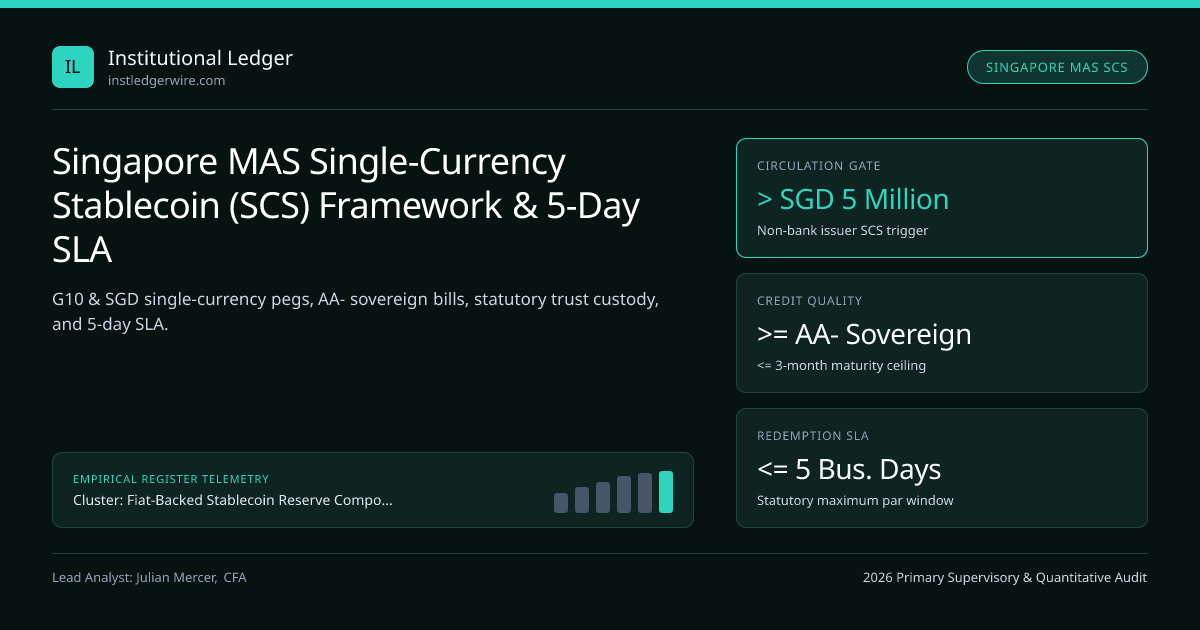
Rather than copying Europe's controversial 60% commercial-bank deposit mandate or restricting issuers solely to domestic currency, the Monetary Authority of Singapore (`MAS`) engineered one of the cleanest institutional stablecoin regimes in the world: the MAS Single-Currency Stablecoin (SCS) Framework. By permitting both SGD and G10 currencies, enforcing 100% same-currency AA- <=3-month sovereign reserves, and locking non-bank issuers inside narrow-activity ring-fences, Singapore positioned MAS-regulated stablecoins as the premier settlement cash leg for Asia-Pacific digital capital markets.
The "MAS-Regulated Stablecoin" Label & Narrow-Entity Ring-Fence#
Before MAS finalized its SCS framework, Singapore's Payment Services Act (PSA 2019) lumped Bitcoin, meme coins, and fiat-backed stablecoins together as generic Digital Payment Tokens (DPTs)—regulating AML/CFT and tech risk without policing 1:1 reserve sufficiency.
Under the finalized SCS regime—benchmarked in our fiat-backed stablecoin reserve cornerstone guide—any non-bank issuer minting more than SGD 5 million of SGD- or G10-pegged tokens in Singapore enters a heightened prudential perimeter:
- Protected Regulatory Label: Only compliant SCS-licensed tokens (such as StraitsX
XSGD/XUSDand Paxos Digital SingaporeUSDG) may call themselves "MAS-regulated stablecoins." Calling an offshore non-SCS token an MAS-regulated stablecoin triggers statutory fines and imprisonment! - Strict Narrow-Activity Ring-Fence: Non-bank SCS issuers are flatly barred from lending stablecoins, offering staking/yield products, running proprietary trading desks, or holding equity stakes in unrelated businesses—preventing corporate contagion from ever threatening the issuing entity!
Zero FX Mismatch & Why MAS Avoided MiCA’s 60% Bank Cash Trap#
Institutional treasury teams scrutinizing reserve rules praise two technical decisions by MAS:
- 100% Currency-Matched
AA-Assets: A USD-pegged SCS must hold 100% USD-denominated cash/<=3-monthAA-sovereign bills; an SGD-pegged SCS must hold 100% SGD-denominated cash, MAS Bills, or Singapore Government Securities (SGS). Holding high-yielding USD T-Bills to back an SGD or JPY stablecoin is strictly illegal—eliminating the cross-currency FX basis risk that destabilizes synthetic FX wrappers! - Sovereign Bill Freedom: Unlike EU MiCA's forced 30%–60% commercial bank cash floor, MAS allows SCS issuers to hold the vast majority of reserves in zero-default-risk <=3-month
AA-government bills and central-bank cash! And recognizing that USD T-Bills custody in New York rather than Singapore, MAS pragmatically permits overseas G-SIB custodians (like BNY Mellon or State Street) provided they hold an regulated branch/subsidiary footprint supervised in Singapore and a minimumA-credit rating.
| Prudential Feature | MAS Single-Currency Stablecoin (SCS) | NYDFS USD Guidance | EU ESMA / EBA MiCA EMT |
|---|---|---|---|
| Permitted Currencies | SGD + all 10 G10 currencies | USD primarily | Any single official currency (non-EUR faces Art. 58 cap) |
| Commercial Bank Cash Floor | None forced — allows ~90%+ sovereign bills! | None forced — allows ~90%+ T-Bills/RRP | 30% standard / 60% Significant forced bank cash |
| Entity Activity Ban | Strict narrow-issuer ban (no lending/prop/VC) | NY Trust fiduciary scope | EMI safeguarding / ancillary payment scope |
| Par Redemption Window | <= 5 business days statutory ceiling | <= 2 business days (T+2) | "At any moment" (T+0/T+1 SEPA norm) |
| Ecosystem Integration | Cash leg for MAS Project Guardian | US prime & USDC settlement | EEA CASP orderbooks (Bitstamp) |
Understanding the 5-Business-Day Redemption Window & Multi-Hub Issue Nuance#
Why does MAS specify a <= 5 business days statutory redemption SLA compared to NYDFS's T+2 ceiling?
- When a Singapore corporate burns a USD or EUR SCS on Friday afternoon Singapore Time (
SGT), New York and Frankfurt markets have not yet opened—and if Monday is a US federal holiday while Tuesday is a Singapore public holiday, clearing a cross-border G10 wire across correspondent cutoffs takes 3 to 4 calendar business days! In routine weekday operations, MAS SCS issuers settle intrabank redemptions in T+0 to T+1. - Note MAS's strict stance on multi-jurisdictional fungible issuance: MAS initially requires full visibility over the entire global reserve of an SCS (or cooperative home-host equivalence arrangements) before granting the SCS badge to globally pooled multi-issuer tokens.
- Variables & Singapore G10/SGD Stablecoin Issuer Solvency & Reserve Separation Audit (SGD 2.0B Circulation, Annual OpEx = SGD 18.0M):
- 1. Segregated Statutory Reserve Trust = >= SGD 2,000,000,000 in SGD Cash, MAS Bills & <=3-month AA+ Singapore Government Securities (100.0% ring-fenced for holders).
- 2. Separate Corporate Base Capital Requirement = max(SGD 1.0M, 0.50 * SGD 18.0M) = SGD 9,000,000 equity.
- 3. Separate Unencumbered Recovery/Wind-Down Liquid Buffer = >= 6 months OpEx (SGD 9,000,000 in liquid corporate cash/SGS) -> Ensures an orderly 6-month par redemption wind-down even if issuer revenue drops to $0!
Powering MAS Project Guardian & APAC Cross-Border OTC Settlement#
Across Singapore institutional OTC desks (Aquanow) and MAS Project Guardian GL1 fixed-income pilots, MAS-regulated XSGD and USD SCS tokens serve as the 24/7 programmable cash leg settling tokenized SGS bonds and cross-currency Asian trade finance.
APAC Stablecoin Onboarding Checklist for Treasury Desks#
Regional treasurers active in our Stablecoin Reserve Attestation hub verify an issuer's explicit MAS Major Payment Institution + SCS designation, audit monthly independent CPA attestations published on the issuer's website, and cross-check APAC licenses alongside Hong Kong HKMA FRS in our verification portal.
Frequently asked questions
Which currencies are eligible for issuance under Singapore’s MAS Single-Currency Stablecoin (SCS) label?
MAS restricts the SCS regime exclusively to stablecoins pegged 1:1 to the Singapore Dollar (SGD) or any G10 currency (USD, EUR, GBP, JPY, AUD, CAD, CHF, NZD, NOK, SEK)—reflecting transparent, ultra-liquid sovereign debt markets where <=3-month AA- government bills exist in size.
Why does MAS prohibit non-bank SCS issuers from running lending, staking, or venture arms?
Learning directly from 2022 crypto conglomerates where venture/trading losses brought down affiliate custody entities, MAS imposes a strict "Business Restriction" ring-fence on non-bank SCS issuers: the issuing legal entity may ONLY perform stablecoin issuance, reserve safekeeping, and directly incidental payment operations.
Why did MAS set a 5-business-day statutory redemption ceiling instead of T+1?
Because MAS allows Singapore-based issuers to issue G10-pegged tokens (such as USD or EUR stablecoins) across Asian-to-Western banking time-zone gaps and bank holidays! While competitive issuers like StraitsX (XSGD/XUSD) and Paxos Digital Singapore settle normal redemptions in T+0/T+1, the 5-business-day outer legal bound prevents technical breaches over US/SG cross-holiday weekends.
What are the prudential capital ("Base Capital" and "Solvency") floors for an MAS SCS issuer?
Non-bank SCS issuers must maintain Base Capital of at least the higher of SGD 1 million OR 50% of annual operating expenses, PLUS liquid unencumbered corporate assets sufficient to fund at least 6 months of orderly wind-down operating expenses without touching tokenholder reserves!
Publication record
- Published
- November 13, 2026
- Updated
- November 14, 2026
- Author
- Julian Mercer, CFA
- Review
- Review not recorded
- Automated fact check
- Passed in the stored pipeline record
- Source URLs
- 3 recorded
AI assistance recorded: anthropic/claude-opus-4.6. This field does not establish human review or source verification.
Academic & Institutional Attribution
Cite This Research & Embed Live Data Card
Standard academic & institutional research paper citation format.
Julian Mercer, CFA. (2026, November 14). Singapore MAS Single-Currency Stablecoin (SCS) Framework & 5-Day SLA. Institutional Ledger. https://instledgerwire.com/stories/mas-single-currency-stablecoin-scs-framework-5-day-redemptionRegulatory Directory Cross-Reference
Referenced Institutions & Regulatory Registries
Mentioned Regulated Institutions
Related Stablecoin Reserve Attestation Audit & Institutional Briefings
Explore Stablecoin Reserve Attestation Audit Hub (20) →Stablecoin Reserve Attestation Audit
Fiat-Backed Stablecoin Reserve Composition, Audits & T-Bill Custody GuideStablecoin Reserve Attestation Audit
Hong Kong HKMA Fiat-Referenced Stablecoin (FRS) Ordinance & CustodyStablecoin Reserve Attestation Audit
CPMI-IOSCO PFMI Rules for Systemically Important StablecoinsStablecoin Reserve Attestation Audit
Intraday Snapshot Window Dressing vs Continuous Proof-of-Reserve OraclesStablecoin Reserve Attestation Audit
Custodial T-Bill Safekeeping: BNY Mellon & State Street Reserve ModelsStablecoin Reserve Attestation Audit
Stablecoin Smart-Contract Freeze & Blacklist Governance Under OFAC/FinCENStablecoin Reserve Attestation Audit
FX Basis & Negative-Rate Risks in Non-USD (EUR, JPY, CHF) StablecoinsStablecoin Reserve Attestation Audit
Stablecoin Redemption Gate Fees, Minimum Burn Thresholds & Run DynamicsInstitutional Crypto Prime Margin
Weekend Gap Risk: CME Friday 4:00 PM CT Close vs 24/7 PerpetualsInstitutional Crypto Prime Margin
Restaking & EigenLayer AVS Slashing Contagion: Institutional PolicyInstitutional Crypto Prime Margin
On-Chain Wallet Ownership Proofs: BIP-322, EIP-191 & Micro-TransfersInstitutional Crypto Prime Margin
Prime Credit Intermediation & Post-2022 Undercollateralized Lending Bans
Institutional Ledger Data, Benchmarks & Contributor Records
CC BY 4.0 Open Data
Open Institutional Datasets (CSV / JSON) →
Download desk-compiled quantitative series & schemas.
2026 Reference Matrix
2026 Institutional Benchmarks & Thresholds →
Statutory capital, clearing, margin & rate conventions.
Editorial Records
Authors & Review Records →
View named contributors where those records are available.
Complete Index
Master Research & Dossier Archive →
Browse all published briefings by topic pillar & date.