
Off Exchange Triparty Collateral
UCC Article 12 Controllable Electronic Records (CER): Crypto Lien Perfection
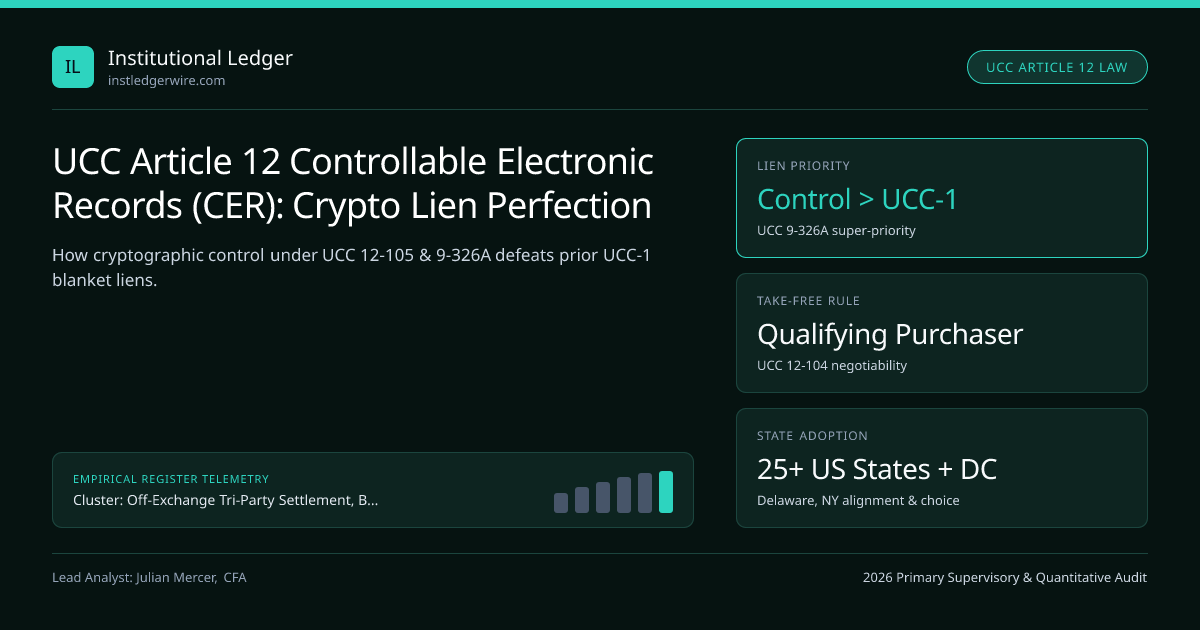
Before the 2022 UCC Article 12 Amendments, native Bitcoin and Ether fell into UCC Article 9 general-intangible traps. Perfecting a security interest via cryptographic control now grants super-priority.
Imagine accepting $75 million of Bitcoin as collateral inside an off-exchange derivatives vault, executing liquidations cleanly when your hedge fund counterparty defaults, and then receiving a federal bankruptcy summons demanding you turn over all $75 million because a regional bank filed a two-page UCC-1 financing statement against "all general intangibles" three years earlier. Before the Uniform Law Commission and American Law Institute promulgated UCC Article 12 (Controllable Electronic Records), that exact legal trap haunted every US digital-asset collateral desk.
The Pre-2022 "General Intangible" Trap Under UCC Article 9#
For seventy years, Article 9 of the Uniform Commercial Code divided personal property into neat buckets: goods, instruments, investment property, deposit accounts, money, and a catch-all residual bin called general intangibles (originally meant for things like patent royalties, tax refunds, and franchise goodwill). Because native Bitcoin and Ether were neither physical coins nor corporate securities, courts defaulted them into general intangibles.
That classification broke 24/7 collateralized crypto markets in two ways:
- Filing-Only Perfection: You could not perfect a security interest in a general intangible by taking possession or cryptographic key control—only by filing a public UCC-1 financing statement, ranked strictly "first in time, first in right."
- Zero Negotiability: Unlike cash or certificated securities, general intangibles carried their prior liens everywhere they traveled! As emphasized in our off-exchange tri-party collateral cornerstone guide, no derivatives venue could safely credit instant margin if every incoming satoshi required a 50-state corporate UCC lien search.
UCC § 12-105 Cryptographic Control — Including 2-of-3 MPC Quorums!#
Enacted across more than 25 US states (including commercial law anchors like Delaware and Washington, D.C., with New York commercial bar harmonization), UCC Article 12 defines a Controllable Electronic Record (CER) and pairs with amended UCC §§ 9-107A, 9-314, and 9-326A to align commercial law with public-key cryptography.
Under UCC § 12-105(a), a secured party has statutory control of a CER if the electronic system gives the person:
- Power to avail itself of substantially all the benefit from the record;
- Exclusive power to prevent others from availing themselves of substantially all the benefit; and
- Exclusive power to transfer control of the record to another person.
Crucially for 2-of-3 MPC off-exchange mirror loops, UCC § 12-105(b) & (e) expressly codifies a presumption of exclusivity even when transfer power is shared through multi-signature or MPC threshold cryptography! Holding 1 shard alongside an agreed co-signer shard that executes automatically upon default satisfies statutory control without forcing the borrower to surrender unilateral single-key custody.
| Statutory Provision | UCC Citation | Legal Function in Off-Exchange Margin | Practical Impact on Prime & Exchange Desks |
|---|---|---|---|
| CER Definition | UCC § 12-102(a)(1) | Electronic record susceptible to cryptographic control | Covers native BTC, ETH, SOL, and non-Article-8 tokens |
| Take-Free Negotiability | UCC § 12-104(e) | Qualifying Purchaser takes free of competing property claims | Venues (Bitstamp, Aquanow) accept margin without 10-day lien searches |
| Shared Quorum Control | UCC § 12-105(e) | Preserves "control" even when shared in M-of-N multisig/MPC | Validates 2-of-3 Fireblocks / BitGo off-exchange vaults |
| Control Super-Priority | UCC § 9-326A | Control security interest has priority over filing-only interest | Defeats borrower's prior corporate bank blanket UCC-1 |
| Choice-of-Law Waterfall | UCC § 12-107 | Express governing-law designation for borderless blockchains | Standardizes Delaware / enacting-state governing clauses |
Super-Priority (§ 9-326A) & Qualifying Purchaser Take-Free Shield (§ 12-104)#
Once perfected via control, a secured lender or off-exchange venue gains two ironclad statutory shields:
UCC § 9-326ASuper-Priority: A security interest in a CER perfected by control has statutory priority over a conflicting security interest held by a party that does not have control—even if the non-controlling lender filed a UCC-1 years earlier!UCC § 12-104(e)Take-Free Rule: Mirrors negotiable instruments and Article 8 protected purchasers. A Qualifying Purchaser (acquiring control for value, in good faith, and without notice of a property claim) acquires its interest free of competing property claims.
- Variables & $75M Institutional Bitcoin Margin Loan / Off-Exchange Pledge Insolvency Test:
- Borrower carries a pre-existing $100M corporate credit facility with "All General Intangibles" UCC-1 filed in 2021.
- Prime Broker accepts $75M of BTC collateral for derivatives trading.
- 1. Legacy Pre-Article-12 Setup / UCC-1 Filing Only Without Control:
- 2021 Bank's prior UCC-1 primes Prime Broker! Recovery on $75M BTC = $0.00 (100% swept to prior bank lender).
- 2. UCC Article 12 Perfection by Control (§ 12-105 2-of-3 MPC Vault + § 9-326A Super-Priority + Enacting-State Choice of Law):
- Control super-priority primes 2021 filing-only UCC-1 -> Prime Broker Senior Recovery = $75,000,000 (100.0% collateral protection!).
Critical Caveat on "Tethered" RWA Assets (§ 12-104(f)) vs Pure Crypto#
General counsels must watch UCC § 12-104(f): Article 12's automatic take-free rule applies automatically to intrinsic digital assets (BTC, ETH) and statutory "controllable accounts / controllable payment intangibles" where the obligor expressly promised to pay the person in control of the CER. For tokenized securities (BlackRock BUIDL) or custodied accounts, counsel instead pairs Article 12 with UCC Article 8 securities-intermediary financial asset elections and ISDA Digital Asset CSA schedules.
Drafting Checklist for US Digital Collateral Agreements#
Legal teams structuring off-exchange pledges across our Off-Exchange Tri-Party Collateral hub insert explicit UCC § 12-107 governing-law clauses selecting Delaware (or another enacted Article 12 jurisdiction), file backup precautionary Delaware UCC-1 statements alongside § 12-105 control, and verify regulated counterparties via our verification portal.
Frequently asked questions
Why was pre-2022 UCC Article 9 "general intangible" classification broken for institutional crypto margin?
General intangibles could only be perfected by filing a UCC-1 in the debtor’s home state, and lacked "take-free" negotiability. If a borrower had an existing bank revolving credit line with an all-assets UCC-1 filing, any BTC posted as margin to a crypto exchange or prime broker arrived burdened by the bank’s senior prior lien!
Does a 2-of-3 MPC or multisig off-exchange vault satisfy UCC § 12-105 cryptographic "control"?
Yes! Official 2022 Amendments UCC § 12-105(e) explicitly modernized control for shared cryptographic quorums: a secured party still has statutory "control" even when power to transfer the CER is shared with the debtor or a tri-party custodian co-signer, avoiding earlier concerns over "exclusive" single-key possession.
Which governing-law clause should institutional pledge agreements select under UCC § 12-107?
UCC § 12-107 ("Washington’s Rule") provides a waterfall choice-of-law safe harbor allowing parties to expressly designate an Article 12-enacting state (such as Delaware or Washington, D.C., alongside enacting commercial hubs) as the CER’s jurisdiction for perfection and priority, even if the blockchain itself is globally decentralized.
If a secured lender only files a UCC-1 financing statement and leaves BTC in the borrower’s self-custody wallet, what is the risk?
While a UCC-1 filing still technically perfects a security interest against a bankruptcy trustee, it is junior to any subsequent lender, prime broker, or exchange who obtains § 12-105 cryptographic control! Worse, if the borrower transfers the BTC to a good-faith Qualifying Purchaser, the UCC-1 lender’s lien is stripped completely.
Publication record
- Published
- November 13, 2026
- Updated
- November 15, 2026
- Author
- Julian Mercer, CFA
- Review
- Review not recorded
- Automated fact check
- Passed in the stored pipeline record
- Source URLs
- 3 recorded
AI assistance recorded: anthropic/claude-opus-4.6. This field does not establish human review or source verification.
Academic & Institutional Attribution
Cite This Research & Embed Live Data Card
Standard academic & institutional research paper citation format.
Julian Mercer, CFA. (2026, November 15). UCC Article 12 Controllable Electronic Records (CER): Crypto Lien Perfection. Institutional Ledger. https://instledgerwire.com/stories/ucc-article-12-controllable-electronic-records-lien-perfectionRegulatory Directory Cross-Reference
Referenced Institutions & Regulatory Registries
Mentioned Regulated Institutions
Primary Tier-1 Supervisory Registries
Related Off Exchange Triparty Collateral & Institutional Briefings
Explore Off Exchange Triparty Collateral Hub (20) →Off Exchange Triparty Collateral
Off-Exchange Tri-Party Settlement & Bankruptcy-Remote Crypto Custody GuideOff Exchange Triparty Collateral
UCC Article 8 Financial-Asset Election & Securities Intermediary CustodyOff Exchange Triparty Collateral
Post-Trade Net Settlement Windows & Intraday Venue Credit ExposureOff Exchange Triparty Collateral
Counterparty Default Waterfall Isolation for Off-Exchange PledgesOff Exchange Triparty Collateral
Bankruptcy-Remote SPVs & Statutory Trusts in Exchange InsolvencyOff Exchange Triparty Collateral
Account Control Agreements (ACA) for Bilateral Crypto DerivativesOff Exchange Triparty Collateral
Pledged Tokenized T-Bills as Off-Exchange Perpetual Futures MarginOff Exchange Triparty Collateral
Automatic Deleveraging (ADL) & Clawback Risks on Mirrored AccountsStablecoin Reserve Attestation Audit
EU MiCA Title III (ART) vs Title IV (EMT) Stablecoin Safeguarding RulesStablecoin Reserve Attestation Audit
MiCA’s 60% EU Bank Deposit Mandate for Significant Stablecoins: Tail RiskStablecoin Reserve Attestation Audit
NYDFS USD Stablecoin Guidance: T+2 Par Redemption & Trust SegregationStablecoin Reserve Attestation Audit
Primary Mint/Burn Fedwire Cutoffs vs Weekend Curve Pool Depegs
Institutional Ledger Data, Benchmarks & Contributor Records
CC BY 4.0 Open Data
Open Institutional Datasets (CSV / JSON) →
Download desk-compiled quantitative series & schemas.
2026 Reference Matrix
2026 Institutional Benchmarks & Thresholds →
Statutory capital, clearing, margin & rate conventions.
Editorial Records
Authors & Review Records →
View named contributors where those records are available.
Complete Index
Master Research & Dossier Archive →
Browse all published briefings by topic pillar & date.