
Off Exchange Triparty Collateral
Bankruptcy-Remote SPVs & Statutory Trusts in Exchange Insolvency
When a crypto exchange or custodian files Chapter 11, an improperly structured subsidiary gets pulled into the automatic stay. Independent Delaware Statutory Trusts and orphan SPVs enforce true isolation.
One of the cruelest lessons of the FTX Chapter 11 bankruptcy was 11 U.S.C. § 502(b) petition-date dollarization: even when unsecured creditors eventually recovered "118% of their petition-date dollar claim" years later, Bitcoin had rallied more than 5x from its $16,871 bankruptcy-date price—meaning omnibus depositors lost nearly 80% of their in-kind Bitcoin! True institutional protection requires bankruptcy-remote SPVs and statutory trusts engineered to survive substantive consolidation, 90-day preference clawbacks, and the § 362 automatic stay.
Why Wholly Owned "Custody LLC" Subsidiaries Fail Without Ring-Fencing#
Many unregulated offshore venues advertise that collateral sits inside a "separate wholly owned Vault Ltd. subsidiary." In US and Commonwealth insolvency courts, a subsidiary whose board consists solely of the exchange CEO and CFO, shares cloud AWS root credentials with the exchange, or sweeps gas fees through parent operating accounts is a prime target for substantive consolidation (In re Owens Corning; In re Augie/Restivo Baking Co.).
As structured across our off-exchange tri-party collateral cornerstone guide and mirrored in Ondo OUSG/USDY SPV engineering, a true bankruptcy-remote vehicle enforces:
- Orphan Trust or Delaware Statutory Trust (
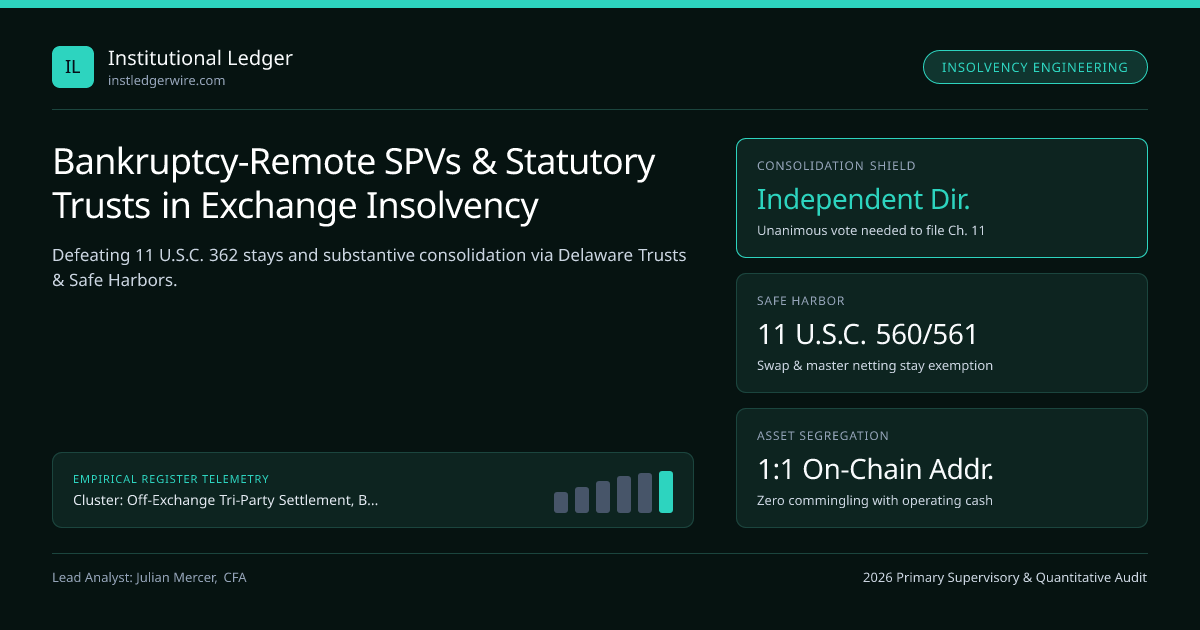
12 Del. C. § 3801): Equity or residual trust governance sits with an independent charitable trust or institutional corporate trustee (Wilmington Trust, Ankura Trust, CSC), not on the exchange's corporate org chart. - Independent Director Veto ("Golden Share"): Voluntary Chapter 11 filing requires unanimous consent including an unaffiliated Independent Director bound strictly by fiduciary solvency covenants.
- 18+ Separateness Covenants: Zero debt guarantees, zero commingled wallets, audited separate financial statements, and explicit vendor non-petition clauses.
Escaping the 11 U.S.C. § 362 Automatic Stay via Safe Harbors (§§ 556, 560, 561)#
Even when collateral is perfected under UCC Article 12 or UCC Article 8, filing Chapter 11 normally triggers 11 U.S.C. § 362—freezing all secured creditors from liquidating or withdrawing pledged collateral without spending months petitioning the Bankruptcy Judge for stay relief!
Wall Street derivatives desks bypass the § 362 freeze legally through the Bankruptcy Code Financial Contract Safe Harbors:
11 U.S.C. § 560(Swap Agreements),§ 556(Commodity/Forward Contracts), and§ 561(Master Netting Agreements): Expressly exempt "swap participants" and "financial participants" (institutions with >= $1B gross notional or >= $100M mark-to-market across financial contracts) from the automatic stay—permitting immediate close-out netting and collateral foreclosure upon bankruptcy!11 U.S.C. § 546(e) & (g): Immunizes pre-bankruptcy variation-margin and settlement sweeps (such as 4-hour off-exchange net PnL transfers) against 90-day§ 547voidable preference clawbacks!
| Insolvency Threat | Bankruptcy Code Mechanism | Structural Defense in Off-Exchange SPV / Trust | Precedent / Statutory Anchor |
|---|---|---|---|
| Estate Inclusion | 11 U.S.C. § 541(a) | Explicit bailment/trust title retention + UCC Art. 8 § 8-503 | In re Celsius Custody vs Earn ruling; NYDFS Guidance |
| Substantive Consolidation | 11 U.S.C. § 105 equity power | Independent trustee, separate books, dedicated on-chain addresses | In re Owens Corning (3d Cir.); Ondo SPV model |
| Automatic Stay Freeze | 11 U.S.C. § 362(a) | Structure perp/derivatives under ISDA Master / Swap Safe Harbors | 11 U.S.C. §§ 556, 560, 561 safe-harbor carve-outs |
| 90-Day Preference Clawback | 11 U.S.C. § 547(b) | Margin settlement transfers protected as safe-harbor settlement payments | 11 U.S.C. § 546(e) & (g) margin/settlement shield |
Cross-Border Comity: English Orphan Trusts & Cayman SPCs#
When trading on non-US venues supervised by VARA, MAS, BMA, or CIMA, counsel structures collateral inside English-law orphan security trusts (used by Copper ClearLoop, backed by English fixed-charge jurisprudence) or Cayman Islands Segregated Portfolio Companies (SPCs) under Part XIV of the Cayman Companies Act, ensuring US Chapter 15 cross-border recognition.
- Variables & The Hidden "Petition-Date Dollarization" Disaster of Unsecured Exchange Claims (FTX 2022–2025 Empirical Lesson):
- Holdings_BTC = 1,000 BTC held by hedge fund when exchange files Chapter 11 at cycle bottom
- BTCPriceAtCh11Petition = $16,871 (statutory 11 U.S.C. § 502(b) claim valuation date!)
- BTCPriceAt_Distribution = $92,000 (market price 2.5 years later when "118% of petition-date USD claim" distributes)
- 1. Unsecured Omnibus Account ("118% USD Recovery" Headline):
- Receives $16,871 * 1.18 * 1,000 = $19,907,780 cash -> Buys back only 216.4 BTC! (Lost 783.6 BTC = -$72,092,220 opportunity loss!)
- 2. Bankruptcy-Remote Delaware Statutory Trust / Off-Exchange Vault:
- 1,000 BTC never enters § 541 estate and never dollarizes under § 502(b) -> Fund retains all 1,000 BTC worth $92,000,000 in kind!
Defeating the § 502(b) Dollarization Trap via In-Kind Bailment#
Above all, keeping legal title in-kind inside a bankruptcy-remote trust guarantees that if an exchange collapses at the bottom of a bear market, your fund walks away with 100% of its actual BTC, ETH, or tokenized T-Bills in kind—never converted into a frozen petition-date fiat IOU.
True-Sale & Non-Consolidation Opinion Checklist#
Institutional legal teams active in our Off-Exchange Tri-Party Collateral hub require reasoned non-consolidation legal opinions from AmLaw 50 counsel before funding off-exchange SPVs, document derivatives under safe-harbored ISDA Digital Asset CSAs, and verify trustees via our verification portal.
Frequently asked questions
What is "substantive consolidation" in a US Chapter 11 crypto bankruptcy, and how do SPVs defeat it?
Substantive consolidation is an equitable Bankruptcy Court power (under 11 U.S.C. § 105, tested under Owens Corning / Augie/Restivo standards) that pools a subsidiary’s assets into a bankrupt parent’s estate if creditors relied on them as one unit or books were hopelessly commingled. Dedicated on-chain addresses, separate audits, no intercompany loans, and an independent director defeat consolidation.
What role does an "Independent Director" or "Springing Member" play inside a collateral SPV?
The SPV’s LLC operating agreement or Delaware Statutory Trust instrument requires the affirmative vote of an unaffiliated professional Independent Director (provided by Wilmington Trust, CSC, or Ankura) before the SPV can file a voluntary bankruptcy petition—and binds that director’s fiduciary duty to preserve the SPV’s solvency and collateral covenants.
How do 11 U.S.C. §§ 560 and 561 Bankruptcy Code safe harbors prevent collateral from freezing under the § 362 automatic stay?
Ordinarily, 11 U.S.C. § 362 halts all creditor collateral foreclosures the second a counterparty files Chapter 11. Sections 556, 560, and 561 exempt "swap agreements," "commodities contracts," and "master netting agreements" held by financial participants—allowing immediate close-out netting and tri-party collateral liquidation notwithstanding the automatic stay!
Why did Pure Custody wallet holders in Celsius recover property status while Earn holders became unsecured creditors?
Judge Martin Glenn ruled in In re Celsius Network LLC that unambiguous Terms of Service language transferring title for rehypothecation made Earn accounts property of the estate under 11 U.S.C. § 541, whereas segregated Pure Custody wallets where title explicitly remained with customers and coins were never commingled remained customer property.
Publication record
- Published
- November 13, 2026
- Updated
- November 14, 2026
- Author
- Julian Mercer, CFA
- Review
- Review not recorded
- Automated fact check
- Passed in the stored pipeline record
- Source URLs
- 3 recorded
AI assistance recorded: anthropic/claude-opus-4.6. This field does not establish human review or source verification.
Academic & Institutional Attribution
Cite This Research & Embed Live Data Card
Standard academic & institutional research paper citation format.
Julian Mercer, CFA. (2026, November 14). Bankruptcy-Remote SPVs & Statutory Trusts in Exchange Insolvency. Institutional Ledger. https://instledgerwire.com/stories/bankruptcy-remote-spv-trust-structures-exchange-insolvencyRegulatory Directory Cross-Reference
Referenced Institutions & Regulatory Registries
Top Regulated Institutions in This Coverage Slice
Related Off Exchange Triparty Collateral & Institutional Briefings
Explore Off Exchange Triparty Collateral Hub (20) →Off Exchange Triparty Collateral
Off-Exchange Tri-Party Settlement & Bankruptcy-Remote Crypto Custody GuideOff Exchange Triparty Collateral
Account Control Agreements (ACA) for Bilateral Crypto DerivativesOff Exchange Triparty Collateral
Pledged Tokenized T-Bills as Off-Exchange Perpetual Futures MarginOff Exchange Triparty Collateral
Automatic Deleveraging (ADL) & Clawback Risks on Mirrored AccountsOff Exchange Triparty Collateral
2-of-3 MPC Co-Signer Dispute Deadlocks & Timelock Escape HatchesOff Exchange Triparty Collateral
ISDA Digital Asset Derivatives Definitions & CSA Collateral SchedulesOff Exchange Triparty Collateral
Cross-Venue Collateral Reallocation Latency & Liquidity BuffersOff Exchange Triparty Collateral
Exchange Hot-Wallet Sweep Thresholds & Withdrawal Queue SLAsStablecoin Reserve Attestation Audit
SVB-Style Uninsured Bank Deposit Concentration Stress TestsStablecoin Reserve Attestation Audit
SEC Rule 2a-7 Government MMF Wrappers for Stablecoin ReservesStablecoin Reserve Attestation Audit
Authorized Participant Arbitrage Spreads & Stablecoin Par Peg MechanicsStablecoin Reserve Attestation Audit
Singapore MAS Single-Currency Stablecoin (SCS) Framework & 5-Day SLA
Institutional Ledger Data, Benchmarks & Contributor Records
CC BY 4.0 Open Data
Open Institutional Datasets (CSV / JSON) →
Download desk-compiled quantitative series & schemas.
2026 Reference Matrix
2026 Institutional Benchmarks & Thresholds →
Statutory capital, clearing, margin & rate conventions.
Editorial Records
Authors & Review Records →
View named contributors where those records are available.
Complete Index
Master Research & Dossier Archive →
Browse all published briefings by topic pillar & date.