
Off Exchange Triparty Collateral
ISDA Digital Asset Derivatives Definitions & CSA Collateral Schedules
Published by ISDA to standardize institutional OTC crypto swaps and options, the ISDA Digital Asset Derivatives Definitions codify fork disruption fallbacks, valuation sources, and CSA collateral haircuts.
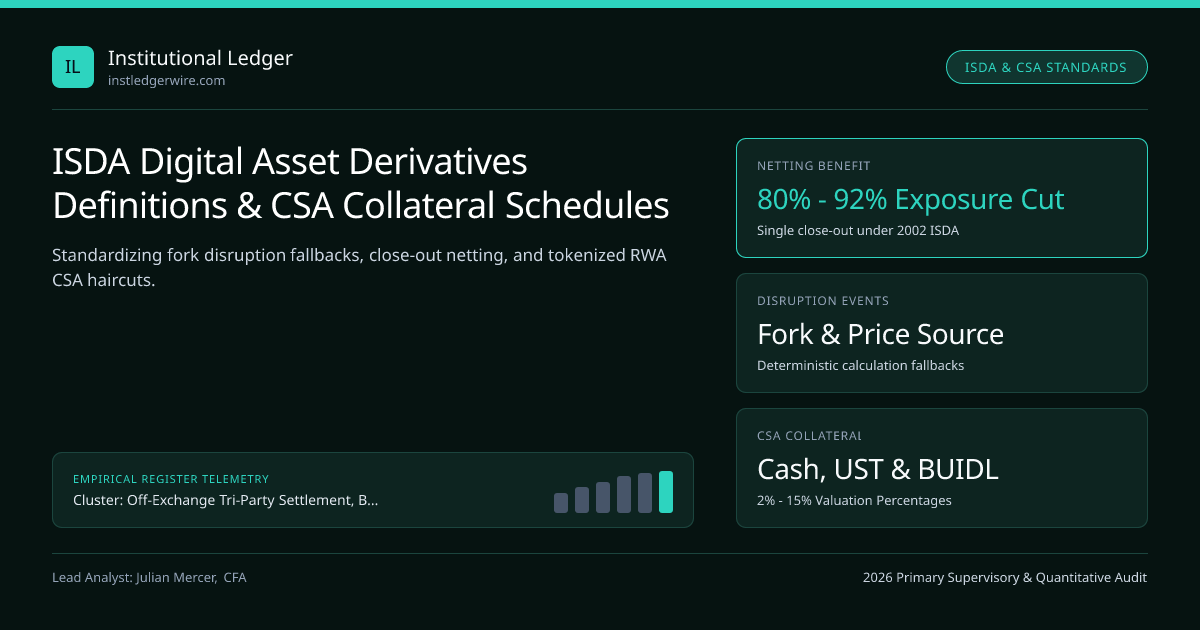
When institutional asset managers trade $100 million BTC volatility collars, variance swaps, or non-deliverable forwards against global liquidity providers like Aquanow, B2BX, or Tier-1 bank desks, bespoke two-page PDFs invite disaster during market crashes. Published by the International Swaps and Derivatives Association, the ISDA Digital Asset Derivatives Definitions and modernized Credit Support Annex (CSA) collateral schedules anchor OTC crypto derivatives inside Wall Street's $600 trillion close-out netting legal fortress.
Why Plugging Into the 2002 ISDA Master Agreement Slashes Credit Risk by 90%#
Without an overarching Master Netting Agreement backed by statutory legal opinions, a bankruptcy trustee can attempt "cherry-picking"—enforcing every in-the-money derivative contract you owe the bankrupt dealer 100 cents on the dollar, while relegating every out-of-the-money contract the bankrupt dealer owes you to pennies on the dollar!
By incorporating the ISDA Digital Asset Derivatives Definitions directly under a 2002 ISDA Master Agreement (governed by New York or English law), all BTC, ETH, FX, and interest-rate derivatives between the two counterparties form a Single Agreement. Upon an Event of Default, Section 6(e) collapses every open leg into one net close-out sum—protected from the Chapter 11 automatic stay by 11 U.S.C. §§ 560 and 561 safe harbors and integrated cleanly across our off-exchange tri-party collateral cornerstone guide.
Blockchain-Native Disruption Fallbacks: Hard Forks, Halts & Cyber Events#
Traditional equity or FX ISDA definitions never had to ask what happens if the US Dollar splits into two competing blockchains at 03:00 UTC Sunday! ISDA's modular Digital Asset Disruption Matrix solves three unique technical failure modes upfront:
- Fork Disruption: Rather than letting a Calculation Agent pick arbitrary winners during a contentious protocol split, institutional confirmations tie reference asset identity directly to regulated benchmark administrators (such as CME CF Bitcoin Reference Rate
BRRsupervised under UK FCA / ESMA BMR rules), cascading through pre-agreed adjustment or early-termination waterfalls. - Price Source Disruption: Automatic fallback cascade across primary index -> secondary composite index -> Dealer Poll -> Postponement cap.
- Hedging / Settlement Disruption (Deliverable Trades): Clear extension windows if an L1 network suffers temporary consensus congestion or if a custodian halts hot sweeps due to an external protocol zero-day.
| ISDA / CSA Provision | Traditional FX/Rates Standard | Digital Asset Derivatives Adaptation | Risk Mitigated |
|---|---|---|---|
| Settlement Type | Cash or deliverable FX | Non-Deliverable (NDF/NDO) in USD/USDC or Physical | Allows banks under BCBS SCO60 to avoid touching spot crypto |
| Fork Disruption | Not applicable | Follows Regulated Benchmark Administrator (CME CF BRR) | Prevents split-chain valuation chaos (e.g., ETH PoS merge) |
Wrong-Way Risk (WWR) | No own-issued bank bonds as IM | Prohibits posting BTC as IM when selling BTC downside puts! | Prevents collateral & trade crashing simultaneously |
| Eligible RWA Margin | Physical CUSIPs via Euroclear/Fed | Adds BlackRock BUIDL & Spot ETFs under Tri-Party ACA | Unlocks 24/7 yield-bearing sovereign initial margin |
Eliminating Wrong-Way Risk (WWR) in 2026 Digital Asset CSAs#
One of the deadliest mistakes of 2021–2022 OTC lending was Wrong-Way Risk (WWR): dealers allowed counterparties selling downside Bitcoin puts (or borrowing USD) to post spot Bitcoin (or worse, correlated altcoins!) as Initial Margin. When BTC plunged 40%, the counterparty's derivative liability exploded at the exact millisecond its posted BTC collateral lost 40% of its value!
Modern 2026 ISDA Paragraph 13 CSA schedules enforce Strict Wrong-Way Risk Exclusions:
- Directional downside crypto sellers must post uncorrelated Eligible Credit Support: USD cash, direct US Treasuries, BlackRock BUIDL (at 97%–98% Valuation Percentage per CFTC GMAC alignment), or regulated USDC (equipped with an automated CSA Ineligible Trigger if USDC ever trades below
$0.985for >60 minutes).
- Variables & Bilateral OTC BTC Option Book CSA Margin Calculation ($50M Notional, $6.0M Net Exposure + $8.0M SIMM Initial Margin):
- 1. Variation Margin CSA (
Exposure = $6,000,000; Prior Posted USDC = $5,400,000 @ 98% Valuation Pct = $5,292,000; MTA = $250,000): - Required VM Delivery = $6,000,000 - $5,292,000 = $708,000 (>= $250k MTA) -> Deliver $708,000 / 0.98 = $722,449 USDC today!
- 2. Segregated Initial Margin CSA (
SIMM_IM = $8,000,000; Pledged in BlackRock BUIDL @ 98% Valuation Percentage): - Required BUIDL Shares in NYDFS Tri-Party ACA = $8,000,000 / 0.98 = $8,163,265 BUIDL (earns ~$346,938/yr sovereign T-Bill yield while pledged!).
24/7 Smart-CSA Variation Margin vs Weekday Fedwire Cutoffs#
Traditional ISDA CSAs call Variation Margin once daily at 09:00 AM New York time for T+0/T+1 Fedwire delivery—leaving a 65-hour weekend blind spot on crypto options! Leading OTC desks execute 24/7 USDC Variation Margin Riders under their NY-law CSA, sweeping intraday VM calls over automated stablecoin settlement rails while keeping Initial Margin untouched inside a tri-party bank/trust ACA.
ISDA Paragraph 13 Negotiation Checklist for Institutional Counsel#
Derivatives counsel active in our Off-Exchange Tri-Party Collateral hub verify clean ISDA netting opinions for counterparty domiciles (FINMA, MAS, BMA, CIMA), add tokenized government MMFs to Paragraph 13 Eligible Collateral tables, and confirm counterparty status via our verification portal.
Frequently asked questions
Why do institutional OTC desks trade crypto derivatives under an ISDA Master Agreement instead of bespoke bilateral term sheets?
Under the 2002 ISDA Master Agreement’s Single Agreement and Close-Out Netting provisions (Section 6(e)), if a counterparty defaults across 40 open BTC options, ETH forwards, and FX hedges, all 40 trades collapse into a single net USD termination payment—slashing counterparty credit exposure and regulatory capital by up to 90%!
How do the ISDA Digital Asset Derivatives Definitions handle a contentious blockchain hard fork mid-trade?
Parties elect modular Fork Disruption terms upfront in the Confirmation (such as Administered Benchmark Preservation, where the derivative follows whichever fork the CME CF Reference Rate adopts, with optional Calculation Agent Adjustment or Cancellation and Payment fallbacks), eliminating chaotic mid-fork litigation.
What is the difference between an ISDA Variation Margin CSA and an Initial Margin CSA for digital assets?
A Variation Margin (VM) CSA typically uses daily title-transfer or NY pledge of liquid cash/USDC with low Minimum Transfer Amounts ($100k–$250k) to zero out current MtM exposure. An Initial Margin (IM) CSA locks segregated collateral (T-Bills, BlackRock BUIDL, or BTC) inside a third-party bank/trust Account Control Agreement with strict zero-rehypothecation rules.
What Valuation Percentages (haircuts) do 2026 institutional ISDA CSAs apply to digital collateral?
USD cash carries 100% Valuation Percentage (0% haircut); direct <1yr US Treasuries carry 99%–99.5%; tokenized government MMFs (BUIDL/BENJI) carry 96%–98% (2%–4% haircut aligned with CFTC GMAC); NYDFS/MiCA USDC carries 95%–98% (with a $0.985 depeg trigger); and spot BTC/ETH posted as IM carry 70%–85% (15%–30% haircut plus wrong-way-risk caps).
Publication record
- Published
- November 13, 2026
- Updated
- November 14, 2026
- Author
- Julian Mercer, CFA
- Review
- Review not recorded
- Automated fact check
- Passed in the stored pipeline record
- Source URLs
- 3 recorded
AI assistance recorded: anthropic/claude-opus-4.6. This field does not establish human review or source verification.
Academic & Institutional Attribution
Cite This Research & Embed Live Data Card
Standard academic & institutional research paper citation format.
Julian Mercer, CFA. (2026, November 14). ISDA Digital Asset Derivatives Definitions & CSA Collateral Schedules. Institutional Ledger. https://instledgerwire.com/stories/isda-digital-asset-definitions-csa-collateral-schedulesRegulatory Directory Cross-Reference
Referenced Institutions & Regulatory Registries
Mentioned Regulated Institutions
Related Off Exchange Triparty Collateral & Institutional Briefings
Explore Off Exchange Triparty Collateral Hub (20) →Off Exchange Triparty Collateral
Off-Exchange Tri-Party Settlement & Bankruptcy-Remote Crypto Custody GuideOff Exchange Triparty Collateral
Cross-Venue Collateral Reallocation Latency & Liquidity BuffersOff Exchange Triparty Collateral
Exchange Hot-Wallet Sweep Thresholds & Withdrawal Queue SLAsOff Exchange Triparty Collateral
Rehypothecation Prohibitions & Segregated On-Chain Pledge Vault AuditsOff Exchange Triparty Collateral
CFTC FCM Customer Segregation (4d / LSOC) vs Offshore Perp PledgesOff Exchange Triparty Collateral
EU MiCA Article 70 & 75 CASP Safeguarding in Off-Exchange SettlementOff Exchange Triparty Collateral
English-Law Fixed vs Floating Charges & Trusts on Digital CollateralOff Exchange Triparty Collateral
Intraday Variation Margin Sweeps Over 24/7 Regulated Stablecoin RailsStablecoin Reserve Attestation Audit
CPMI-IOSCO PFMI Rules for Systemically Important StablecoinsStablecoin Reserve Attestation Audit
Intraday Snapshot Window Dressing vs Continuous Proof-of-Reserve OraclesStablecoin Reserve Attestation Audit
Custodial T-Bill Safekeeping: BNY Mellon & State Street Reserve ModelsStablecoin Reserve Attestation Audit
Stablecoin Smart-Contract Freeze & Blacklist Governance Under OFAC/FinCEN
Institutional Ledger Data, Benchmarks & Contributor Records
CC BY 4.0 Open Data
Open Institutional Datasets (CSV / JSON) →
Download desk-compiled quantitative series & schemas.
2026 Reference Matrix
2026 Institutional Benchmarks & Thresholds →
Statutory capital, clearing, margin & rate conventions.
Editorial Records
Authors & Review Records →
View named contributors where those records are available.
Complete Index
Master Research & Dossier Archive →
Browse all published briefings by topic pillar & date.