
Off Exchange Triparty Collateral
Counterparty Default Waterfall Isolation for Off-Exchange Pledges
Traditional CCPs mutualize tail defaults across clearing members, whereas crypto perpetual venues rely on pre-funded insurance pools and PnL haircutting. Off-exchange pledges strictly isolate principal.
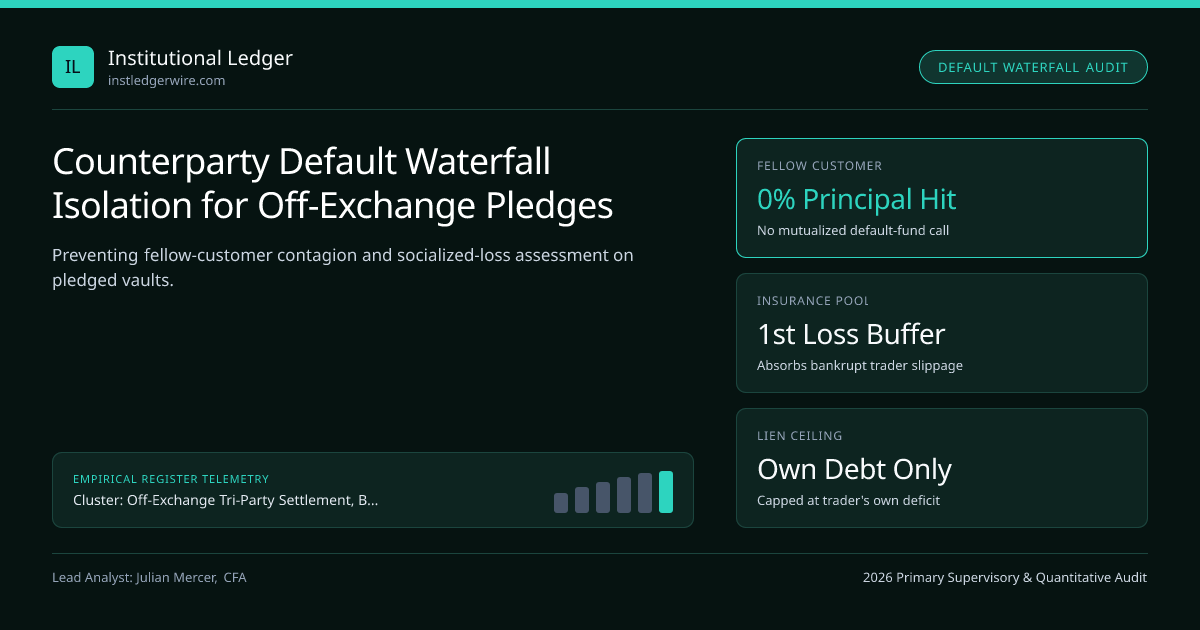
During March 2020's "Black Thursday" crash and May 2021's leveraged washout, billions of dollars in 50x-leveraged retail positions gapped straight past their zero-equity bankruptcy prices before matching engines could liquidate them. On poorly capitalized exchanges, those negative-equity holes threatened commingled omnibus deposits. Inside modern institutional off-exchange architectures, strict default-waterfall firewalls ensure another trader's blowup can never assess a single dollar of your segregated vault principal.
Fellow-Customer Risk: CCP Mutualization vs Isolated Custodial Pledges#
In traditional futures clearing overseen by CFTC Core Principles and ESMA EMIR rules, clearing members accept a calculated trade-off: client initial margin is protected (e.g., under CFTC Legally Segregated, Operationally Commingled LSOC rules), while clearing-member firms contribute billions into a mutualized Guaranty Fund that absorbs extreme tail losses if a fellow clearing member defaults.
In 24/7 digital-asset markets—where retail traders and unregulated offshore funds often sit on the same matching engine alongside institutional market makers—institutional hedge funds refuse to mutualize fellow-customer default risk. As detailed across our off-exchange tri-party collateral cornerstone guide, every institutional tri-party security deed and 2-of-3 MPC policy enforces strict individual-account isolation:
- Your off-exchange vault secures solely your own trading entity's net settlement deficit.
- Neither the custodian nor the venue possesses contractual right or cryptographic signing authority to debit Vault A to plug a negative-equity hole left by Bankrupt Whale B.
Auditing Perpetual Exchange Insurance Funds: Hard Assets vs House Tokens#
Even though your vault principal is immune, an undercapitalized exchange default waterfall still hurts delta-neutral funds by triggering Layer 3 Automatic Deleveraging (ADL)—forcibly closing your profitable short perpetual hedge right in the middle of a market crash!
Before delegating $50M+ via off-exchange mirrors to BitMEX, Bitfinex, Backpack Exchange, or Bitstamp derivatives books, quantitative due-diligence teams run a three-point Insurance Fund audit:
- 100% Haircut on Native Exchange Tokens: Following FTX's FTT mirage, risk committees assign zero dollar value to any portion of an Insurance Fund held in the exchange's own governance/utility token (which crashes 80% precisely during a venue crisis). Only verifiable BTC, ETH, USDC, and T-Bills count.
- Per-Contract vs Shared Pool Rules: Verify whether a meme-coin perpetual blowup can drain the core BTC-PERP insurance pool, or whether altcoin insurance pools are compartmentalized!
- Incremental Partial Liquidation Engines: Modern venues liquidate distressed accounts in 5%–10% tranches as mark price crosses maintenance bands rather than dumping a $200M whale position in one market order.
| Waterfall Layer | Loss-Bearing Party | Trigger Threshold | Impact on Solvent Off-Exchange Trader | Due-Diligence Verification |
|---|---|---|---|---|
| Layer 1: Defaulter IM | Defaulting leveraged account | Maintenance Margin Ratio >= 100% | Zero — normal orderbook liquidation | Audit incremental partial-liquidation engine |
| Layer 2: Insurance Fund | Venue pre-funded reserve pool | Fill worse than 0-equity bankruptcy price | Zero — absorbed by venue reserve | Verify on-chain BTC/USDC Insurance wallets |
| Layer 3: ADL / VMGH | Opposing profitable position holders | Insurance Fund hits $0 on specific contract | Position closed early (leaves spot hedge unhedged!) | Monitor ADL percentile lights (BitMEX, Bitfinex) |
| Layer 4: Venue Equity | Exchange corporate balance sheet | Operational / system deficit | Unsettled 4h PnL delayed if insolvent | Cap unsettled window via dynamic sweeps |
| Firewall: Client Vault | Solvent off-exchange pledgor | NEVER TRIGGERED for third-party debt | $0.00 principal loss (SAB 122 isolated) | Confirm non-mutualization clause in ACA/Deed |
Basel III CRE54 & Non-Contagion Legal Opinions#
For bank-affiliated prime desks subject to BCBS SCO60 and Basel CRE54 clearing exposure standards, external legal counsel must opine that posted initial margin is bankruptcy-remote both from the venue/custodian and from fellow-customer defaults—a standard cleanly met by CFTC FCM segregation and segregated off-exchange trusts.
- Variables & Perpetual Venue Default-Waterfall Adequacy Audit ($8.0B BTC/ETH Open Interest Venue):
- TotalVenueOpenInterestUSD = $8,000,000,000 aggregate perpetual futures open interest
- StressedGapSlippage_Pct = 0.0085 (85 bps average negative-equity slippage across 25% of OI liquidating in a 15% 5-minute wick -> $17.0M deficit)
- 1. Weak Offshore Venue ($25M nominal Insurance Fund, of which $20M is Exchange's own illiquid token + $5M USDT):
- Liquid Hard-Asset Insurance = $5,000,000 -> Coverage Multiple = $5M / $17M = 0.29x (FAILS! Triggers violent ADL clawbacks).
- 2. Institutional-Grade Venue ($180M verifiable on-chain BTC + USDC Insurance Fund):
- Liquid Hard-Asset Insurance = $180,000,000 -> Coverage Multiple = $180M / $17M = 10.59x (Absorbs 10x historical Black Thursday shock with zero ADL!).
Defending Against Layer 3 ADL Spillover#
Because default-waterfall exhaustion resolves via position deleveraging rather than principal seizure, institutional basis desks pair default-waterfall audits directly with real-time ADL queue monitoring and mirrored-account hedge recovery plus tight 4-hour dynamic variation-margin sweeps.
Venue Default-Waterfall Scorecard for Prime Risk Committees#
Counterparty risk teams active in our Off-Exchange Tri-Party Collateral hub demand hard-asset insurance-to-open-interest ratios above 1.0%, confirm per-contract altcoin pool isolation, and verify exchange regulatory registrations across VARA, MAS, and ESMA in our verification portal.
Frequently asked questions
Can an exchange tap my solvent off-exchange tri-party vault to cover another trader’s bankruptcy deficit?
Never under an institutional segregated pledge or ClearLoop/2-of-3 MPC agreement! The security deed or Account Control Agreement strictly limits the exchange’s secured claim to "Secured Obligations owed by this specific Pledgor." Fellow-customer defaults elsewhere on the venue cannot legally or cryptographically touch your principal.
How does a crypto exchange’s Insurance Fund differ from CME’s Clearing Guaranty Fund?
CME’s Guaranty Fund is funded by mandatory clearing-member contributions plus CME "skin-in-the-game" and carries assessment powers over surviving members. Crypto exchange Insurance Funds are funded organically by capturing leftover liquidation fees when positions liquidate better than bankruptcy price, with zero assessment calls on solvent traders.
What happens if a flash crash wipes out 100% of a perpetual exchange’s Insurance Fund?
Instead of assessing solvent traders’ principal collateral, crypto perpetual engines trigger Automatic Deleveraging (ADL) or Variation Margin Gains Haircutting (VMGH)—force-closing profitable opposing positions at bankruptcy price, which caps upside PnL in that cycle without touching your pledged vault principal.
What red flags do institutional risk desks look for when auditing a venue’s Insurance Fund?
Three lethal red flags: (1) an Insurance Fund denominated heavily in the exchange’s own illiquid native exchange token rather than BTC/USDT/USDC; (2) opaque internal ledger balances with no verifiable on-chain cold-wallet proof; and (3) insurance pool ratio below 0.5% of total venue open interest.
Publication record
- Published
- November 13, 2026
- Updated
- November 15, 2026
- Author
- Julian Mercer, CFA
- Review
- Review not recorded
- Automated fact check
- Passed in the stored pipeline record
- Source URLs
- 3 recorded
AI assistance recorded: anthropic/claude-opus-4.6. This field does not establish human review or source verification.
Academic & Institutional Attribution
Cite This Research & Embed Live Data Card
Standard academic & institutional research paper citation format.
Julian Mercer, CFA. (2026, November 15). Counterparty Default Waterfall Isolation for Off-Exchange Pledges. Institutional Ledger. https://instledgerwire.com/stories/counterparty-default-waterfall-isolation-off-exchange-pledgesRegulatory Directory Cross-Reference
Referenced Institutions & Regulatory Registries
Mentioned Regulated Institutions
Related Off Exchange Triparty Collateral & Institutional Briefings
Explore Off Exchange Triparty Collateral Hub (20) →Off Exchange Triparty Collateral
Off-Exchange Tri-Party Settlement & Bankruptcy-Remote Crypto Custody GuideOff Exchange Triparty Collateral
Bankruptcy-Remote SPVs & Statutory Trusts in Exchange InsolvencyOff Exchange Triparty Collateral
Account Control Agreements (ACA) for Bilateral Crypto DerivativesOff Exchange Triparty Collateral
Pledged Tokenized T-Bills as Off-Exchange Perpetual Futures MarginOff Exchange Triparty Collateral
Automatic Deleveraging (ADL) & Clawback Risks on Mirrored AccountsOff Exchange Triparty Collateral
2-of-3 MPC Co-Signer Dispute Deadlocks & Timelock Escape HatchesOff Exchange Triparty Collateral
ISDA Digital Asset Derivatives Definitions & CSA Collateral SchedulesOff Exchange Triparty Collateral
Cross-Venue Collateral Reallocation Latency & Liquidity BuffersStablecoin Reserve Attestation Audit
Primary Mint/Burn Fedwire Cutoffs vs Weekend Curve Pool DepegsStablecoin Reserve Attestation Audit
SVB-Style Uninsured Bank Deposit Concentration Stress TestsStablecoin Reserve Attestation Audit
SEC Rule 2a-7 Government MMF Wrappers for Stablecoin ReservesStablecoin Reserve Attestation Audit
Authorized Participant Arbitrage Spreads & Stablecoin Par Peg Mechanics
Institutional Ledger Data, Benchmarks & Contributor Records
CC BY 4.0 Open Data
Open Institutional Datasets (CSV / JSON) →
Download desk-compiled quantitative series & schemas.
2026 Reference Matrix
2026 Institutional Benchmarks & Thresholds →
Statutory capital, clearing, margin & rate conventions.
Editorial Records
Authors & Review Records →
View named contributors where those records are available.
Complete Index
Master Research & Dossier Archive →
Browse all published briefings by topic pillar & date.