
Off Exchange Triparty Collateral
Post-Trade Net Settlement Windows & Intraday Venue Credit Exposure
Off-exchange custody shields principal, yet leaves unrealized positive variation margin exposed between periodic net settlement sweeps. Risk desks optimize cycle frequency vs dynamic dollar caps.
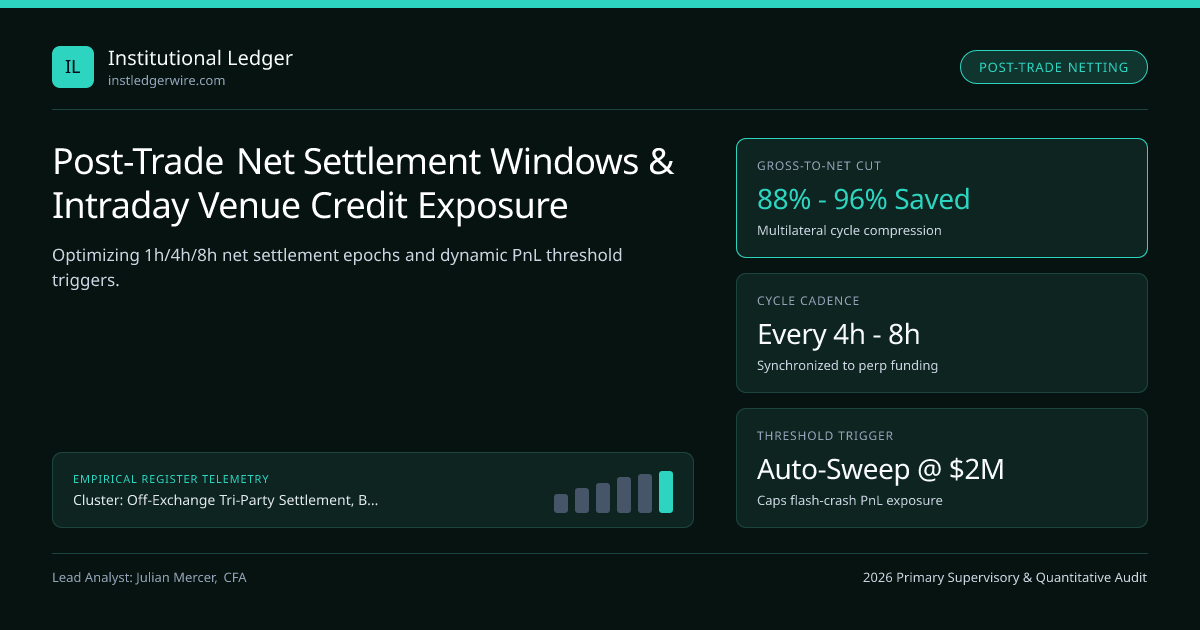
Ask ten portfolio managers whether off-exchange custody eliminates exchange counterparty risk, and nine will say yes. Ask a veteran derivatives risk officer, and you get a sharper answer: off-exchange vaults protect 100% of your starting principal, but leave your intraday winning variation margin unsecured until the settlement sweep clears. When Bitcoin plunges 15% in ninety minutes, your short perpetual hedge generates +$15 million of profit on the exchange—and if that venue halts before your 24-hour settlement cut, your hedge fails right when spot drops!
Why Off-Exchange Mirrors Require Deferred Net Settlement (DNS)#
In CPMI-IOSCO Principles for Financial Market Infrastructures (PFMI Principle 8), settlement systems trade off between Real-Time Gross Settlement (RTGS) and Deferred Net Settlement (DNS). If a market maker quoting BTC/USD on Bitstamp and Bitfinex settled every $50,000 fill gross on-chain, executing $400M of two-way daily flow would trigger 8,000 blockchain transactions and tie up tens of millions in pre-funded settlement float.
As structured across our off-exchange tri-party collateral cornerstone guide, custodial mirror networks aggregate gross fills across 4-hour or 8-hour windows, computing a single bilateral net obligation—typically compressing gross flow by 90% to 96% settled in regulated USDC or custodial USD book transfers.
The Asymmetric Hedge Trap During Violent Downward Cascades#
Consider how a delta-neutral cash-and-carry fund actually loses money if an exchange fails mid-window:
- Leg 1 (Long Spot): $100M of physical BTC sits safely inside a bankruptcy-remote cold vault.
- Leg 2 (Short Perp): $100M short BTC-PERP sits on an exchange via an off-exchange mirror.
- Flash Crash: Market news triggers a 20% BTC plunge—and simultaneously renders the exchange insolvent!
- Net Portfolio Reality: Your safe cold-storage BTC is now worth $80M (-$20M market move). Your short perp made +$20M, keeping your fund delta-neutral ONLY IF the exchange actually delivers $20M of USDC during the variation-margin sweep! If you relied on lazy 24-hour end-of-day sweeps, up to $20M of uncollected hedge profit sits trapped inside the exchange's insolvency waterfall.
| Settlement Policy | Normal Schedule | Emergency Threshold Trigger | Peak Uncollected PnL ($100M Book) | Best-Fit Institutional Strategy | ||
|---|---|---|---|---|---|---|
| Legacy T+1 Daily Cut | Once at 00:00 UTC | None | $15.0M – $22.0M | Obsolete — excessive venue credit exposure | ||
| 8-Hour Funding Cycle | 00:00, 08:00, 16:00 UTC | Optional manual call | $8.5M – $12.0M | Low-leverage spot & calm-regime carry | ||
| 4-Hour Rolling Cycle | Every 4 hours (6x/day) | None | $6.0M – $8.5M | Multi-venue market making (Bitstamp, Bitfinex) | ||
| Hybrid 4h + Dynamic Cap | Every 4 hours | **Auto-sweep if ` | PnL | >= $2.5M`** | Capped at ~$2.5M | Institutional standard for perpetuals (BitMEX, Backpack) |
| Continuous DLT Sync | Sub-minute / hourly | Smart-contract auto-margin | < $500k | Canton Network institutional repo & swaps |
Engineering Hybrid Time + Dynamic Dollar Cap Triggers#
Top prime-risk desks never rely on clock-based settlement alone. Instead, they configure Hybrid Settlement Rules directly inside their mirror-custody SLA and intraday variation-margin stablecoin sweeps:
- Baseline Time Trigger: Settle automatically every 4 hours (or every 8 hours synchronized with 00:00, 08:00, and 16:00 UTC perpetual funding payments).
- Dynamic Exposure Trigger: Continuously poll unrealized + realized net PnL via WebSocket. The instant
|Unsettled_PnL|exceeds 2.5% of delegated equity (e.g., $2.5M on a $100M book), fire an immediate out-of-cycle settlement call. - 15-Minute Circuit Breaker: If the exchange fails to fund its side of the custodial sweep within 15 minutes of a dynamic call, automated execution bots flatten the perp leg on a backup venue (BitMEX, Backpack Exchange, or CME) and halt venue quoting.
- Variables & $100M Short Perpetual Hedge Intraday Venue Credit Model (BTC Stressed Daily Vol sigma = 8.5%):
- Position_Notional = $100,000,000 short BTC-PERP hedge against custodied spot BTC
- sigma_daily = 0.085 (8.5% stressed daily volatility during cascade liquidation day)
- Z_999 = 3.090 (99.9% one-tailed normal/jump-adjusted confidence multiplier)
- 1. 24-Hour Daily Settlement Cycle (Window = 24h):
- 99.9% Unsettled Positive PnL Receivable = $100M * 0.085 * sqrt(24/24) * 3.09 = $26,265,000 unsecured venue exposure!
- 2. 4-Hour Settlement Cycle Without Cap (Window = 4h):
- 99.9% Unsettled Positive PnL Receivable = $100M * 0.085 * sqrt(4/24) * 3.09 = $10,722,642
- 3. Hybrid 4-Hour + $2.5M Dynamic Auto-Sweep Cap (10-Minute Execution Latency):
- Peak Unsecured Exposure = $2,500,000 + ($100M * 0.085 * sqrt(0.167/24) * 3.09) = $4,689,000 even in a 3-sigma flash crash!
Cross-Venue Synchronization to Avoid Cash Starvation#
When hedging Long Venue A against Short Venue B, misaligned settlement clocks cause painful liquidity squeezes: if Losing Venue A sweeps -$8M out of your USDC treasury at 12:00 UTC while Winning Venue B doesn't pay +$8M until 00:00 UTC, your treasury must bridge a 12-hour $8M cash gap! Aligning multi-venue cutoffs alongside cross-venue collateral reallocation buffers eliminates this funding wedge.
Risk Committee Calibration SOP for Net Settlement Windows#
Quantitative risk managers active in our Off-Exchange Tri-Party Collateral hub size per-venue unsettled PnL caps strictly below 50% of one month's expected strategy carry, monitor exchange settlement pool balances in real time, and verify regulated counterparties via our verification portal.
Frequently asked questions
Why do off-exchange settlement networks batch settlements every 4 or 8 hours instead of every minute?
Institutional market makers execute tens of thousands of offsetting long and short fills per hour across spot and perpetual pairs. Netting 4 or 8 hours of gross turnover ($500M traded) typically collapses down to a single $3M net variation-margin transfer—saving 94%+ in settlement liquidity and aligning cleanly with 8-hour perpetual funding timestamps (00:00, 08:00, 16:00 UTC).
Who is exposed to credit risk during the 4-hour window before net settlement completes?
Whoever has net positive unrealized/realized PnL since the last sweep! If Bitcoin drops 12% in two hours and your short perpetual position gains +$18M, that +$18M exists only as an internal database receivable on the exchange until the custodian actually sweeps $18M of USDC from the exchange’s settlement pool into your off-exchange vault.
How do dynamic threshold triggers cap tail exposure during a 20% intraday crypto flash crash?
Instead of waiting passively for the 16:00 UTC clock strike while +$25M of winning PnL accumulates on a distressed exchange, hybrid settlement engines enforce min(4_hours, |Unsettled_PnL| >= $2,500,000). Breaching $2.5M immediately triggers an out-of-cycle settlement transfer within 5 minutes, halting further trading if the venue fails to pay.
What happens if an exchange delays or fails an 8-hour off-exchange settlement sweep?
Under institutional mirror-network rulebooks, missing a settlement SLA cutoff (typically a 15-to-30-minute grace window) freezes new margin delegation to that venue, blocks outbound sweeps from winning client vaults, and activates default-waterfall dispute resolution.
Publication record
- Published
- November 13, 2026
- Updated
- November 15, 2026
- Author
- Julian Mercer, CFA
- Review
- Review not recorded
- Automated fact check
- Passed in the stored pipeline record
- Source URLs
- 3 recorded
AI assistance recorded: anthropic/claude-opus-4.6. This field does not establish human review or source verification.
Academic & Institutional Attribution
Cite This Research & Embed Live Data Card
Standard academic & institutional research paper citation format.
Julian Mercer, CFA. (2026, November 15). Post-Trade Net Settlement Windows & Intraday Venue Credit Exposure. Institutional Ledger. https://instledgerwire.com/stories/post-trade-net-settlement-windows-intraday-credit-exposureRegulatory Directory Cross-Reference
Referenced Institutions & Regulatory Registries
Mentioned Regulated Institutions
Primary Tier-1 Supervisory Registries
Related Off Exchange Triparty Collateral & Institutional Briefings
Explore Off Exchange Triparty Collateral Hub (20) →Off Exchange Triparty Collateral
Off-Exchange Tri-Party Settlement & Bankruptcy-Remote Crypto Custody GuideOff Exchange Triparty Collateral
Counterparty Default Waterfall Isolation for Off-Exchange PledgesOff Exchange Triparty Collateral
Bankruptcy-Remote SPVs & Statutory Trusts in Exchange InsolvencyOff Exchange Triparty Collateral
Account Control Agreements (ACA) for Bilateral Crypto DerivativesOff Exchange Triparty Collateral
Pledged Tokenized T-Bills as Off-Exchange Perpetual Futures MarginOff Exchange Triparty Collateral
Automatic Deleveraging (ADL) & Clawback Risks on Mirrored AccountsOff Exchange Triparty Collateral
2-of-3 MPC Co-Signer Dispute Deadlocks & Timelock Escape HatchesOff Exchange Triparty Collateral
ISDA Digital Asset Derivatives Definitions & CSA Collateral SchedulesStablecoin Reserve Attestation Audit
NYDFS USD Stablecoin Guidance: T+2 Par Redemption & Trust SegregationStablecoin Reserve Attestation Audit
Primary Mint/Burn Fedwire Cutoffs vs Weekend Curve Pool DepegsStablecoin Reserve Attestation Audit
SVB-Style Uninsured Bank Deposit Concentration Stress TestsStablecoin Reserve Attestation Audit
SEC Rule 2a-7 Government MMF Wrappers for Stablecoin Reserves
Institutional Ledger Data, Benchmarks & Contributor Records
CC BY 4.0 Open Data
Open Institutional Datasets (CSV / JSON) →
Download desk-compiled quantitative series & schemas.
2026 Reference Matrix
2026 Institutional Benchmarks & Thresholds →
Statutory capital, clearing, margin & rate conventions.
Editorial Records
Authors & Review Records →
View named contributors where those records are available.
Complete Index
Master Research & Dossier Archive →
Browse all published briefings by topic pillar & date.