
Off Exchange Triparty Collateral
Custodial Mirror-Settlement Loops vs Bank Tri-Party Control Agreements
Institutional desks choose between sub-100ms crypto-native custodial mirror loops for 24/7 orderbook venues and G-SIB bank tri-party Account Control Agreements for ISDA bilateral derivatives.
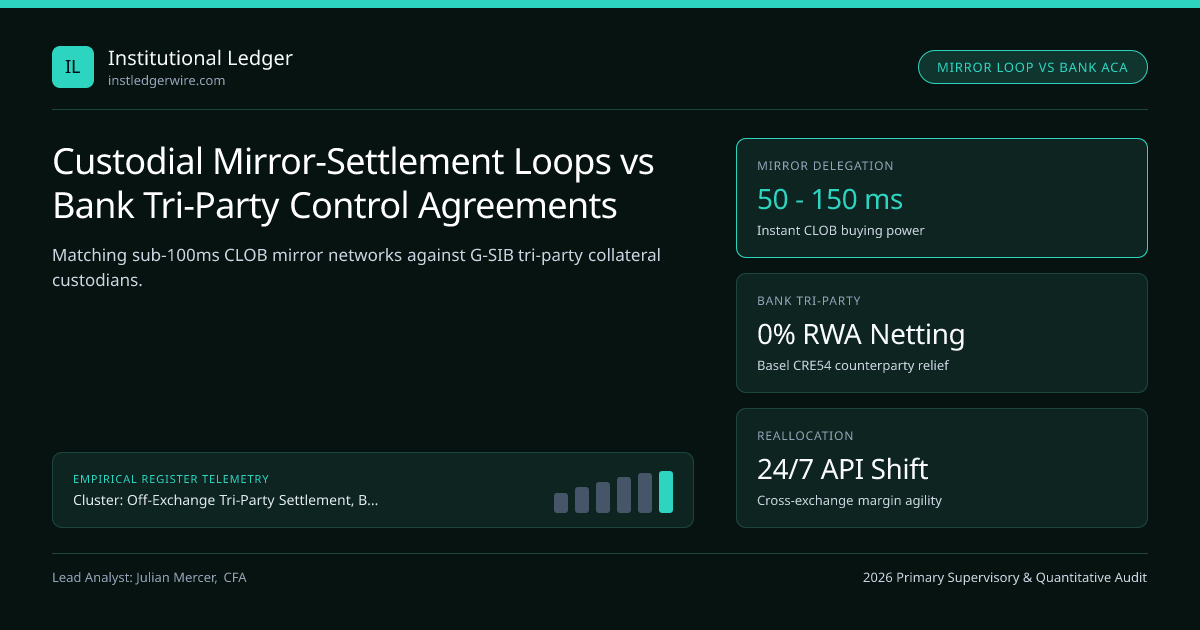
When a $2 billion multi-strategy hedge fund trades Bitcoin perpetual swaps on BitMEX or Bitfinex alongside bilateral non-deliverable crypto options with a Wall Street swap dealer, a single off-exchange pipe rarely fits both trades. Understanding the structural divide between crypto-native custodial mirror-settlement loops and G-SIB bank tri-party Account Control Agreements (ACAs) allows treasury architects to optimize both 24/7 orderbook agility and Basel III counterparty capital relief.
How Custodial Mirror-Settlement Loops Achieve Sub-100ms Orderbook Fills#
Central-limit-orderbook (CLOB) exchanges cannot query an external bank mainframe every time a high-frequency market maker updates 500 resting quotes per second. As outlined in our off-exchange tri-party collateral cornerstone guide, custodial mirror loops decouple asset safekeeping from pre-trade margin checking:
- The trader deposits $50M of BTC, USDC, or tokenized Treasuries into a dedicated off-exchange vault at a regulated custodian or English-law trust.
- When the trader clicks "Delegate $50M to Bitstamp," the custodian places a cryptographic hold preventing unilateral client withdrawal and transmits an authenticated FIX/REST payload to Bitstamp.
- Bitstamp immediately credits a $50M synthetic margin sub-account inside its in-memory matching engine—allowing full-speed trading while real coins never touch Bitstamp's hot or cold wallets.
- Every 4 to 8 hours, post-trade net settlement windows transfer only the net won or lost variation margin between the client's vault and the exchange's custodial vault.
Inside 2-of-3 MPC Off-Exchange Vaults vs Centralized Custodian Ledgers#
Within crypto-native mirror networks, risk officers draw a sharp distinction between centralized trust-ledger loops and on-chain 2-of-3 MPC vaults:
- In a trust-ledger loop (Copper ClearLoop), rapid cross-exchange reallocation happens as an internal book update on the trustee's ledger—delivering sub-second cross-venue mobility under English-law fixed charges and equitable trusts.
- In an on-chain 2-of-3 MPC vault (Fireblocks Off-Exchange / BitGo), each client-exchange pair generates a dedicated on-chain address controlled by three MPC shards: 1 Client, 1 Exchange, and 1 Co-signer policy engine. Even if the custody software vendor disappeared overnight, the client and exchange (or deterministic timelock script) can reconstruct valid transactions directly on L1—analyzed further in custodian co-signer deadlocks and timelock escape hatches.
| Comparison Dimension | Trust Mirror Loop (ClearLoop-Style) | 2-of-3 MPC Off-Exchange | G-SIB Bank Tri-Party ACA |
|---|---|---|---|
| Target Trading Venues | 24/7 CLOBs (Bitstamp, Bitfinex, BitMEX) | CLOBs & institutional OTC (Aquanow) | ISDA OTC Swap Dealers, CME FCMs, Prime Banks |
| Delegation / Pledge Speed | 50 – 150 milliseconds via API | 1 block (lock) / <200ms (re-assign) | Intraday SWIFT MT527 / ISO 20022 tri-party |
| Legal Foundation | English-law equitable trust + security deed | Bilateral pledge + cryptographic TSS quorum | NY UCC Art. 8/12 Account Control Agreement |
| Prudential Capital (BCBS SCO60) | Buy-side / hedge-fund optimized | Buy-side & VASP/CASP optimized | Full G-SIB Uncleared Margin Rules (UMR) & SA-CCR |
| Eligible Collateral | BTC, ETH, USDC, BUIDL | Native L1/ERC-20 crypto & RWA tokens | Fiat cash, physical UST CUSIPs, Equities, ETFs |
Why G-SIB Swap Desks Require Bank Tri-Party Account Control Agreements#
When trading OTC options, forwards, or total-return swaps against regulated dealers supervised by the OCC, Fed, FINMA, or BaFin, Uncleared Margin Rules (UMR) and Basel III CRE54 / SA-CCR mandate segregated initial margin at an independent custodian under a formal tri-party Account Control Agreement (`ACA`).
Here, legacy tri-party titans like BNY Mellon and State Street—and bank-backed specialists like Standard Chartered's Zodia Custody—shine: they custody physical US Treasury CUSIPs, sovereign cash, and spot ETFs under SEC SAB 122-exempt banking charters, issuing SWIFT ISO 20022 collateral valuations and honoring formal Notices of Exclusive Control (NOEC) only upon verified ISDA Event of Default.
- Variables & $300M Multi-Venue Market-Neutral Basis & OTC Volatility Fund:
- 1. Siloed Legacy Setup ($150M idle cash in Bank ACA for OTC swaps + $150M 0%-yield USDT prefunded across 3 crypto CLOBs):
- Blended Collateral Yield = ($150M * 4.40% + $150M * 0.00%) / $300M = 2.20% ($6,600,000/yr) + $150M exposed to venue default!
- 2. Unified Hybrid Architecture ($300M in BlackRock BUIDL split dynamically across Bank ACA & Custodial Mirror Loop @ 10 bps fee):
- Blended Net Collateral Yield = 4.25% - 0.10% = 4.15% ($12,450,000/yr -> +$5,850,000/yr carry gain + $0 venue principal risk!).
The 2026 Convergence: Tokenized Bank Assets Inside 24/7 Mirror Loops#
Today's premier institutional setup fuses both models: BNY Mellon custodies underlying US Treasury bills inside BlackRock BUIDL, while hedge funds hold the resulting ERC-3643 BUIDL tokens inside 24/7 custodial mirror vaults—earning full sovereign T-Bill yield while delegating instant weekend perpetual margin across partner exchanges.
Selection Framework for Multi-Strategy Prime Desks#
Operations leads active in our Off-Exchange Tri-Party Collateral hub deploy custodial mirror loops for high-turnover 24/7 CLOB execution, pair G-SIB bank tri-party ACAs for bilateral ISDA UMR swaps, and verify custodian charters through our verification portal.
Frequently asked questions
How do Copper ClearLoop, Ceffu MirrorX, and Fireblocks Off-Exchange differ architecturally?
Copper ClearLoop relies on an English-law equitable trust with an independent security trustee administering cross-venue charges off-chain; Ceffu MirrorX integrates native delegation exclusively with Binance institutional sub-accounts; Fireblocks Off-Exchange uses on-chain 2-of-3 MPC vaults where neither custodian nor exchange can move funds unilaterally.
Why do Wall Street swap dealers insist on G-SIB bank tri-party ACAs instead of crypto-native MPC mirror loops?
Under Basel III SA-CCR and US prudential swap-margin rules (12 CFR Part 45 / CFTC Reg 23.157), initial margin posted by or to a covered swap entity must be held at an independent third-party custodian under an enforceable legal control agreement disallowing rehypothecation—typically satisfied by a G-SIB trust bank.
Can a custodial mirror loop reallocate collateral from Exchange A to Exchange B on a Saturday night?
Yes. Once open positions on Exchange A are closed and net PnL settles, the exchange sends a cryptographic release message to the mirror custodian. Within seconds, the trader delegates that exact vault balance to Exchange B via API—without waiting for slow L1 blockchain confirmations or Monday bank wires.
What happens if the mirror network’s custodian itself enters administration or insolvency?
In properly structured English-law trust setups (ClearLoop) or NYDFS/OCC statutory trust charters, client assets never enter the custodian’s corporate estate, and backup MPC key-recovery shards or replacement security trustees allow recovery even if the technology vendor ceases operations.
Publication record
- Published
- November 13, 2026
- Updated
- November 14, 2026
- Author
- Julian Mercer, CFA
- Review
- Review not recorded
- Automated fact check
- Passed in the stored pipeline record
- Source URLs
- 3 recorded
AI assistance recorded: anthropic/claude-opus-4.6. This field does not establish human review or source verification.
Academic & Institutional Attribution
Cite This Research & Embed Live Data Card
Standard academic & institutional research paper citation format.
Julian Mercer, CFA. (2026, November 14). Custodial Mirror-Settlement Loops vs Bank Tri-Party Control Agreements. Institutional Ledger. https://instledgerwire.com/stories/custodial-mirror-settlement-loops-vs-bank-triparty-controlRegulatory Directory Cross-Reference
Referenced Institutions & Regulatory Registries
Mentioned Regulated Institutions
Referenced Supervisory Authorities
Related Off Exchange Triparty Collateral & Institutional Briefings
Explore Off Exchange Triparty Collateral Hub (20) →Off Exchange Triparty Collateral
Off-Exchange Tri-Party Settlement & Bankruptcy-Remote Crypto Custody GuideOff Exchange Triparty Collateral
UCC Article 12 Controllable Electronic Records (CER): Crypto Lien PerfectionOff Exchange Triparty Collateral
UCC Article 8 Financial-Asset Election & Securities Intermediary CustodyOff Exchange Triparty Collateral
Post-Trade Net Settlement Windows & Intraday Venue Credit ExposureOff Exchange Triparty Collateral
Counterparty Default Waterfall Isolation for Off-Exchange PledgesOff Exchange Triparty Collateral
Bankruptcy-Remote SPVs & Statutory Trusts in Exchange InsolvencyOff Exchange Triparty Collateral
Account Control Agreements (ACA) for Bilateral Crypto DerivativesOff Exchange Triparty Collateral
Pledged Tokenized T-Bills as Off-Exchange Perpetual Futures MarginStablecoin Reserve Attestation Audit
Overnight Reverse Repo & 93-Day T-Bill WAM Caps in StablecoinsStablecoin Reserve Attestation Audit
EU MiCA Title III (ART) vs Title IV (EMT) Stablecoin Safeguarding RulesStablecoin Reserve Attestation Audit
MiCA’s 60% EU Bank Deposit Mandate for Significant Stablecoins: Tail RiskStablecoin Reserve Attestation Audit
NYDFS USD Stablecoin Guidance: T+2 Par Redemption & Trust Segregation
Institutional Ledger Data, Benchmarks & Contributor Records
CC BY 4.0 Open Data
Open Institutional Datasets (CSV / JSON) →
Download desk-compiled quantitative series & schemas.
2026 Reference Matrix
2026 Institutional Benchmarks & Thresholds →
Statutory capital, clearing, margin & rate conventions.
Editorial Records
Authors & Review Records →
View named contributors where those records are available.
Complete Index
Master Research & Dossier Archive →
Browse all published briefings by topic pillar & date.