
Tokenized Treasuries Rwa Settlement
BlackRock BUIDL (Reg D 3c7) vs Franklin BENJI (1940 Act MMF) Compared
BlackRock BUIDL and Franklin Templeton BENJI command over $5.2B in combined tokenized US Treasury AUM, diverging sharply across 3(c)(7) vs 1940 Act investor gates, DeFi composability, and fees.
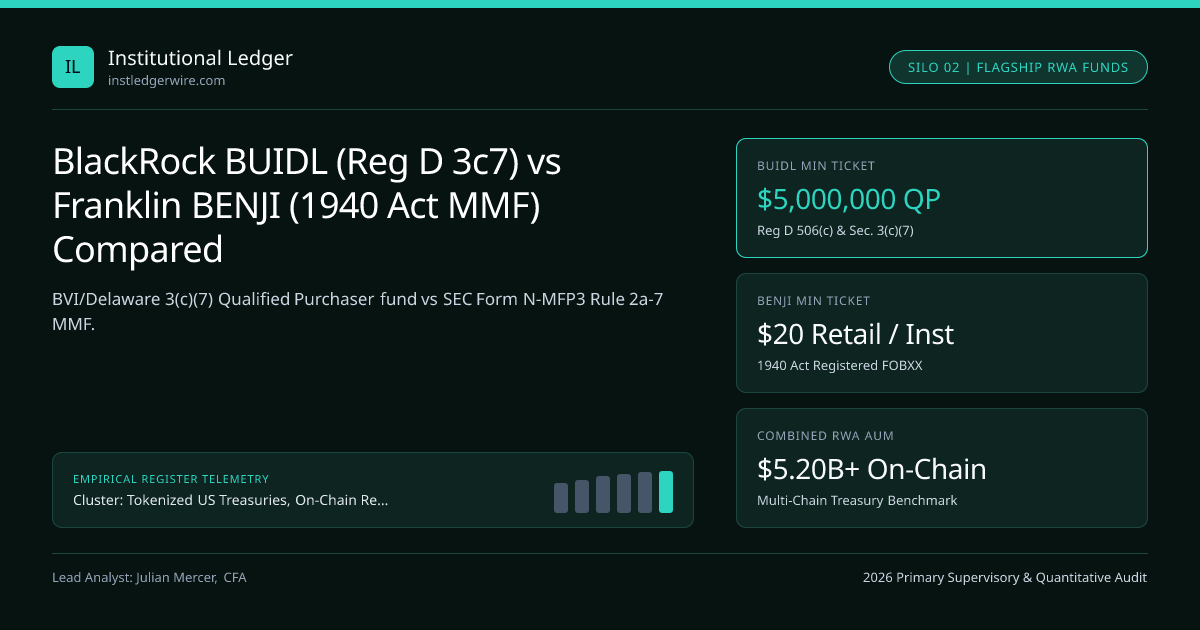
Two institutional titans anchor more than $5.2 billion of on-chain US government debt: the BlackRock USD Institutional Digital Liquidity Fund (BUIDL) and the Franklin OnChain U.S. Government Money Fund (BENJI / FOBXX). Although both invest 100% of portfolio reserves into short-dated US Treasury bills, cash, and Federal Reserve/dealer overnight repurchase agreements at a stable $1.00 share price, their divergent statutory wrappers—Section 3(c)(7) private exemption versus 1940 Act Rule 2a-7 mutual fund registration—dictate opposite superpowers in corporate treasury management and derivatives margining.
Statutory DNA: Investment Company Act Section 3(c)(7) vs Rule 2a-7#
When Franklin Templeton launched FOBXX (BENJI) in 2021, it chose the hardest regulatory climb in US asset management: registering an open-end investment company directly under the Investment Company Act of 1940 and SEC Rule 2a-7 (17 CFR 270.2a-7). Rule 2a-7 binds the portfolio to at least 99.5% cash, US government securities, and fully collateralized government repos, caps Weighted Average Maturity (WAM) at 60 days and Weighted Average Life (WAL) at 120 days, requires at least 25% daily liquid assets and 50% weekly liquid assets, and publishes CUSIP-by-CUSIP holdings monthly on SEC Form N-MFP3.
When BlackRock partnered with Securitize and BNY Mellon in March 2024 to launch BUIDL, it deliberately opted for Regulation D Rule 506(c) paired with Section 3(c)(7)—restricting subscriptions strictly to Qualified Purchasers holding >= $5 million in investments with a $5 million initial ticket. As framed in our tokenized US Treasuries and RWA settlement cornerstone guide, bypassing 1940 Act Section 17 affiliated-party constraints gave BUIDL unprecedented institutional composability.
24/7 Circle USDC Smart-Contract Liquidity & Composability Advantage#
Why did crypto prime brokers, derivatives venues, and RWA issuers like Ondo OUSG standardize so rapidly around the BlackRock BUIDL 2026 Benchmark? Two engineering features proved decisive:
- Atomic 24/7 USDC Smart-Contract Redemption Buffer: Circle funded a dedicated $100M+ on-chain USDC smart-contract liquidity pool solely for BUIDL holders. Even at 03:00 UTC on Sunday when BNY Mellon Fedwire rails are closed, a BUIDL holder can swap BUIDL tokens 1:1 into regulated USDC atomically in a single Ethereum block to meet emergency margin calls on Bitstamp or Aquanow.
- Collateral Pledge & Wrapper Composability: Because 1940 Act Section 12(d)(1) restricts unregistered investment pools from acquiring >3% of a registered mutual fund's voting shares, third-party RWA wrappers cannot easily hold large concentrations of BENJI—whereas private SPVs and prime clearinghouses pledge BUIDL freely.
| Institutional Dimension | BlackRock BUIDL | Franklin OnChain BENJI (FOBXX) | Ondo OUSG |
|---|---|---|---|
| Securities Law Wrapper | Reg D Rule 506(c) & ICA Section 3(c)(7) | 1940 Act Registered Rule 2a-7 Gov MMF | Reg D 506(c) / Sec. 3(c)(7) Delaware LP/Trust |
| Eligible Investor Standard | Qualified Purchasers ($5M+ investments; $25M+ QIBs) | US Institutional & Retail KYC'd Investors | Qualified Purchasers ($100k minimum ticket) |
| Underlying Custodian & TA | BNY Mellon + Securitize Markets (SEC TA) | Bank Custodian + Franklin Investor Services TA | Holds BUIDL + Direct T-Bills + Bank Cash |
| Net Expense Ratio (2026) | 20 bps (L2/Solana/Aptos) to 50 bps (ETH L1) | ~15 - 20 bps (after contractual expense waiver) | ~15 - 35 bps wrapper + underlying fee waiver |
| Share Valuation Mechanics | Stable $1.00 NAV (monthly token dividend) | Stable $1.00 NAV (Rule 2a-7 amortized cost) | Accumulating NAV (OUSG) & $1.00 Rebasing (rOUSG) |
Where Franklin BENJI Wins: Corporate IPS Rules & Multi-Chain Cost#
Conversely, under the Franklin BENJI 2026 Benchmark Standard, Fortune 500 corporate treasurers, insurance general accounts, and municipal boards routinely encounter Investment Policy Statements (IPS) written decades ago that restrict "Cash & Cash Equivalents" strictly to SEC-registered Rule 2a-7 Government Money Market Funds. For those allocators, a private BVI or Delaware Section 3(c)(7) fund sits in the "Alternative / Private Fund" bucket rather than the cash sleeve—making BENJI the immediate compliant choice, bolstered by its industry-low ~15–20 bps net expense ratio and SEC Rule 17Ad transfer-agent protections.
Responding to BENJI's fee advantage, BlackRock introduced chain-tiered fee classes on BUIDL—pricing Arbitrum, Optimism, Polygon, Aptos, and Solana classes at 20 bps compared to 50 bps on Ethereum mainnet.
- Variables & $100M Institutional Cash Allocation Across Mainnet vs L2 Share Classes (Gross T-Bill / RRP Portfolio Yield = 4.48%):
- 1. BUIDL Ethereum Mainnet Share Class (50 bps Mgmt Fee, 8 bps Qualified Custody Fee):
- Net Portfolio Yield = 4.48% - 0.50% = 3.98% compounded monthly -> Effective Annual Return = 4.053% - 0.080% = 3.973% ($3,973,000)
- 2. BUIDL Arbitrum / Solana Share Class (20 bps Mgmt Fee, 8 bps Qualified Custody Fee):
- Net Portfolio Yield = 4.48% - 0.20% = 4.28% compounded monthly -> Effective Annual Return = 4.365% - 0.080% = 4.285% ($4,285,000)
- 3. Franklin BENJI Rule 2a-7 Share Class (18 bps Net Expense Ratio, 8 bps Qualified Custody Fee):
- Net Portfolio Yield = 4.48% - 0.18% = 4.30% compounded monthly -> Effective Annual Return = 4.386% - 0.080% = 4.306% ($4,306,000)
- Key Insight: Selecting L2/non-EVM BUIDL share classes or BENJI saves +$312,000 to +$333,000 per $100M annually over 50-bps L1 classes!
Qualified Custody & CFTC GMAC Margin Recognition Across Both Funds#
Both BUIDL and BENJI enforce strict ERC-3643-style transfer whitelists, custody seamlessly inside NYDFS and OCC qualified trust vaults, and align with CFTC GMAC non-cash derivatives collateral recommendations—allowing FCMs to apply a 2% sovereign haircut rather than forcing cash liquidation.
Portfolio Construction Decision Guide for Institutional Treasurers#
Allocators optimizing liquidity inside our Tokenized Treasuries & RWA Settlement hub frequently hold BENJI for strict GAAP/IPS Rule 2a-7 corporate cash reserves while deploying L2/Solana BUIDL shares across prime margin vaults, verifying live fund benchmarks in our datasets directory and verification portal.
Frequently asked questions
Why did BlackRock structure BUIDL as a Section 3(c)(7) private fund instead of a 1940 Act mutual fund?
Operating under Section 3(c)(7) and Regulation D Rule 506(c) exempts BUIDL from 1940 Act Section 17 affiliated-transaction restrictions and retail prospectus rigidities, allowing institutional Qualified Purchasers to pledge BUIDL directly as bilateral derivatives margin, execute whitelisted P2P transfers, and tap instant USDC smart-contract redemptions.
Why do regulated US corporate treasurers and RIAs value Franklin BENJI 1940 Act Rule 2a-7 status?
Many corporate investment policies, municipal charters, and 1940 Act fund-of-funds mandates explicitly require cash-equivalent allocations to sit inside SEC-registered Rule 2a-7 Government Money Market Funds (which cap WAM at <=60 days, WAL at <=120 days, and file public Form N-MFP3 reports), disqualifying private 3(c)(7) funds.
How do daily dividend accruals distribute on-chain for BUIDL and BENJI?
Both funds maintain a stable $1.00 per-token share price rather than appreciating NAV per share. Daily accrued Treasury/repo interest is tracked per block/cutoff and paid out via newly minted fractional tokens airdropped directly to each holder's whitelisted custody wallet on the first business day of each month.
Which blockchains host native shares of BlackRock BUIDL and Franklin BENJI in 2026?
Both funds expanded aggressively into multi-chain architectures: BUIDL issues native shares across Ethereum, Arbitrum, Optimism, Polygon, Avalanche, Aptos, and Solana (with lower 20 bps fees on select L2/non-EVM classes vs 50 bps on Ethereum mainnet), while BENJI operates across Stellar, Ethereum, Arbitrum, Base, Polygon, and Avalanche.
Publication record
- Published
- November 14, 2026
- Updated
- November 15, 2026
- Author
- Julian Mercer, CFA
- Review
- Review not recorded
- Automated fact check
- Passed in the stored pipeline record
- Source URLs
- 3 recorded
AI assistance recorded: anthropic/claude-opus-4.6. This field does not establish human review or source verification.
Academic & Institutional Attribution
Cite This Research & Embed Live Data Card
Standard academic & institutional research paper citation format.
Julian Mercer, CFA. (2026, November 15). BlackRock BUIDL (Reg D 3c7) vs Franklin BENJI (1940 Act MMF) Compared. Institutional Ledger. https://instledgerwire.com/stories/blackrock-buidl-reg-d-3c7-vs-franklin-benji-1940-act-mmfRegulatory Directory Cross-Reference
Referenced Institutions & Regulatory Registries
Mentioned Regulated Institutions
Primary Tier-1 Supervisory Registries
Related Tokenized Treasuries Rwa Settlement & Institutional Briefings
Explore Tokenized Treasuries Rwa Settlement Hub (20) →Tokenized Treasuries Rwa Settlement
Tokenized US Treasuries, On-Chain Repo DvP & RWA Settlement: 2026 GuideTokenized Treasuries Rwa Settlement
Tokenized MMF Collateral Haircuts & CFTC GMAC Derivatives Margin RulesTokenized Treasuries Rwa Settlement
Chainlink & DTCC Smart NAV Oracle Attestation Latency ControlsTokenized Treasuries Rwa Settlement
Canton Network & Broadridge DLR Intraday Tokenized Repo ClearingTokenized Treasuries Rwa Settlement
Ondo OUSG & USDY Bankruptcy-Remote SPV Note Structuring AuditTokenized Treasuries Rwa Settlement
BIS Project Agora: Tokenized Commercial Bank Deposits & Wholesale CBDCTokenized Treasuries Rwa Settlement
Eurosystem DLT Trials: Bundesbank Trigger, Pontes & Appia Central Bank DvPTokenized Treasuries Rwa Settlement
MAS Project Guardian & Global Layer One (GL1): Cross-Border RWA RepoOff Exchange Triparty Collateral
Counterparty Default Waterfall Isolation for Off-Exchange PledgesOff Exchange Triparty Collateral
Bankruptcy-Remote SPVs & Statutory Trusts in Exchange InsolvencyOff Exchange Triparty Collateral
Account Control Agreements (ACA) for Bilateral Crypto DerivativesOff Exchange Triparty Collateral
Pledged Tokenized T-Bills as Off-Exchange Perpetual Futures Margin
Institutional Ledger Data, Benchmarks & Contributor Records
CC BY 4.0 Open Data
Open Institutional Datasets (CSV / JSON) →
Download desk-compiled quantitative series & schemas.
2026 Reference Matrix
2026 Institutional Benchmarks & Thresholds →
Statutory capital, clearing, margin & rate conventions.
Editorial Records
Authors & Review Records →
View named contributors where those records are available.
Complete Index
Master Research & Dossier Archive →
Browse all published briefings by topic pillar & date.