
Stablecoin Reserve Attestation Audit
FX Basis & Negative-Rate Risks in Non-USD (EUR, JPY, CHF) Stablecoins
USD stablecoins thrive effortlessly on 4%+ US Treasury yields, whereas JPY, CHF, and EUR stablecoin issuers navigate ultra-low or negative sovereign bill yields, banking safekeeping fees, and strict FX match mandates.
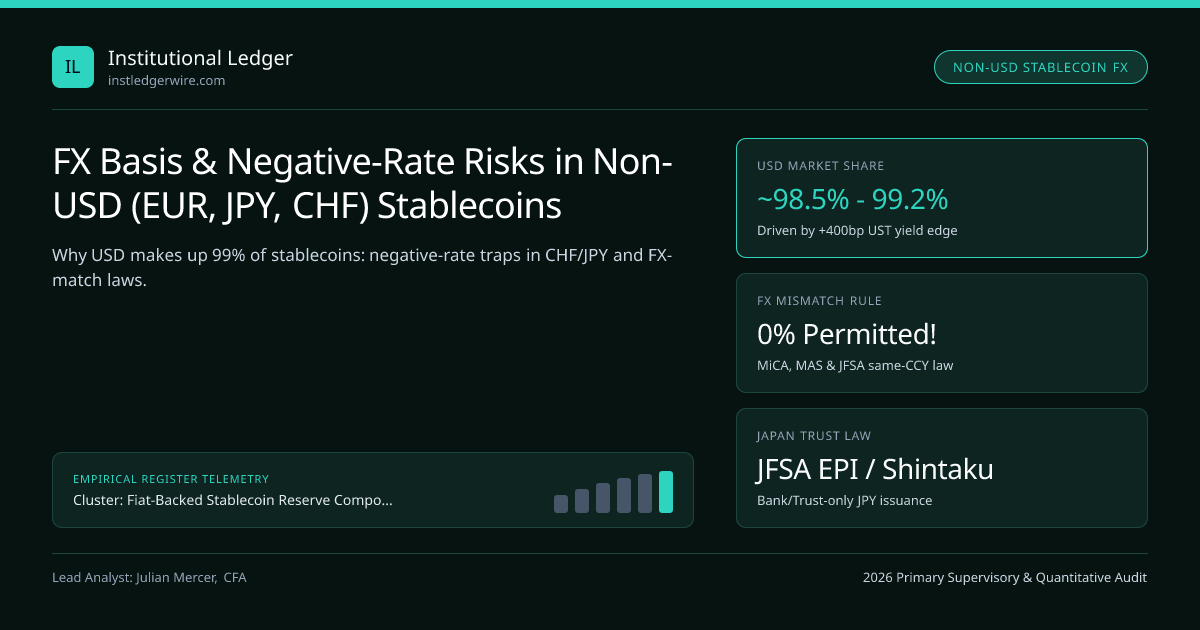
Look at global public-blockchain data and a striking statistic jumps off the screen: while the Euro, Japanese Yen, British Pound, and Swiss Franc account for over 50% of traditional SWIFT FX turnover, non-USD currencies represent barely ~1% of global fiat stablecoin supply. The culprit is pure fixed-income arithmetic: low or negative non-USD policy rates collide head-on with custody, audit, and MiCA bank-deposit costs—creating specific credit traps institutional risk officers must watch whenever central banks cut rates.
Covered Interest Parity: Why You Cannot Back a Yen Token With US T-Bills#
Novice fintech founders regularly pitch the same flawed idea: "Japanese short rates are 0.40% while US Treasury bills pay 4.45%—let's issue a Yen stablecoin, invest the reserves in US T-Bills, hedge the FX, and pocket 4%!"
Both prudential law and Covered Interest Parity (CIP) crush that trade instantly:
- Statutory Same-Currency Mandates: Under EU MiCA Article 38(1), MAS Single-Currency Stablecoin rules, and Japan's JFSA Payment Services Act, reserve assets must be denominated in the exact same official currency referenced by the token!
- No-Arbitrage FX Forward Points: Even where derivatives hedging is modeled, selling USD 3 months forward against JPY or CHF locks in forward points equal to
-(r_USD - r_JPY)plus cross-currency basis swap spread—leaving the issuer earning less than native JGBs while introducing bilateral FX swap counterparty risk!
The Negative-Rate (NIRP) Audit Redline: Watching for "Yield Reach"#
Between 2014 and 2022, the Swiss National Bank (-0.75%), European Central Bank (-0.50%), and Bank of Japan (-0.10%) held policy rates below zero! Under EU MiCA Article 49, an EMT issuer must redeem at 100.00% par (EUR 1.00) free of charge and cannot pass negative interest through by rebasing a holder's balance downward!
Consequently, whenever EUR, CHF, or JPY short rates drop below ~35 to 50 basis points (the break-even cost of Big-4 AT-C 205 / ISAE 3000 audits, G-SIB custody, and 2%–3% own-funds capital), standalone non-USD stablecoin startups face negative operating margins! As warned in our fiat-backed stablecoin reserve cornerstone guide, institutional risk committees watch small non-USD issuers like hawks during rate-cutting cycles to ensure they never reach for risky BBB corporate bonds or unrated bank time deposits to plug operating deficits!
| Currency | Primary Regulatory Regime | Permitted Reserve Assets | Sovereign Short Rate Profile | Primary Institutional Use Case |
|---|---|---|---|---|
US Dollar (USD) | NYDFS / SEC 2a-7 / MiCA (USDC) | <=93d US T-Bills, NY Fed RRP, G-SIB cash | High (~4.2%–4.6%) — strongly profitable | Global crypto collateral & cross-border treasury |
Euro (EUR) | EU MiCA Title IV EMT (ESMA, AMF, BaFin) | 30%–60% EU bank deposits + Eurozone Level 1 bills | Moderate (~2.0%–2.8%) — NIRP tested | EEA CASP spot/perp pairs (Bitstamp) & eWpG bonds |
Japanese Yen (JPY) | Japan JFSA PSA EPI (Shintaku Trust) | 100% JPY Japanese bank trust deposits (or gov bonds) | Ultra-Low (~0.25%–0.60%) | Japanese bank consortium DLT securities & FX PvP |
Swiss Franc (CHF) | Swiss FINMA Bank Guarantee / Bank Token | SNB sight deposits / default-guaranteed bank claims | Ultra-Low (~0.25%–0.75%) | SIX Digital Exchange / Swiss private wealth settlement |
Why Bank-Issued & Multi-Currency Giants Win Non-USD Corridors#
Only two issuer archetypes sustain institutional-grade EUR, JPY, and CHF stablecoins across full interest-rate cycles:
- Profitable USD Umbrella Issuers: Circle SAS (
EURC, paired with USDC), where massive USD Treasury reserve profitability effortlessly funds pristine Eurozone MiCA compliance and shared multi-currency APIs. - Direct Chartered Banks & Japanese
ShintakuTrusts: Société Générale Forge (EURCV), German bank consortium initiatives under BaFin, Swiss FINMA-guaranteed bank tokens, and Japanese trust banks (MUFGProgmat Coin) where stablecoin rails drive lucrative institutional FX, custody, and Eurosystem / Project Agora bond-settlement fees!
- Variables & Covered Interest Parity Proof Why JPY Stablecoins Cannot Harvest 4.45% USD T-Bill Yields (90-Day Horizon T = 0.25):
- SpotUSDJPY = 150.00; rUSDTBill = 4.45%; rJPYBill = 0.40%; 3MUSDJPYCrossCurrency_Basis = -0.25% (-25 bps hedging cost!)
- 1. 90-Day Forward USD/JPY Rate by No-Arbitrage = 150.00 * (1 + 0.0040 * 0.25) / (1 + 0.0445 * 0.25) = 148.50 (Forward discount = -4.00% ann.!)
- 2. Net Hedged Return in JPY = 4.45% - 4.05% (forward points) - 0.25% (FX swap dealer basis) = 0.15% in JPY (WORSE than holding native 0.40% JGBs directly + adds FX counterparty credit risk!).
24/7 On-Chain EUR/USD & USD/JPY Execution vs CLS Cutoffs#
Despite smaller market caps, regulated EURC and Japanese EPI tokens unlock 24/7 weekend FX Payment-versus-Payment (PvP) swaps across Bitstamp and OTC desks (Aquanow, B2BX) when traditional CLS FX utility windows close on Friday evening.
Non-USD Stablecoin Credit Screening Checklist#
Multi-currency treasurers active in our Stablecoin Reserve Attestation hub reject any non-USD stablecoin lacking parent G-SIB/USD-scale financial backing when domestic policy rates sit below 1.00%, confirm 100% same-currency AAA/AA sovereign/G-SII reserves, and verify licenses via our verification portal.
Frequently asked questions
Why can’t a Japanese Yen (JPY) stablecoin issuer buy 4.5% US Treasury bills and pocket the 4.0% yield spread?
First, Japan’s revised Payment Services Act supervised by the JFSA mandates 100% JPY demand trust deposits (Shintaku) or Japanese sovereign bounds! Second, if unhedged, a 5% drop in USD/JPY instantly renders the JPY stablecoin 95% insolvent! Third, if FX-hedged via a 3-month USD/JPY forward, Covered Interest Parity costs ~4.1%+ per year in forward points—wiping out the entire USD yield advantage!
What killed or forced restructuring at European Euro stablecoins during the ECB’s -0.50% Negative Interest Rate Policy (NIRP) era?
Between 2014 and mid-2022, short-term German Bubills and ECB bank deposits charged -0.50% to -0.75% per year! Every EUR 1B of par-redeemable Euro stablecoins lost EUR 5M–7.5M/yr on reserves BEFORE paying auditors or custodians—forcing issuers either to charge holder custody fees, rely on parent equity subsidies, or shut down until ECB rates rose positive!
How does Japan’s JFSA Electronic Payment Instruments (EPI) law structure regulated Yen stablecoins?
Japan enacted the world’s first dedicated statutory framework for Electronic Payment Instruments (EPIs) in June 2023 under the Payment Services Act, restricting issuance solely to licensed Japanese Banks, Fund Transfer Service Providers (capped at JPY 1M/tx), and Trust Companies (Tokutei Shintaku trust-type stablecoins like Progmat Coin, backed 100% by segregated Japanese bank deposits).
How do multinational FX desks execute 24/7 EUR/USD and USD/JPY on-chain swaps despite thinner non-USD liquidity?
Using regulated Title IV EMTs (EURC alongside USDC issued by Circle SAS in France) paired on institutional CLOBs (Bitstamp EUR pairs), concentrated-liquidity FX AMMs, and multi-dealer OTC RFQ desks (Aquanow, B2BX)—with wholesale corridors rapidly scaling on BIS Project Agora.
Publication record
- Published
- November 13, 2026
- Updated
- November 14, 2026
- Author
- Julian Mercer, CFA
- Review
- Review not recorded
- Automated fact check
- Passed in the stored pipeline record
- Source URLs
- 3 recorded
AI assistance recorded: anthropic/claude-opus-4.6. This field does not establish human review or source verification.
Academic & Institutional Attribution
Cite This Research & Embed Live Data Card
Standard academic & institutional research paper citation format.
Julian Mercer, CFA. (2026, November 14). FX Basis & Negative-Rate Risks in Non-USD (EUR, JPY, CHF) Stablecoins. Institutional Ledger. https://instledgerwire.com/stories/fx-hedging-negative-spread-risks-non-usd-euro-yen-stablecoinsRegulatory Directory Cross-Reference
Referenced Institutions & Regulatory Registries
Mentioned Regulated Institutions
Related Stablecoin Reserve Attestation Audit & Institutional Briefings
Explore Stablecoin Reserve Attestation Audit Hub (20) →Stablecoin Reserve Attestation Audit
Fiat-Backed Stablecoin Reserve Composition, Audits & T-Bill Custody GuideStablecoin Reserve Attestation Audit
Stablecoin Redemption Gate Fees, Minimum Burn Thresholds & Run DynamicsStablecoin Reserve Attestation Audit
Basel SCO60 Group 1b Stabilisation Test Failures on StablecoinsStablecoin Reserve Attestation Audit
Treasury-Bill Yield Compression & Stablecoin Issuer Reserve EconomicsStablecoin Reserve Attestation Audit
AICPA AT-C 205 Monthly Stablecoin Reserve Attestation Criteria DecodedStablecoin Reserve Attestation Audit
Overnight Reverse Repo & 93-Day T-Bill WAM Caps in StablecoinsStablecoin Reserve Attestation Audit
EU MiCA Title III (ART) vs Title IV (EMT) Stablecoin Safeguarding RulesStablecoin Reserve Attestation Audit
MiCA’s 60% EU Bank Deposit Mandate for Significant Stablecoins: Tail RiskInstitutional Crypto Prime Margin
Tax-Lot Relief (HIFO, Specific ID) & FASB ASC 350-60 Prime Sub-Ledger SyncInstitutional Crypto Prime Margin
Multi-Custodian Prime Routing & Single-Point-of-Failure MitigationInstitutional Crypto Prime Margin
Stressed VaR & Concentration Liquidity Add-Ons for Altcoin CollateralMarket Insights
Nomura explores sale of crypto unit Laser Digital: Bloomberg
Institutional Ledger Data, Benchmarks & Contributor Records
CC BY 4.0 Open Data
Open Institutional Datasets (CSV / JSON) →
Download desk-compiled quantitative series & schemas.
2026 Reference Matrix
2026 Institutional Benchmarks & Thresholds →
Statutory capital, clearing, margin & rate conventions.
Editorial Records
Authors & Review Records →
View named contributors where those records are available.
Complete Index
Master Research & Dossier Archive →
Browse all published briefings by topic pillar & date.