
Qualified Custody Mpc Hsm Controls
SOC 1 Type II vs SOC 2 Type II Audits in Institutional Crypto Custody
Institutional fund auditors require both SOC 1 Type II financial sub-ledger examinations under AT-C 320 and SOC 2 Type II security controls across 12-month digital asset custody windows.
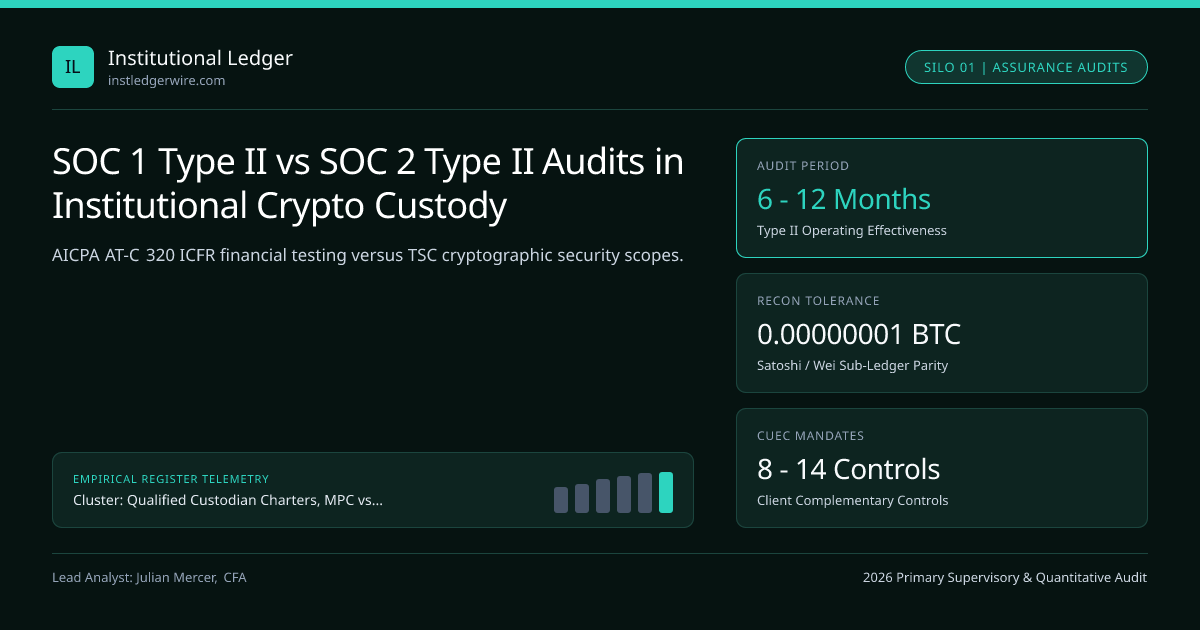
Operational due diligence teams onboarding qualified digital asset custodians frequently discover that a glossy SOC 2 Type II badge fails to satisfy Big Four fund auditors at fiscal year-end. While SOC 2 Type II tests physical vault and cryptographic security under AICPA Trust Services Criteria, institutional financial statement audits under FASB ASU 2023-08 (ASC 350-60) and SEC SAB 122 depend on a companion SOC 1 Type II examination under AT-C Section 320 (or ISAE 3402 internationally) verifying Wei- and Satoshi-level sub-ledger completeness.
AT-C 320 Financial Controls vs Trust Services Criteria Security Scopes#
Understanding why institutional allocators demand both reports begins with their distinct statutory mandates. As mapped in our qualified digital asset custody cornerstone guide, a SOC 1 Type II examination evaluates Internal Controls over Financial Reporting (ICFR). Its control objectives test whether customer deposits, sweeps, gas deductions, validator rewards, and corporate actions (hard forks or token migrations) post accurately and completely to client statements at exact UTC block-height cutoffs. Without an unqualified SOC 1 Type II opinion, an investment fund's external CPA firm under PCAOB AS 2601 cannot rely on custodian statements and must perform expensive independent full-node transaction tracing.
Conversely, a SOC 2 Type II examination audits operational security across five Trust Services Criteria—primarily Security, Availability, and Processing Integrity. Here the CPA firm's cryptography specialists sample air-gapped FIPS 140-3 HSM ceremonies, threshold MPC key-share refresh transcripts, reproducible enclave binary hashes, and zero-trust employee deprovisioning.
Dissecting Section III System Boundaries & Subservice Carve-Outs#
Sophisticated risk officers skip the two-page auditor opinion letter first and turn directly to Section III (System Description) and Section IV (Test Procedures and Results). A recurring red flag in digital asset custody reports is scope narrowing: a custodian may boast an unqualified SOC 2 Type II opinion that quietly limits its boundary to secp256k1 Bitcoin and Ethereum vaults while excluding newly onboarded Solana Ed25519 signing services or omnibus staking infrastructure.
Equally critical is distinguishing between the inclusive method and the carve-out method for subservice organizations. Nearly all custodians carve out colocation datacenters (Equinix, Iron Mountain), cloud enclave hosts (AWS), or third-party staking node operators. Under a carve-out SOC 1 Type II, the custodian must enforce Complementary Subservice Organization Controls (CSOCs)—proving its own risk team audited those vendors' SOC reports. Supervisors such as NYSDFS and MAS scrutinize these sub-custodial chains during annual examinations, a liability vector we analyze in custodian sub-custody delegation and ancillary staking liability.
| Assurance Dimension | SOC 1 Type II (Financial Controls) | SOC 2 Type II (Security & Integrity) | Proof-of-Reserves (AUP / AT-C 205) | ISO/IEC 27001 Certification |
|---|---|---|---|---|
| Governing Standard | AICPA AT-C 320 / ISAE 3402 | AICPA AT-C 105 & 205 (TSC) | AICPA AT-C 205 / 215 Point-in-Time | ISO/IEC 27001:2022 ISMS |
| Primary Institutional Reader | Fund CPA Auditor (FASB ASC 350-60) | CISO, Operational Due Diligence, Underwriter | Prime Trading Desk & Counterparties | Global Procurement & MAS / ESMA |
| Observation Horizon | 6 to 12 months continuous sampling | 6 to 12 months continuous sampling | Instantaneous block-height snapshot | 3-year cycle with surveillance |
| Core Crypto Controls Tested | Sub-ledger parity, fork/airdrop cutoff, fee math | HSM/MPC ceremonies, enclave builds, vault access | On-chain asset sum >= Merkle liabilities | Governance policies; lacks deep tx sampling |
| Regulatory Custody Anchor | Mandatory for 1940 Act & ETF trusts (NYSDFS) | Expected across regulated venues (Bitstamp) | Supplement for exchanges (Bitfinex) | Baseline IT hygiene |
Blockchain Finality Cutoffs, Reorg Handling & Section IV Exceptions#
Unlike T+1 equity depositories with deterministic end-of-day batch files, public blockchains run 24/7/365 and experience probabilistic block reorganizations. A rigorous SOC 1 Type II tests how the custodian's indexing engine handles 23:59:59 UTC fiscal cutoffs—confirming, for example, that Ethereum balances require two finalized Beacon Chain epochs (64 slots) and that dual-client independent full nodes (such as Geth + Nethermind paired with Prysm + Lighthouse) cross-verify state roots before crediting client sub-ledgers.
When reviewing Section IV matrices across 25 to 60 sampled occurrences per control, due diligence teams classify any noted exceptions by blast radius. A delayed quarterly access review on an internal HR wiki is minor; a single un-witnessed vault badge entry or an unapproved emergency hotfix to policy-engine code constitutes a disqualifying control deficiency for FASB ASC 350-60 fair-value custody reporting.
- Variables & Fund Audit Economics (Multi-Chain $1.5B Institutional Fund, 14 Custody Chains):
- Hfullreindex = 420 CPA specialist hours (independent full-node sync, UTXO/trace reconstruction across 14 chains)
- w_SOC1 = 0.78 maximum PCAOB AU-C 402 substantive testing reduction with clean SOC 1 Type II + SOC 2 Type II
- I_unqualified = 1.0 if unqualified opinion covering all 14 chains; 0.0 if chain is carved out of Section III system description
- GapDays = 61 days (October 31 SOC period-end to December 31 fund FYE, covered by bridge letter)
- N_exceptions = Number of Section IV deviations (0 in Tier-1 trust vs 3 IAM/cutoff exceptions in mid-tier custodian)
- H_remediation = 45 hours incremental shadow testing per Section IV exception
- Worked Audit Cost Comparison (at $480/hr Specialist Digital Asset Audit Rate):
- 1. Custodian A (Clean SOC 1/2 Type II, 0 exceptions, 61-day gap):
- Hours = 420 * (1 - 0.78 * 1.0 * (1 - 61/365)) + 0 = 420 * (1 - 0.6496) = 147.2 hrs -> $70,656 audit fee
- 2. Custodian B (SOC 2 Type II only -> I_unqualified = 0 for ICFR + 2 exceptions):
- Hours = 420 * 1.0 + (2 * 45) = 510.0 hrs -> $244,800 audit fee ($174,144 annual fund expense penalty)
Complementary User Entity Controls (CUECs) & Bridge Letter Governance#
Every SOC 1 and SOC 2 report lists 8 to 14 Complementary User Entity Controls near the end of Section III. Custodians explicitly condition their control effectiveness on the institutional client implementing M-of-N approver quorums via hardware biometric co-signing policy engines, locking IP whitelists for trading venues like Bitstamp and Aquanow, and reconciling daily webhook feeds. Fund COOs map each CUEC into their internal compliance calendar and collect formal Q4 bridge letters whenever the custodian's examination window closes on September 30 or October 31.
Due Diligence Verification Protocol Before Funding#
Prior to wiring or transferring genesis allocations inside our Qualified Custody & HSM Controls hub, allocators execute an NDA to inspect the full 120-page Type II reports (never accepting summary letters), verify the signing CPA firm's peer-review standing, and cross-check custodian regulatory registrations through our verification portal and institutional rankings.
Frequently asked questions
Why do Big Four fund auditors reject a standalone SOC 2 Type II report during annual financial audits?
External financial statement auditors operating under PCAOB AS 2601 or AICPA AU-C 402 can only reduce substantive blockchain re-indexing procedures if the custodian holds a SOC 1 Type II report testing financial completeness, cutoff accuracy, staking reward accruals, and sub-ledger reconciliation.
What hidden scope exclusions commonly weaken a crypto custodian SOC 2 Type II report?
Weak reports restrict scope to corporate cloud infrastructure while carving out newly launched Layer-1 signing daemons, third-party validator sub-custodians, or physical cold-vault facilities operated under a separate subsidiary.
How do Complementary User Entity Controls (CUECs) shift operational liability onto the institutional client?
Custodian SOC reports specify CUECs requiring the client to enforce dual-approver whitelist changes, rotate API keys every 90 days, and verify destination checksums out-of-band. If a client skips a CUEC and suffers an API sweep, the custodian audit opinion remains unmodified.
How are gap periods between the SOC Type II report end date and a fund December 31 fiscal year-end handled?
When a SOC 1 Type II period closes on September 30, the custodian issues a formal bridge letter covering October 1 through December 31 attesting to zero material control changes or breaches, supplemented by year-end block-height confirmation.
Publication record
- Published
- November 14, 2026
- Updated
- November 14, 2026
- Author
- Julian Mercer, CFA
- Review
- Review not recorded
- Automated fact check
- Passed in the stored pipeline record
- Source URLs
- 3 recorded
AI assistance recorded: anthropic/claude-opus-4.6. This field does not establish human review or source verification.
Academic & Institutional Attribution
Cite This Research & Embed Live Data Card
Standard academic & institutional research paper citation format.
Julian Mercer, CFA. (2026, November 14). SOC 1 Type II vs SOC 2 Type II Audits in Institutional Crypto Custody. Institutional Ledger. https://instledgerwire.com/stories/soc-1-type-2-vs-soc-2-type-2-digital-asset-custody-auditsRegulatory Directory Cross-Reference
Referenced Institutions & Regulatory Registries
Mentioned Regulated Institutions
Related Qualified Custody Mpc Hsm Controls & Institutional Briefings
Explore Qualified Custody Mpc Hsm Controls Hub (20) →Qualified Custody Mpc Hsm Controls
Qualified Digital Asset Custody, MPC Signing & FIPS 140-3 HSM Controls: 2026 GuideQualified Custody Mpc Hsm Controls
Basel III SCO60 Group 1 vs Group 2 Crypto Bank Capital Weights ExplainedQualified Custody Mpc Hsm Controls
SEC SAB 122 & FASB ASC 450-20 Custody Liability Accounting for BanksQualified Custody Mpc Hsm Controls
Specie & Crime Insurance Exclusions in Digital Asset Cold VaultsQualified Custody Mpc Hsm Controls
Omnibus vs Segregated On-Chain Wallets: Insolvency & Bailment LawQualified Custody Mpc Hsm Controls
BaFin Krypto-Verwahrgeschaeft vs EU MiCA Article 70 CASP Custody RulesQualified Custody Mpc Hsm Controls
Spot Bitcoin & Ether ETF In-Kind Creation Custody SLA WorkflowsQualified Custody Mpc Hsm Controls
Quorum Policy Engines & Biometric Hardware Co-Signing ControlsTokenized Treasuries Rwa Settlement
Tokenized MMF Collateral Haircuts & CFTC GMAC Derivatives Margin RulesTokenized Treasuries Rwa Settlement
Chainlink & DTCC Smart NAV Oracle Attestation Latency ControlsTokenized Treasuries Rwa Settlement
Canton Network & Broadridge DLR Intraday Tokenized Repo ClearingTokenized Treasuries Rwa Settlement
Ondo OUSG & USDY Bankruptcy-Remote SPV Note Structuring Audit
Institutional Ledger Data, Benchmarks & Contributor Records
CC BY 4.0 Open Data
Open Institutional Datasets (CSV / JSON) →
Download desk-compiled quantitative series & schemas.
2026 Reference Matrix
2026 Institutional Benchmarks & Thresholds →
Statutory capital, clearing, margin & rate conventions.
Editorial Records
Authors & Review Records →
View named contributors where those records are available.
Complete Index
Master Research & Dossier Archive →
Browse all published briefings by topic pillar & date.