
Stablecoin Reserve Attestation Audit
Intraday Snapshot Window Dressing vs Continuous Proof-of-Reserve Oracles
A single predictable 11:59 PM month-end attestation timestamp invites overnight balance-sheet window dressing. Pairing surprise intra-month CPA cutoffs with smart-contract Proof-of-Reserve mint guards seals the gap.
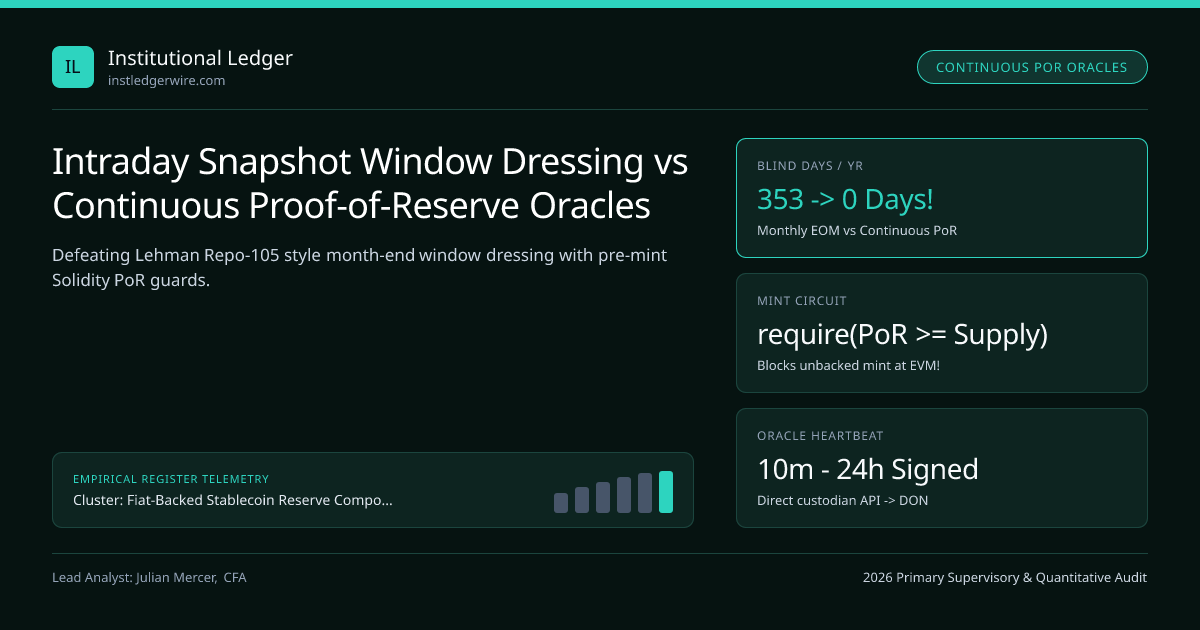
In traditional accounting scandals—from Lehman Brothers' infamous quarter-end "Repo 105" balance-sheet cosmetics to early 2018 offshore crypto controversies—bad actors exploited a simple timing flaw: when everyone knows the auditor only snaps a photograph at 4:00 PM on the last Friday of the month, what happens on the other twenty-nine days? Combining surprise intra-month CPA cutoffs with on-chain Proof-of-Reserve (PoR) pre-mint circuit breakers closes that loophole permanently.
Anatomy of Point-in-Time Snapshot Window Dressing#
Why is a predictable single-timestamp monthly snapshot mathematically insufficient on its own? Consider two classic forensic patterns flagged by regulators and IOSCO:
- Overnight Intra-Group Cash Loops: Borrowing $500M overnight on Day 30 from an affiliated trading desk (or entering an unrecorded short-term repo/loan), letting the bank print a clean 5:00 PM closing balance statement, and returning the $500M at 9:01 AM on Day 1 of the next month!
- Multi-Chain Supply Timing Skew: Burning tokens on Chain A five minutes before the Chain A snapshot block while delaying the corresponding re-mint on Chain B until five minutes after the Chain B snapshot block—temporarily understating global liabilities!
As detailed in our AICPA AT-C 205 attestation breakdown and fiat-backed stablecoin reserve cornerstone guide, NYDFS neutralized Trick #1 and #2 legally by forcing CPAs to audit unannounced retrospective random dates alongside exact UTC synchronized multi-chain block heights.
Cryptographic Defense: Chainlink SecureMint Proof-of-Reserve Guards#
Even with rigorous NYDFS monthly CPA exams, two operational gaps remain: a monthly PDF arrives 15 to 30 days after month-end, and a pure post-trade accounting report cannot stop a compromised MINTER_ROLE key from executing an infinite-mint exploit at 3:00 AM!
Enter Programmable On-Chain Proof-of-Reserve (PoR):
- Direct-to-Custodian Source Principle: Crucially, oracle nodes never query an API controlled by the stablecoin issuer itself! Instead, decentralized oracle nodes (mirroring the architecture of DTCC Smart NAV) read cryptographically signed balance endpoints directly from the independent qualified custodian bank or registered fund administrator custodying the T-Bills and cash.
- Pre-Mint Bytecode Enforcement (
SecureMint): Inside the stablecoin's Soliditymint(address to, uint256 amount)function, the smart contract queries the on-chain PoR feed (checked for heartbeat freshness) and enforces:
require(totalSupply + amount <= porFeed.latestAnswer, "Exceeds verified custodian reserve");
- Even if an attacker somehow stole threshold HSM signing shards, the Ethereum Virtual Machine itself refuses to mint unbacked tokens!
| Verification Mechanism | Reporting Latency | Catches Intraday Borrowing? | Catches Secret Legal Side-Liens? | Blocks Compromised Mint Key? |
|---|---|---|---|---|
| Predictable EOM AUP Letter | 30–60 days | No — easily window-dressed on Day 30 | No — AUP expresses zero lien opinion | No |
| NYDFS EOM + Surprise Random AT-C 205 | 15–30 days | Yes — retrospective surprise date + bank logs | Yes — direct custodian lien confirmations | Post-incident detection only |
| Live On-Chain PoR Feed Alone | 10 min – 24 hrs | Yes — continuous automated polling | No — API cannot read secret legal side-letters! | Yes — via SecureMint require! |
Combined AT-C 205 + SecureMint PoR | Real-Time + Monthly | Yes (100% continuous) | Yes (Big-4 CPA confirmed) | Yes (Cryptographically blocked!) |
Automated DeFi & Off-Exchange Collateral Circuit Breakers#
Downstream institutional consumers—automated variation-margin engines, lending protocols, and OTC RFQ routers (Aquanow)—subscribe directly to on-chain PoR feeds alongside regulated USDC benchmarks. If a stablecoin's attested PoR ever drops below 99.8% of multi-chain supply (or if the oracle heartbeat goes stale past 26 hours), automated risk hooks pause accepting new collateral in that token weeks before a monthly PDF would ever print!
- Variables & Compromised MINTER_ROLE Key Blast-Radius Containment ($5.0B Regulated Stablecoin w/ $10.0M Equity Cushion = $5,010,000,000 Reserve):
- Suppose an insider or nation-state attacker compromises the issuer's operational minting server at 03:00 UTC and attempts to mint 2,000,000,000 fake stablecoins ($2.0B) to dump on Curve and Bitstamp:
- 1. Legacy Uncapped ERC-20
mint(attacker, 2e9): - Transaction succeeds! Attacker drains every Curve/Uniswap pool in 60 seconds before human blacklisting reacts -> Peg collapses!
- 2. PoR-Guarded
SecureMint(require(newSupply <= porOracle.latestReserve)): 5,000M + 2,000M > 5,010M-> EVM REVERTS THE ATTACK TRANSACTION ATOMICALLY IN 0 MILLISECONDS! Max excess mint capped at $10M surplus (easily frozen via blacklist)!
Why You Still Need BOTH the Oracle AND the Big-4 CPA#
Smart-contract maximalists sometimes claim on-chain PoR makes CPAs obsolete. Wrong! A bank's read-only REST API reports Account Balance = $2,000,000,000—it cannot tell an oracle node whether the CEO signed a secret side-letter in Cayman pledging that account to guarantee a parent debt! Only a human Big-4 AT-C 205 legal & bank-encumbrance confirmation catches off-chain legal liens, while only an on-chain PoR oracle enforces real-time block-by-block math. Institutional grade demands both.
Telemetry Integration Checklist for Risk & Smart-Contract Teams#
Risk engineers active in our Stablecoin Reserve Attestation hub verify that any PoR-integrated stablecoin pulls data directly from an independent chartered custodian (never self-attested issuer endpoints), pair PoR feeds with NYDFS/ESMA AT-C 205 reviews, and audit issuers via our verification portal.
Frequently asked questions
How did historical bad actors perform "month-end snapshot window dressing" on early stablecoin or custody reports?
As documented in NY Attorney General and CFTC historical enforcement settlements from 2018–2021, an operator holding an intraday reserve deficit could temporarily sweep cash from an affiliated trading exchange into its bank account at 9:00 AM on attestation day, capture a clean 4:00 PM bank statement screenshot, and wire the cash right back out the next morning!
How does NYDFS’s "retrospective random business day" rule catch intraday window dressing?
Because the independent CPA picks the random business day (say, Tuesday the 14th) *after* the month is already over! Unless the issuer actually held >=100.0% unencumbered segregated reserves at the close of every single business day of the month, it faces a high probability of getting caught red-handed on the surprise audit date.
How does an automated on-chain Proof-of-Reserve (PoR) pre-mint circuit breaker work in Solidity?
Decentralized oracle nodes query read-only institutional APIs directly at the independent reserve custodian/fund administrator (verifying settled cash + T-Bill CUSIPs) and publish a signed reserve total on-chain. When the issuer’s HSM calls mint(to, $50M), the smart contract checks require(attestedReserves >= currentSupply + $50M)—reverting any unbacked mint!
Can continuous Proof-of-Reserve oracles completely replace Big-4 AICPA AT-C 205 CPA attestations?
No — they are complementary! An automated API oracle verifies real-time custodial account balances in seconds (eliminating the 30-day PDF reporting lag), whereas a human Big-4 CPA examination under AT-C 205 inspects off-chain legal contracts, side letters, hidden debt guarantees, and unrecorded legal liens that an API balance endpoint cannot read!
Publication record
- Published
- November 13, 2026
- Updated
- November 15, 2026
- Author
- Julian Mercer, CFA
- Review
- Review not recorded
- Automated fact check
- Passed in the stored pipeline record
- Source URLs
- 3 recorded
AI assistance recorded: anthropic/claude-opus-4.6. This field does not establish human review or source verification.
Academic & Institutional Attribution
Cite This Research & Embed Live Data Card
Standard academic & institutional research paper citation format.
Julian Mercer, CFA. (2026, November 15). Intraday Snapshot Window Dressing vs Continuous Proof-of-Reserve Oracles. Institutional Ledger. https://instledgerwire.com/stories/intraday-snapshot-window-dressing-vs-continuous-por-oraclesRegulatory Directory Cross-Reference
Referenced Institutions & Regulatory Registries
Mentioned Regulated Institutions
Related Stablecoin Reserve Attestation Audit & Institutional Briefings
Explore Stablecoin Reserve Attestation Audit Hub (20) →Stablecoin Reserve Attestation Audit
Fiat-Backed Stablecoin Reserve Composition, Audits & T-Bill Custody GuideStablecoin Reserve Attestation Audit
Custodial T-Bill Safekeeping: BNY Mellon & State Street Reserve ModelsStablecoin Reserve Attestation Audit
Stablecoin Smart-Contract Freeze & Blacklist Governance Under OFAC/FinCENStablecoin Reserve Attestation Audit
FX Basis & Negative-Rate Risks in Non-USD (EUR, JPY, CHF) StablecoinsStablecoin Reserve Attestation Audit
Stablecoin Redemption Gate Fees, Minimum Burn Thresholds & Run DynamicsStablecoin Reserve Attestation Audit
Basel SCO60 Group 1b Stabilisation Test Failures on StablecoinsStablecoin Reserve Attestation Audit
Treasury-Bill Yield Compression & Stablecoin Issuer Reserve EconomicsStablecoin Reserve Attestation Audit
AICPA AT-C 205 Monthly Stablecoin Reserve Attestation Criteria DecodedInstitutional Crypto Prime Margin
Prime Credit Intermediation & Post-2022 Undercollateralized Lending BansInstitutional Crypto Prime Margin
Perpetual Funding-Rate Volatility, Impact Notional & Auto-Liquidation EnginesInstitutional Crypto Prime Margin
Institutional MEV Protection: Private RPCs, Block Relays & Sandwich DefenseInstitutional Crypto Prime Margin
Tax-Lot Relief (HIFO, Specific ID) & FASB ASC 350-60 Prime Sub-Ledger Sync
Institutional Ledger Data, Benchmarks & Contributor Records
CC BY 4.0 Open Data
Open Institutional Datasets (CSV / JSON) →
Download desk-compiled quantitative series & schemas.
2026 Reference Matrix
2026 Institutional Benchmarks & Thresholds →
Statutory capital, clearing, margin & rate conventions.
Editorial Records
Authors & Review Records →
View named contributors where those records are available.
Complete Index
Master Research & Dossier Archive →
Browse all published briefings by topic pillar & date.