
Stablecoin Reserve Attestation Audit
Stablecoin Smart-Contract Freeze & Blacklist Governance Under OFAC/FinCEN
Every major fiat-backed stablecoin embeds administrative blacklist(address) bytecode to enforce OFAC sanctions and law-enforcement freeze orders—creating unique smart-contract contagion risks for DeFi pools and omnibus wallets.
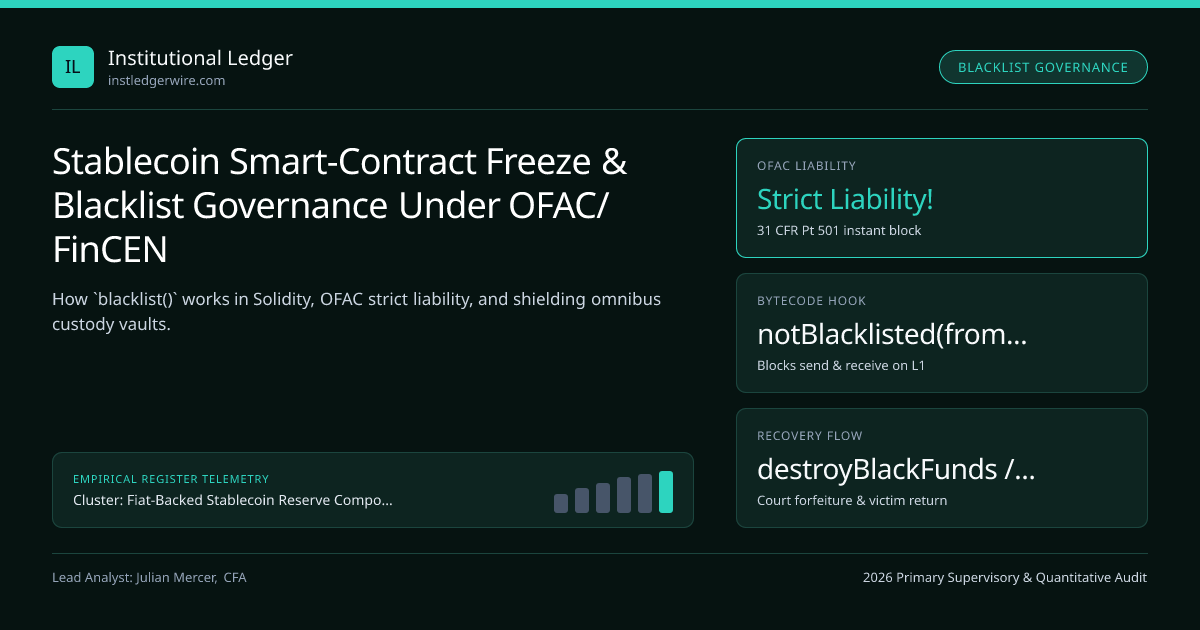
Unlike decentralized Layer-1 Bitcoin or Ether, every regulated fiat-backed stablecoin is an upgradeable smart contract equipped with an administrative blacklist switch. Because FinCEN, the US Treasury's Office of Foreign Assets Control (OFAC), and European sanctions authorities enforce strict liability against regulated issuers, institutional treasury architects must engineer wallet topologies that prevent tainted counterparties or dusting bots from ever touching core settlement vaults.
Inside Stablecoin Bytecode: Role-Separated BLACKLISTER Governance#
Inspect the verified Solidity proxy implementation of regulated USDC (FiatTokenV2_2) on Ethereum and you find a clean, auditable access-control modifier guarding transfer, transferFrom, mint, and burn:
notBlacklisted(msg.sender)andnotBlacklisted(to)(plusnotBlacklisted(from)on delegated transfers!).- Once
blacklist(0xTarget)is executed, that address can neither send NOR receive stablecoins, nor redeem them. - Crucially for smart-contract security (mirroring our analysis of forced-transfer and freeze governance in permissioned RWA and our fiat-backed stablecoin reserve cornerstone guide), Tier-1 issuers strictly isolate
BLACKLISTER_ROLEon dedicated compliance HSMs completely separate fromMASTER_MINTERandPAUSER_ROLE. Compromising a compliance officer's blacklister key can never mint a single token or steal a single dollar—and any erroneous freeze can be cleanly reversed viaunBlacklistupon court/OFAC clearance.
OFAC Strict Liability vs Law-Enforcement Probable-Cause Orders#
Compliance counsel distinguishes two very different legal pathways triggering on-chain freezes:
- Sanctions Designations (Automatic & Immediate): Under
31 CFR Part 501and OFAC's Sanctions Compliance Guidance for the Virtual Currency Industry, US persons face strict civil liability (even without intent!) if they process transactions for a Specially Designated National (SDN). Automated issuer compliance daemons ingest OFAC XML updates within 60 seconds, queuing immediate HSM blacklisting of explicitly listed SDN addresses. - Criminal Hacks & Civil Injunctions (Judicial Process): Unlike arbitrary unilateral freezes, onshore regulated issuers require a valid subpoena/seizure warrant, court Temporary Restraining Order (
TRO), or emergency statutory law-enforcement directive before freezing non-SDN disputed funds—and hold the corresponding T-Bill reserve dollars intact in segregated escrow until a final judicial forfeiture/restitution order directs burn-and-reissue to the rightful victim.
| Bytecode / Compliance Feature | Regulated ERC-20 Stablecoin (USDC) | Offshore Stablecoin (USDT) | Permissioned RWA (ERC-3643) |
|---|---|---|---|
| Pre-Transfer KYC Check | None on L1 (permissionless ERC-20) | None on L1 (permissionless) | 100% Mandatory isVerified(to) |
| Freeze Granularity | Binary whole-address blacklist(addr) | Binary whole-address addBlackList(addr) | Dollar-granular freezePartialTokens + full freeze |
| Confiscation / Reissue | Court-order burn + mint via legal governance | destroyBlackFunds(addr) + reissue | forcedTransfer to verified court trustee |
| Governing Enforcement | FinCEN, OFAC, NYDFS & EU ESMA | DoJ / OFAC cooperative + offshore court | SEC Transfer Agent + OFAC + Court orders |
The Ephemeral Quarantine Inbox Pattern: Immunizing $100M+ Vaults#
Never publish your primary $100M off-exchange collateral or treasury vault address as an open public deposit address! Why?
- If an external counterparty unknowingly forwards USDC 2 hops removed from a DPRK Lazarus bridge exploit (or if a griefing bot sends
0.01 USDCfrom a sanctioned contract) directly into your main vault, your internal BSA/AML team must file blocking/SAR reports and segregate tainted accounting! - Institutional custodians and OTC desks (Aquanow, Bitstamp) enforce the Ephemeral Intake Quarantine Pattern:
- Generate a fresh deterministic child address (
BIP-32 / CREATE2) for each inbound counterparty settlement. - Upon finalized L1 confirmation, automated Know-Your-Transaction (
KYT) engines (Chainalysis, TRM Labs, Elliptic) score multi-hop provenance in< 3 seconds. - Clean funds sweep automatically into the pristine Core Vault; flagged funds remain quarantined in the disposable child address without ever commingling!
- Variables & $150M OTC / Prime Treasury Stablecoin Intake Architecture Comparison:
- Vault_Balance = $150,000,000 institutional settlement pool
- PTaintedDeposit = 0.02/yr (probability an external counterparty or dusting bot sends SDN/hack-tainted USDC toward intake)
- 1. Direct Intake Into Single $150M Vault Address (
Uses_Quarantine = 0, triggers 21-day compliance hold / legal clearance on commingled funds @ 12% ROE): - Disrupted Liquidity = $150,000,000 stalled -> Expected Ops/Carry Cost + Reputation Hit = $1,035,616+!
- 2. Ephemeral Per-Counterparty Deposit Address + <3-Second Automated KYT Gate (
Uses_Quarantine = 1): - Only the tainted $25,000 incoming deposit sits frozen in QuarantineAddr#8841 for FinCEN SAR/OFAC blocking report; $150,000,000 Core Vault suffers $0.00 disruption!
DeFi Pool Risk: Why Institutional Pools Require Whitelisted Entry Gates#
Because ERC-20 blacklist freezes an entire contract address rather than one user's LP share, depositing $50M of institutional USDC into an unscreened, anonymous DeFi pool carries latent sanctions-contagion risk—explaining why regulated desks strongly favor KYC-gated institutional pools (ERC-3643 / Project Guardian Trust Anchors) where sanctioned wallets cannot enter the pool in the first place!
BSA/AML & Sanctions Governance Checklist for Treasury Ops#
Chief Compliance Officers active in our Stablecoin Reserve Attestation hub mandate automated KYT ephemeral deposit screening on all stablecoin intakes, screen counterparty wallets pre-flight before firing 24/7 variation-margin sweeps, and verify regulated VASP/CASP counterparties via our verification portal.
Frequently asked questions
Under what exact legal triggers do Circle (USDC) vs Tether (USDT) invoke on-chain wallet blacklisting?
Regulated onshore issuers like Circle (USDC) publish formal Law Enforcement Request Policies: they freeze addresses strictly upon (1) statutory OFAC / UN / EU / UK sanctions list designations, OR (2) valid binding court orders, warrants, or emergency law-enforcement freeze directives with documented probable cause—whereas offshore issuers also execute proactive hacks/terrorist freezes with DoJ/Secret Service/FBI coordination.
What happens to the underlying US Treasury bill reserve dollars when a hacker’s $10M stablecoin wallet is blacklisted on-chain?
The $10M of Treasury bills NEVER becomes free profit for the issuer! The frozen tokens remain a segregated reserve liability pending formal legal disposition: upon a final federal court forfeiture judgment or victim-restitution order, the issuer invokes burn/reissue (destroyBlackFunds or court-ordered burn + fresh mint) to deliver $10M to the US Marshals Service or hacked victim!
Can a malicious attacker "dust" our institutional custody vault with $1 from Tornado Cash to get our $50M USDC vault blacklisted?
Known as a "dusting attack," compliance teams at OFAC and Circle explicitly recognize unsolicited incoming dust sent to known regulated custodians and exchanges! However, to keep core vaults 100% pristine and avoid manual OFAC license paperwork, institutional custodians use ephemeral per-deposit screening addresses—sweeping into the main vault ONLY if KYT risk score passes clean!
What happens if an entire unpermissioned DeFi smart contract (like a Tornado Cash pool) gets added to OFAC’s SDN list?
Because standard ERC-20 blacklist(contractAddress) freezes the entire smart contract address as a single mapping(address => bool), every stablecoin locked inside that contract becomes immobile until an OFAC Specific License is obtained—proving why institutions use permissioned KYC-gated pools (ERC-3643 / Institutional DeFi) rather than anonymous mixers!
Publication record
- Published
- November 13, 2026
- Updated
- November 15, 2026
- Author
- Julian Mercer, CFA
- Review
- Review not recorded
- Automated fact check
- Passed in the stored pipeline record
- Source URLs
- 3 recorded
AI assistance recorded: anthropic/claude-opus-4.6. This field does not establish human review or source verification.
Academic & Institutional Attribution
Cite This Research & Embed Live Data Card
Standard academic & institutional research paper citation format.
Julian Mercer, CFA. (2026, November 15). Stablecoin Smart-Contract Freeze & Blacklist Governance Under OFAC/FinCEN. Institutional Ledger. https://instledgerwire.com/stories/stablecoin-freeze-blacklist-governance-law-enforcement-ordersRegulatory Directory Cross-Reference
Referenced Institutions & Regulatory Registries
Mentioned Regulated Institutions
Referenced Supervisory Authorities
Related Stablecoin Reserve Attestation Audit & Institutional Briefings
Explore Stablecoin Reserve Attestation Audit Hub (20) →Stablecoin Reserve Attestation Audit
Fiat-Backed Stablecoin Reserve Composition, Audits & T-Bill Custody GuideStablecoin Reserve Attestation Audit
FX Basis & Negative-Rate Risks in Non-USD (EUR, JPY, CHF) StablecoinsStablecoin Reserve Attestation Audit
Stablecoin Redemption Gate Fees, Minimum Burn Thresholds & Run DynamicsStablecoin Reserve Attestation Audit
Basel SCO60 Group 1b Stabilisation Test Failures on StablecoinsStablecoin Reserve Attestation Audit
Treasury-Bill Yield Compression & Stablecoin Issuer Reserve EconomicsStablecoin Reserve Attestation Audit
AICPA AT-C 205 Monthly Stablecoin Reserve Attestation Criteria DecodedStablecoin Reserve Attestation Audit
Overnight Reverse Repo & 93-Day T-Bill WAM Caps in StablecoinsStablecoin Reserve Attestation Audit
EU MiCA Title III (ART) vs Title IV (EMT) Stablecoin Safeguarding RulesInstitutional Crypto Prime Margin
Institutional MEV Protection: Private RPCs, Block Relays & Sandwich DefenseInstitutional Crypto Prime Margin
Tax-Lot Relief (HIFO, Specific ID) & FASB ASC 350-60 Prime Sub-Ledger SyncInstitutional Crypto Prime Margin
Multi-Custodian Prime Routing & Single-Point-of-Failure MitigationInstitutional Crypto Prime Margin
Stressed VaR & Concentration Liquidity Add-Ons for Altcoin Collateral
Institutional Ledger Data, Benchmarks & Contributor Records
CC BY 4.0 Open Data
Open Institutional Datasets (CSV / JSON) →
Download desk-compiled quantitative series & schemas.
2026 Reference Matrix
2026 Institutional Benchmarks & Thresholds →
Statutory capital, clearing, margin & rate conventions.
Editorial Records
Authors & Review Records →
View named contributors where those records are available.
Complete Index
Master Research & Dossier Archive →
Browse all published briefings by topic pillar & date.