
Stablecoin Reserve Attestation Audit
Custodial T-Bill Safekeeping: BNY Mellon & State Street Reserve Models
Behind every Tier-1 USD stablecoin and tokenized RWA fund sits the Fedwire Securities Book-Entry System accessed through G-SIB custody banks—isolating T-Bill CUSIPs via statutory NY UCC Article 8 accounts.
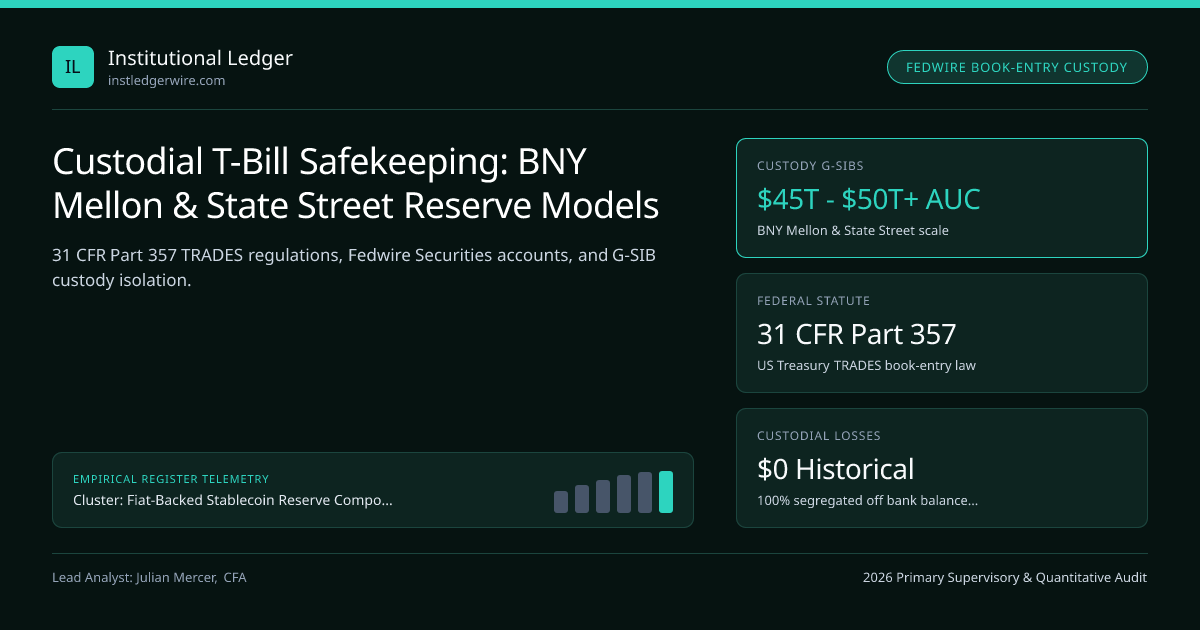
Saying a stablecoin is "backed by US Treasury bills" answers only half the due-diligence question—the half that destroyed institutional confidence in several smaller offshore tokens between 2023 and 2025 was the second question: "Through how many intermediary hands are those US Treasury bills actually custodied?" Understanding how BNY Mellon and State Street safeguard CUSIPs directly on the Federal Reserve's Fedwire Securities Book-Entry System (31 CFR Part 357) separates Tier-1 sovereign plumbing from fragile multi-hop sub-custody chains.
How Marketable US Treasury Debt Actually Lives: 31 CFR Part 357 (TRADES)#
Nobody stores $35 billion of US Treasury bills inside a basement vault or on a thumb drive. Every single marketable US Treasury bill, note, and bond exists as an electronic book entry inside the Federal Reserve Banks' Fedwire Securities Service, governed by US Department of the Treasury regulations at 31 CFR Part 357 (the Treasury/Reserve Automated Debt Entry System, TRADES).
Under 31 CFR § 357.11 and § 357.12:
- Only eligible depository institutions (like The Bank of New York Mellon, State Street Bank and Trust, JPMorgan Chase, and Citibank) hold direct Participant Securities Accounts on the Federal Reserve's root ledger.
- Federal Treasury law expressly adopts Revised UCC Article 8 property rules (UCC Article 8 financial-asset custody): on the Federal Reserve's books, BNY Mellon's Customer Securities Account is legally walled off from BNY Mellon's Proprietary Account, and on BNY Mellon's SOC 1-audited custody ledger, your stablecoin's Statutory Reserve Trust holds an inviolable, off-balance-sheet property entitlement!
The Multi-Hop Offshore Sub-Custody Trap (Lessons From Custody Disputes)#
Why have smaller non-US stablecoins repeatedly suffered terrifying redemption freezes or litigation scandals despite claiming "100% T-Bill backing"? Because they sat 3 to 5 hops away from Fedwire!
Trace a typical cut-rate offshore reserve chain:
- Offshore Stablecoin Issuer (BVI) hands $500M to an unlicensed or lightly supervised Trust Company / Introducer (Hong Kong / Nevada);
- That middleman routes cash through an offshore investment adviser or Cayman fund;
- Which opens a margin prime-brokerage account at a mid-tier broker;
- Which finally clears through a US custody bank!
If any single middleman in Hops 1, 2, or 3 suffers a regulatory cease-and-desist (like Prime Trust in 2023), diverts funds into illiquid trade-finance notes, or signs a prime-brokerage cross-lien, the stablecoin issuer cannot touch its T-Bills! By contrast, under our fiat-backed stablecoin reserve cornerstone guide, regulated USDC, BlackRock BUIDL, and NYDFS trust issuers custody 1-hop direct at BNY Mellon or State Street!
| Custody Dimension | Direct Custody G-SIB (BNY Mellon / State Street) | Offshore Prime-of-Prime Broker Account | Institutional Audit Takeaway |
|---|---|---|---|
| Distance from Fedwire Root | 1 Hop — Direct Federal Reserve Master Securities Participant | 3–4 Hops (Offshore Broker -> US Clearer -> Bank -> Fed) | Every extra hop adds counterparty insolvency stay risk! |
| Governing Federal Statute | 31 CFR Part 357 (TRADES) + NY UCC § 8-503 | Foreign contract law + upstream omnibus liens | Confirm direct US G-SIB safekeeping in AT-C 205 footnote! |
| Bank Balance-Sheet Status | 100% Off-Balance-Sheet (OCC Custody Handbook) | Often commingled in upstream margin omnibus | Zero exposure to custodian bank credit spreads on T-Bills! |
| Tri-Party Repo Liquidity | Native internal 08:30 AM ET cash/UST unwind (BUIDL / USDC) | Requires cross-bank wires & T+1 settlement | Enables $10B+ single-morning liquidity without friction |
Cash Deposits vs Custodied T-Bills Inside the Same G-SIB!#
Institutional credit officers always distinguish two completely separate legal relationships at BNY Mellon or State Street:
- $32B in Custodied T-Bills: Off-balance-sheet property under OCC Custody Services Handbook &
31 CFR Part 357. Zero credit exposure to the bank! - $2B in Uninvested Cash Deposits: On-balance-sheet deposit liability of the G-SIB (protected structurally by the G-SIB's 25%+ TLAC bail-in stack, yet still minimized to working transaction float via daily sweeps into Overnight Reverse Repo).
- Variables & Multi-Hop Custodial Chain Fragility Comparison ($10.0B US Treasury Bill Reserve Over 5-Year Cycle):
- 1. 4-Hop Offshore Sub-Custody Chain (Cayman Wrapper -> BVI Introducer -> Mid-Tier Clearing Broker -> Custody Bank; each non-G-SIB hop carries 1.8% 5-yr freeze/regulatory-hold/lien-dispute risk):
- 5-Year Uninterrupted Access Probability = (1 - 0.018)^3 * 0.9995 = 94.65% (5.35% probability of a devastating reserve freeze — e.g., TrueUSD / Prime Trust / First Digital style custody disputes!).
- 2. Direct 1-Hop Custody G-SIB + Statutory NYDFS / 1940 Act Section 17(f) Safekeeping:
- Zero sub-brokers, direct Fedwire Customer Book-Entry segregation -> Uninterrupted Legal Title Access > 99.99%!
Intrabank Synergy: Instant 08:30 AM ET Tri-Party Repo & Zero-Fee Minting#
Because BNY Mellon serves simultaneously as (a) the primary custodian of the US Tri-Party Repo market, (b) the Section 17(f) custodian for BlackRock's USDXX reserve fund and BUIDL, and (c) an institutional cash settlement bank, tens of billions of dollars shift seamlessly between T-Bills, dealer reverse repo, and institutional primary burns without slow interbank Fedwire hops!
Custodial Hop-Count Audit Checklist for Risk Committees#
Operational due-diligence teams active in our Stablecoin Reserve Attestation hub demand explicit named disclosure of the ultimate T-Bill custodian bank inside every AT-C 205 attestation (rejecting vague "held at US financial institutions" wording!), verify 1-hop G-SIB safekeeping, and confirm custodian standing via our verification portal.
Frequently asked questions
If BNY Mellon custodies $35 billion of US Treasury bills for a stablecoin reserve, does BNY Mellon face $35B of balance-sheet risk?
Zero! Unlike cash deposits (which sit ON a bank’s balance sheet as deposits), custodied US Treasury securities sit 100% OFF BNY Mellon’s balance sheet inside segregated Fedwire Securities customer book-entry accounts governed by 31 CFR Part 357 and NY UCC § 8-503! Even in a hypothetical bank receivership, custodied T-Bills return intact to the client trust.
What is the difference between a Custody G-SIB’s "Fedwire Omnibus Customer Account" and sub-account segregation?
At the Federal Reserve Bank of New York level, a Custody G-SIB maintains a Master Proprietary Fedwire Securities account (its own bonds) strictly separated from its Master Customer Omnibus Fedwire Securities account (all client bonds), while BNY Mellon’s audited SOC 1 Type II sub-ledger maps exact CUSIP entitlements to each named statutory Reserve Trust!
Why did holding US Treasuries via small offshore brokerage intermediaries cause delays or scares at smaller stablecoins?
When a small offshore stablecoin buys T-Bills through Tier-3 Broker -> Clearing Broker -> Sub-Custodian -> Fedwire Bank (a 4-hop chain!), each middleman adds margin-lien setoff boilerplate, reconciliation delays, and potential SIPC/brokerage insolvency stays! Direct Tier-1 G-SIB safekeeping collapses the chain to 1 regulated hop straight onto Fedwire.
How does BNY Mellon simultaneously power intraday Tri-Party Repo liquidity for custodied stablecoin reserves?
BNY Mellon clears the vast majority of the entire ~$2.5+ trillion US Tri-Party Repo market! Keeping both a stablecoin’s T-Bill CUSIPs and its Overnight Reverse Repo cash inside BNY Mellon’s tri-party platform allows $15B+ of overnight repo collateral allocations and morning cash unwinds to settle seamlessly on BNY’s internal books at 8:30 AM ET!
Publication record
- Published
- November 13, 2026
- Updated
- November 14, 2026
- Author
- Julian Mercer, CFA
- Review
- Review not recorded
- Automated fact check
- Passed in the stored pipeline record
- Source URLs
- 3 recorded
AI assistance recorded: anthropic/claude-opus-4.6. This field does not establish human review or source verification.
Academic & Institutional Attribution
Cite This Research & Embed Live Data Card
Standard academic & institutional research paper citation format.
Julian Mercer, CFA. (2026, November 14). Custodial T-Bill Safekeeping: BNY Mellon & State Street Reserve Models. Institutional Ledger. https://instledgerwire.com/stories/custodial-omnibus-tbill-safekeeping-bny-state-street-modelsRegulatory Directory Cross-Reference
Referenced Institutions & Regulatory Registries
Top Regulated Institutions in This Coverage Slice
Referenced Supervisory Authorities
Related Stablecoin Reserve Attestation Audit & Institutional Briefings
Explore Stablecoin Reserve Attestation Audit Hub (20) →Stablecoin Reserve Attestation Audit
Fiat-Backed Stablecoin Reserve Composition, Audits & T-Bill Custody GuideStablecoin Reserve Attestation Audit
Stablecoin Smart-Contract Freeze & Blacklist Governance Under OFAC/FinCENStablecoin Reserve Attestation Audit
FX Basis & Negative-Rate Risks in Non-USD (EUR, JPY, CHF) StablecoinsStablecoin Reserve Attestation Audit
Stablecoin Redemption Gate Fees, Minimum Burn Thresholds & Run DynamicsStablecoin Reserve Attestation Audit
Basel SCO60 Group 1b Stabilisation Test Failures on StablecoinsStablecoin Reserve Attestation Audit
Treasury-Bill Yield Compression & Stablecoin Issuer Reserve EconomicsStablecoin Reserve Attestation Audit
AICPA AT-C 205 Monthly Stablecoin Reserve Attestation Criteria DecodedStablecoin Reserve Attestation Audit
Overnight Reverse Repo & 93-Day T-Bill WAM Caps in StablecoinsInstitutional Crypto Prime Margin
Perpetual Funding-Rate Volatility, Impact Notional & Auto-Liquidation EnginesInstitutional Crypto Prime Margin
Institutional MEV Protection: Private RPCs, Block Relays & Sandwich DefenseInstitutional Crypto Prime Margin
Tax-Lot Relief (HIFO, Specific ID) & FASB ASC 350-60 Prime Sub-Ledger SyncInstitutional Crypto Prime Margin
Multi-Custodian Prime Routing & Single-Point-of-Failure Mitigation
Institutional Ledger Data, Benchmarks & Contributor Records
CC BY 4.0 Open Data
Open Institutional Datasets (CSV / JSON) →
Download desk-compiled quantitative series & schemas.
2026 Reference Matrix
2026 Institutional Benchmarks & Thresholds →
Statutory capital, clearing, margin & rate conventions.
Editorial Records
Authors & Review Records →
View named contributors where those records are available.
Complete Index
Master Research & Dossier Archive →
Browse all published briefings by topic pillar & date.