
Qualified Custody Mpc Hsm Controls
Omnibus vs Segregated On-Chain Wallets: Insolvency & Bailment Law
Individually segregated on-chain digital asset custody addresses provide deterministic blockchain title proof in insolvency, whereas omnibus wallets rely entirely on sub-ledger integrity.
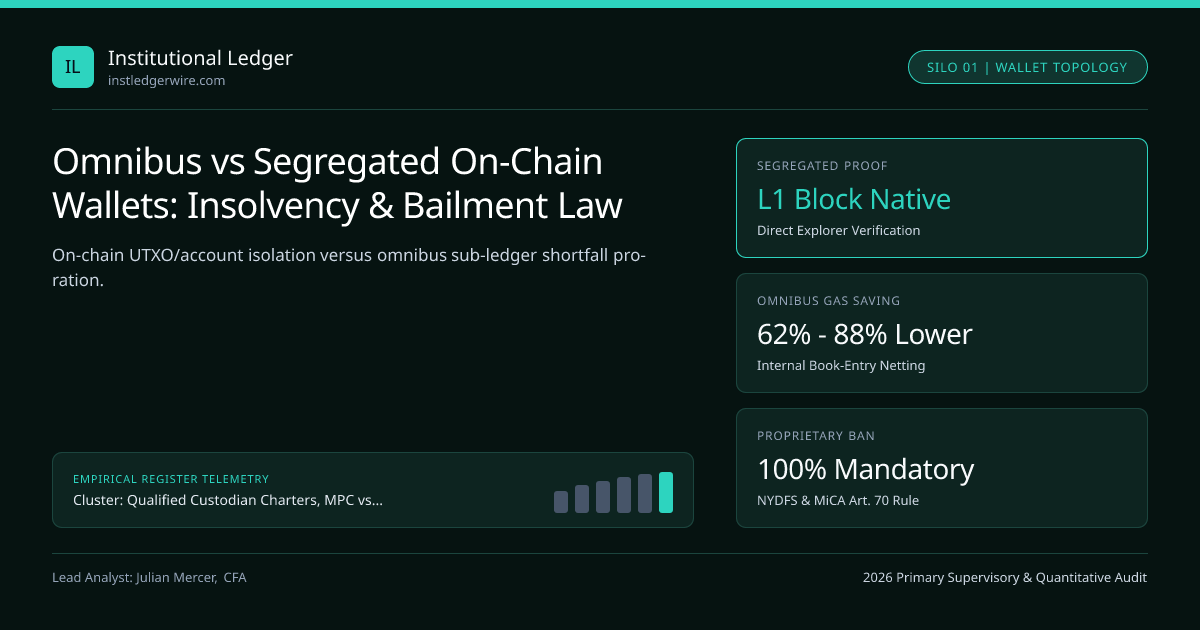
When a digital asset custodian enters receivership, bankruptcy judges examine two facts before releasing a single token: what the custody contract states regarding title, and whether on-chain wallet state corroborates that claim without ambiguity. While both NYSDFS January 2023 Custodial Guidance and EU MiCA Article 70 permit client-only omnibus pools alongside individually segregated addresses, dedicated on-chain wallet segregation eliminates fellow-customer shortfall pro-ration and delivers instantaneous Layer-1 audit proof.
Proprietary Firewall Mandates Under NYDFS Guidance & MiCA Article 70#
Across every Tier-1 jurisdiction covered in our qualified digital asset custody cornerstone guide, commingling client assets with the custodian's own corporate balances on the blockchain is strictly outlawed. NYDFS guidance directs custodians to maintain customer virtual currency in either separate on-chain wallets per customer or one or more omnibus on-chain wallets holding exclusively customer virtual currency, reconciled daily against internal books. Similarly, Article 70(1) of the European Union's Markets in Crypto-Assets Regulation (supervised by ESMA and national authorities like BaFin) requires Crypto-Asset Service Providers (CASPs) to ensure that client crypto-assets are operationally and legally separated on distributed ledgers from the CASP's own estate.
Even small operational leaks—such as leaving custodian-owned Ethereum inside a client ERC-20 address to pay future gas fees without clear accounting demarcation—can muddy property boundaries unless managed through automated gas-station smart relays.
Individually Segregated L1 Wallets vs Omnibus Fungible Bulks#
In an individually segregated wallet architecture, each institutional legal entity (for example, Fund_Series_A_Trust) receives dedicated BIP-32 extended public key (xpub) branches or standalone smart-contract/MPC addresses. Neither the custodian nor any other client deposits tokens into those addresses. Consequently, the fund's administrator, internal controller reporting under SEC SAB 122, and external CPA firm query a Bitcoin or Ethereum archival node directly to verify 100% reserve existence down to the exact block timestamp.
In an omnibus architecture, deposits from hundreds of clients sweep into shared warm and cold UTXO pools. Omnibus pooling cuts Layer-1 consolidation gas fees by 62% to 88% and allows clients of the same custodian or integrated venue (such as Bitstamp or Aquanow) to settle OTC trades via instantaneous internal database entries. However, legal ownership of specific UTXOs disappears; clients instead hold co-ownership shares in a fungible bulk—often structured in the US via a UCC Article 8 "financial asset" election naming the trust company as securities intermediary.
| Segregation Model | On-Chain Address Mapping | Insolvency Recovery Standard | Audit Verification Method | Regulatory Status |
|---|---|---|---|---|
| Dedicated Vault Segregation | Unique BIP-32 root / L1 addresses per legal entity | Specific property return (in specie exact UTXO/account) | Direct public node query (Spot ETF Benchmark) | Preferred across NYSDFS, FINMA, OCC |
| Client-Only Omnibus + Sub-Ledger | Shared client cold/warm pool; house strictly separate | Pro-rata share of fungible bulk (UCC Sec. 8-503 / NY BL) | SOC 1 Type II + ZK Proof-of-Reserves | Permitted under ESMA MiCA Art. 70 & NYDFS |
| Virtual Sub-Account on Exchange | Exchange omnibus hot/cold sweep (Bitstamp, Bitso) | Depends on trust vs unsecured user agreement | Exchange PoR + auditor confirmation | Permitted for licensed VASPs; ineligible for cold ETF core |
| Unsegregated House Commingling | Client deposits swept into corporate treasury wallets | General unsecured creditor in Chapter 11 estate | Unverifiable on-chain | Illegal under NYDFS, MiCA, MAS, SFC |
Shortfall Contagion & Swiss FINMA Article 242a Contrasts#
The critical divergence between segregated and omnibus models surfaces during a partial operational loss. Suppose an operational bug or sub-custodian freeze destroys 12% of an omnibus ETH pool. Under UCC Section 8-503(b) and common-law commingled trust rules, every client in that omnibus pool shares the 12% deficit pro-rata—even clients who never authorized the affected workflow. Conversely, a client sitting in an isolated segregated vault funded via air-gapped FIPS 140-3 HSMs retains 100% of its uncompromised UTXOs.
Jurisdictional rules reinforce this split. As detailed in our analysis of FINMA DLT custody segregation and Swiss bankruptcy privilege, Article 242a of the Swiss Debt Enforcement and Bankruptcy Act grants automatic bankruptcy separation (Aussonderung) only if crypto-based assets are either held individually on-chain per client or held in a collective pool where each client's exact share is continuously determinable from immutable records.
- Variables & $400M Corporate Digital Asset Treasury Analysis:
- AUM = $400,000,000 (allocated 80% BTC, 15% ETH, 5% USDC)
- pcustodiandistress = 0.0025 (25 bps annual probability of sub-custodian operational freeze or omnibus ledger discrepancy)
- Recovery_Segregated = 0.995 (direct L1 UTXO title return via statutory receiver; 0.5% legal administrative fee)
- Recovery_Omnibus = 0.860 (historical pro-rata fungible bulk haircut + 18-month receivership time-value discount)
- DeltaFeebps = 0.0004 (4.0 bps custody fee surcharge for dedicated segregated vault addresses = $160,000/yr)
- Nsweeps * GasCost = 600 annual ERC-20/UTXO consolidation & gas-station sweeps * $14.50 = $8,700/yr
- Worked Expected Economic Value:
- 1. Expected Insolvency Haircut Avoided = $400,000,000 * 0.0025 * (0.995 - 0.860) = $1,000,000 * 0.135 = $135,000/yr
- 2. Plus External Audit Savings (Direct Node Verification vs Omnibus Confirmation) = $52,000/yr CPA fee reduction
- 3. Total Gross Benefit ($187,000/yr) - Incremental Custody & Gas Cost ($168,700/yr) = +$18,300/yr net positive EV + zero fellow-client contagion
Hybrid Treasury Allocation: Segregated Cold Core + Omnibus Settlement#
Institutional allocators rarely make an all-or-nothing choice. Best-practice treasury design holds 90% to 95% of reserves inside individually segregated cold addresses matching the Spot Crypto ETFs 2026 Benchmark Standard, while maintaining a 5% to 10% working-capital sleeve inside an omnibus warm account audited under SOC 1 Type II sub-ledger controls for rapid prime clearing.
Contractual Bailment Clauses to Verify Before Onboarding#
General counsels reviewing custody contracts inside our Qualified Custody & HSM Controls hub strike any clause granting a "right of use," loan conversion, or cross-client lien over segregated wallets, confirm deterministic address-mapping schedules in the service appendix, and verify charter standing through our regulatory verification hub.
Frequently asked questions
Does holding client funds in an omnibus wallet automatically make them custodian property in bankruptcy?
No, provided two conditions hold: custodian proprietary funds are strictly excluded from the omnibus address, and the custody agreement establishes an express statutory trust, bailment, or UCC Article 8 financial-asset entitlement backed by reconciled sub-ledgers, as codified by NYDFS and MiCA Article 70.
What happens if an omnibus client wallet suffers a 15% partial shortfall prior to custodian insolvency?
Under uniform commercial and trust insolvency principles (including UCC Section 8-503), entitlement holders in a commingled fungible bulk share property interests pro-rata. Every client in that omnibus pool absorbs the 15% haircut equally and files an unsecured claim for the deficit.
Why do spot Bitcoin ETFs and sovereign mandates insist on individually segregated on-chain addresses?
Individually segregated addresses allow fund administrators, ETF authorized participants, and Big Four auditors to verify exact UTXO balances directly against the Bitcoin or Ethereum state root 24/7 without relying on custodian database exports or risking fellow-client omnibus contagion.
When is omnibus wallet pooling operationally superior for institutional traders?
High-frequency market makers executing intraday settlements across prime venues use client-only omnibus warm pools because internal ledger transfers settle in milliseconds with zero Layer-1 gas fees, avoiding ERC-20 sweep bottlenecks during Ethereum base-fee spikes.
Publication record
- Published
- November 14, 2026
- Updated
- November 15, 2026
- Author
- Julian Mercer, CFA
- Review
- Review not recorded
- Automated fact check
- Passed in the stored pipeline record
- Source URLs
- 3 recorded
AI assistance recorded: anthropic/claude-opus-4.6. This field does not establish human review or source verification.
Academic & Institutional Attribution
Cite This Research & Embed Live Data Card
Standard academic & institutional research paper citation format.
Julian Mercer, CFA. (2026, November 15). Omnibus vs Segregated On-Chain Wallets: Insolvency & Bailment Law. Institutional Ledger. https://instledgerwire.com/stories/omnibus-vs-segregated-on-chain-wallet-insolvency-treatmentRegulatory Directory Cross-Reference
Referenced Institutions & Regulatory Registries
Mentioned Regulated Institutions
Referenced Supervisory Authorities
Related Qualified Custody Mpc Hsm Controls & Institutional Briefings
Explore Qualified Custody Mpc Hsm Controls Hub (20) →Qualified Custody Mpc Hsm Controls
Qualified Digital Asset Custody, MPC Signing & FIPS 140-3 HSM Controls: 2026 GuideQualified Custody Mpc Hsm Controls
BaFin Krypto-Verwahrgeschaeft vs EU MiCA Article 70 CASP Custody RulesQualified Custody Mpc Hsm Controls
Spot Bitcoin & Ether ETF In-Kind Creation Custody SLA WorkflowsQualified Custody Mpc Hsm Controls
Quorum Policy Engines & Biometric Hardware Co-Signing ControlsQualified Custody Mpc Hsm Controls
Disaster Recovery, Shamir Key Sharding & Geographic Custody QuorumsQualified Custody Mpc Hsm Controls
FINMA DLT Custody Segregation & Swiss Art. 242a Bankruptcy PrivilegeQualified Custody Mpc Hsm Controls
MAS Payment Services Act 90% Cold Wallet Mandate & Statutory TrustQualified Custody Mpc Hsm Controls
Hong Kong SFC Virtual Asset Custody: 98% Cold Seed Storage & InsuranceTokenized Treasuries Rwa Settlement
BIS Project Agora: Tokenized Commercial Bank Deposits & Wholesale CBDCTokenized Treasuries Rwa Settlement
Eurosystem DLT Trials: Bundesbank Trigger, Pontes & Appia Central Bank DvPTokenized Treasuries Rwa Settlement
MAS Project Guardian & Global Layer One (GL1): Cross-Border RWA RepoTokenized Treasuries Rwa Settlement
Project mBridge Multi-CBDC PvP Corridor: Sovereign Settlement & Nostro Relief
Institutional Ledger Data, Benchmarks & Contributor Records
CC BY 4.0 Open Data
Open Institutional Datasets (CSV / JSON) →
Download desk-compiled quantitative series & schemas.
2026 Reference Matrix
2026 Institutional Benchmarks & Thresholds →
Statutory capital, clearing, margin & rate conventions.
Editorial Records
Authors & Review Records →
View named contributors where those records are available.
Complete Index
Master Research & Dossier Archive →
Browse all published briefings by topic pillar & date.