
Qualified Custody Mpc Hsm Controls
Threshold ECDSA & EdDSA MPC Key-Share Refresh Ceremonies in Custody
CGGMP21 threshold ECDSA and FROST EdDSA MPC protocols eliminate single-point private key assembly while rotating cryptographic shares every 15 to 60 minutes across isolated enclaves.
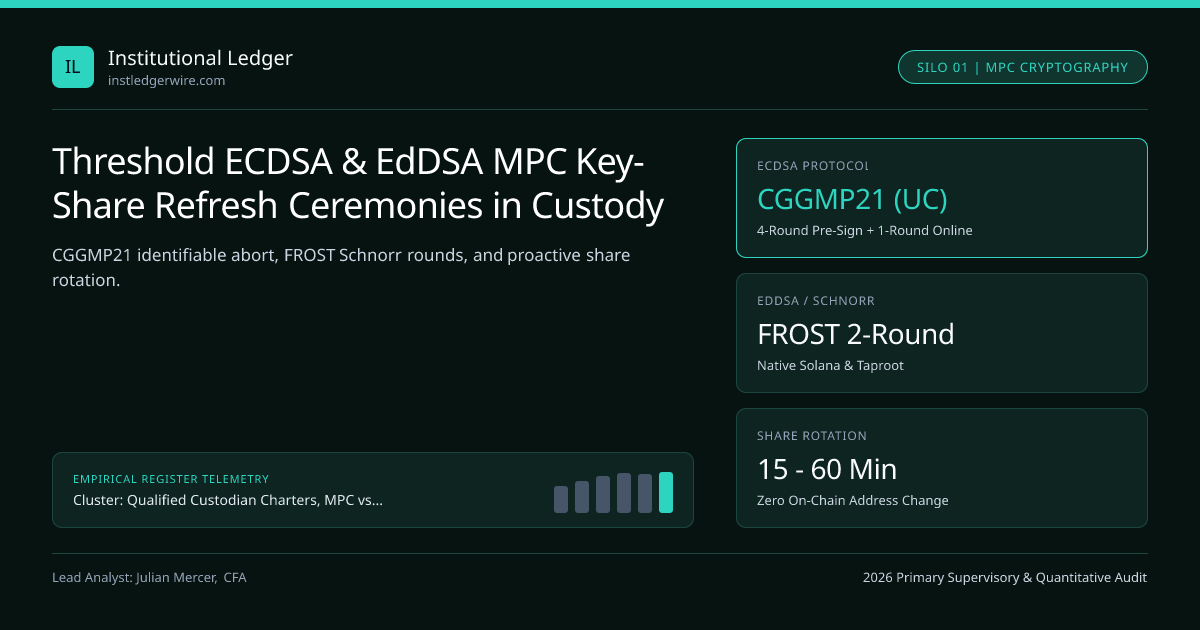
Modern institutional warm vaults process sub-second digital asset settlement across Bitcoin, Ethereum, and Solana without ever materializing a complete private key in volatile memory by pairing CGGMP21 threshold ECDSA with 2-round FROST EdDSA and 30-minute proactive share refreshes. Under NIST IR 8214C threshold cryptography benchmarks, shrinking the key-share refresh epoch from static annual keys down to 30-minute polynomial rotations compresses simultaneous 3-of-5 shard compromise risk by eight orders of magnitude while preserving identical on-chain deposit addresses.
Distributed Key Generation and Multiplicative-to-Additive Nonce Security#
In traditional single-key custody, a hardware or software generator samples a 256-bit secret scalar $x$ and splits or encrypts it—creating a fleeting genesis vulnerability. Threshold Multi-Party Computation eliminates the trusted dealer entirely via Verifiable Secret Sharing (Feldman or Pedersen VSS): each of $n$ isolated nodes generates its own secret entropy fragment and exchanges zero-knowledge commitments so every participant holds an additive or Shamir evaluation share $x_i$ of a master public key $Q = xG$ that no machine has ever seen. Within our qualified digital asset custody cornerstone architecture, MPC serves as the primary signing layer for intraday ETF liquidity and prime brokerage sweeps.
Executing ECDSA over secp256k1 per NIST FIPS 186-5 requires computing $s = k^{-1}(H(m) + rx) \bmod q$, where both the ephemeral nonce $k$ and private scalar $x$ are secret-shared. Computing the product $k^{-1}x$ without revealing either operand relies on Multiplicative-to-Additive (MtA) sub-protocols built on Paillier additively homomorphic encryption or Oblivious Transfer (OT). Any flaw in auxiliary Paillier modulus proofs can leak bits of $x_i$—precisely the vector exposed in 2023 BitForge disclosures against unpatched GG18 libraries.
CGGMP21 Identifiable Abort vs FROST Two-Round Schnorr Signing#
Institutional custody engineering teams supervised by NYSDFS and MAS now mandate CGGMP21 (Canetti, Gennaro, Goldfeder, Makriyannis, Peled) for secp256k1 workloads. CGGMP21 achieves Universal Composability (UC) security, splits heavy MtA cryptography into an asynchronous 3-round offline pre-signing phase, and executes the online transaction signature in a single non-interactive broadcast taking 85 to 220 milliseconds. Crucially, if one enclave suffers memory corruption or adversarial tampering, CGGMP21's zero-knowledge proofs produce an identifiable abort—cryptographically pinpointing the exact misbehaving shard so automated orchestration can quarantine that node and route around it using the remaining quorum.
For non-EVM networks using Ed25519 or Bitcoin Taproot (BIP-340), linear Schnorr algebra avoids Paillier encryption altogether. Custodians implement FROST (Flexible Round-Optimized Schnorr Threshold Signatures), generating standard 64-byte EdDSA signatures in two lightweight rounds. Because threshold signatures produce native single-key signatures on-chain, gas fees match a standard EOA transfer and external observers cannot scrape multisig signer topologies—protecting institutional privacy across venues like Aquanow and Backpack Exchange.
| Signing Scheme | Elliptic Curve Scope | Online Rounds | Identifiable Abort | On-Chain Footprint | Typical Institutional Deployment |
|---|---|---|---|---|---|
| CGGMP21 Threshold ECDSA | secp256k1 (BTC, ETH, EVM) | 1 round (with 3-round pre-sign) | Yes — cryptographic blame proof | Single 65-byte ECDSA sig | Warm prime custody & Aquanow settlement |
| CMP20 Threshold ECDSA | secp256k1 | 1 round (with pre-sign) | Partial | Single 65-byte ECDSA sig | Multi-cloud custodian warm vaults |
| FROST Threshold Schnorr | Ed25519 / secp256k1 Taproot | 2 rounds (or 1 with nonce cache) | Yes — via Schnorr share check | Single 64-byte Schnorr sig | Solana, Sui, BTC Taproot (Bitstamp flows) |
| Gennaro-Goldfeder GG18 | secp256k1 | 8-9 interactive rounds | No — requires restart triage | Single 65-byte ECDSA sig | Deprecated unless patched for BitForge ZK |
| Smart-Contract Multisig | EVM Chains Only | Asynchronous on-chain tx | Public on-chain signer log | 3x-5x calldata & storage gas | DAO treasuries; non-chain-agnostic |
Proactive Secret Sharing & Confidential Computing Enclave Attestation#
Threshold cryptography only defeats an attacker who fails to compromise $t$ shares before key rotation. Under proactive secret sharing (Herzberg et al.), every 15 to 60 minutes all signing nodes jointly sample a fresh degree-$(t-1)$ polynomial $\delta(z)$ constrained such that $\delta(0) = 0$, adding $\delta(i)$ to share $x_i$. An attacker who exfiltrated Share 1 at 09:10 UTC and Share 2 at 09:25 UTC finds both shards mathematically incompatible with Share 3 after the 09:30 UTC refresh—all without sweeping funds or altering client deposit whitelists.
To harden runtime memory against cloud hypervisor insiders, production MPC nodes execute inside hardware-rooted Trusted Execution Environments (AWS Nitro Enclaves, Intel SGX/TDX, or air-gapped FIPS 140-3 Level 3 HSMs acting as root key-wrapping modules). Before participating in a refresh or signing round, each enclave verifies peer Platform Configuration Registers (PCRs) signed by silicon-manufacturer keys, ensuring only reproducibly built, auditor-hashed binaries touch share material.
- where pwindow = sum{j=t}^{n} C(n, j) * (lambdanode * Trefresh)^j * (1 - lambdanode * Trefresh)^(n - j)
- Variables & Institutional Calibration:
- n = 5 independent signing enclaves (AWS Nitro, Azure Confidential, GCP SEV, Client On-Prem HSM, Escrow Vault)
- t = 3 threshold shares required within a single refresh epoch to reconstruct scalar x
- lambda_node = 0.04 annualized per-enclave zero-day / insider compromise hazard rate (4.566e-6 per hour)
- T_refresh = 0.5 hours (30-minute proactive polynomial share rotation) vs 8,760 hours (static unrefreshed shares)
- Worked Annual Security Gain Calculation:
- 1. Static Unrefreshed 3-of-5 (T = 8,760h):
- psinglenode = 0.04; pbreach1yr = C(5,3)(0.04)^3(0.96)^2 + C(5,4)(0.04)^4(0.96) + (0.04)^5
- pbreachstatic = 10 * 0.000064 * 0.9216 + 5 * 0.00000256 * 0.96 = 0.000602 (6.02 bps annual key loss risk!)
- 2. Proactive 30-Minute Refresh 3-of-5 (Trefresh = 0.5h, Nwindows = 17,520/yr):
- lambda * T_refresh = 2.283e-6 per window
- p_window ≈ 10 * (2.283e-6)^3 = 1.190e-16 per 30-min epoch
- pbreachproactive_1yr ≈ 17,520 * 1.190e-16 = 2.085e-12 (288,000,000x reduction in simultaneous shard theft risk)
Policy Engine Binding, SOC 2 Type II Testing & Recovery Fallbacks#
MPC shards must never sign raw hexadecimal digests blindly. Custodians interpose quorum policy engines and biometric hardware co-signing controls alongside EIP-712 typed-data smart contract allowlists inside the attested enclave boundary so compromised middleware cannot trick shards into authorizing unauthorized sweeps. During SOC 1 and SOC 2 Type II digital asset custody audits, external cryptographers inspect DKG ceremony transcripts, RNG entropy health checks, and offline Shamir disaster-recovery sharding packages aligned with the SPOT-CRYPTO-ETFS 2026 Standard and BCBS SCO60 2026 Benchmark.
Operational Audit Criteria for Institutional Allocators#
Before funding an MPC custody workspace inside our Qualified Custody & HSM Controls hub, risk officers require independent Trail of Bits, NCC Group, or Kudelski cryptographic audit reports covering the exact CGGMP21 and FROST commit hashes in production, verify client-held co-signing or recovery shares so custodian cloud outages cannot freeze redemptions, and validate counterparty credentials via our institution verification registry.
Frequently asked questions
Why is threshold ECDSA mathematically harder to implement securely than threshold EdDSA/Schnorr?
Schnorr and EdDSA signatures are linear in both the secret key and the per-message nonce, allowing clean 2-round aggregation under FROST. ECDSA computes the modular inverse of the nonce k^-1 multiplied by the secret key x, requiring Paillier homomorphic encryption or oblivious transfer plus zero-knowledge range proofs.
What vulnerability did the CGGMP21 specification patch compared to earlier GG18 implementations?
Early GG18 deployments that omitted auxiliary Paillier modulus zero-knowledge proofs allowed a malicious co-signer to craft malformed moduli (such as BitForge-class attacks) and extract partner key shares across 16 to 256 signing queries. CGGMP21 mandates strict ZK parameter proofs and identifiable abort.
Does proactive MPC key-share refresh change the public deposit address or incur blockchain fees?
No. Proactive refresh adds a freshly sampled polynomial f_delta(z) where f_delta(0) = 0 to each participant share. Because the constant term remains unchanged, the public key Q = x*G and all on-chain deposit addresses stay identical with zero blockchain transactions.
How do institutional custodians prevent cloud hypervisor operators from reading MPC shares in RAM?
Custodians bind each MPC signing node inside Confidential Computing Trusted Execution Environments—such as AWS Nitro Enclaves, Intel TDX/SGX, or dedicated FIPS 140-3 HSM co-processors—using cryptographic PCR attestation measurements before releasing encrypted share state.
Publication record
- Published
- November 14, 2026
- Updated
- November 14, 2026
- Author
- Julian Mercer, CFA
- Review
- Review not recorded
- Automated fact check
- Passed in the stored pipeline record
- Source URLs
- 3 recorded
AI assistance recorded: anthropic/claude-opus-4.6. This field does not establish human review or source verification.
Academic & Institutional Attribution
Cite This Research & Embed Live Data Card
Standard academic & institutional research paper citation format.
Julian Mercer, CFA. (2026, November 14). Threshold ECDSA & EdDSA MPC Key-Share Refresh Ceremonies in Custody. Institutional Ledger. https://instledgerwire.com/stories/threshold-ecdsa-eddsa-mpc-key-share-refresh-ceremoniesRegulatory Directory Cross-Reference
Referenced Institutions & Regulatory Registries
Mentioned Regulated Institutions
Related Qualified Custody Mpc Hsm Controls & Institutional Briefings
Explore Qualified Custody Mpc Hsm Controls Hub (20) →Qualified Custody Mpc Hsm Controls
Qualified Digital Asset Custody, MPC Signing & FIPS 140-3 HSM Controls: 2026 GuideQualified Custody Mpc Hsm Controls
Air-Gapped FIPS 140-3 Level 3 & Level 4 HSM Cold Signing Vaults ExplainedQualified Custody Mpc Hsm Controls
SOC 1 Type II vs SOC 2 Type II Audits in Institutional Crypto CustodyQualified Custody Mpc Hsm Controls
Basel III SCO60 Group 1 vs Group 2 Crypto Bank Capital Weights ExplainedQualified Custody Mpc Hsm Controls
SEC SAB 122 & FASB ASC 450-20 Custody Liability Accounting for BanksQualified Custody Mpc Hsm Controls
Specie & Crime Insurance Exclusions in Digital Asset Cold VaultsQualified Custody Mpc Hsm Controls
Omnibus vs Segregated On-Chain Wallets: Insolvency & Bailment LawQualified Custody Mpc Hsm Controls
BaFin Krypto-Verwahrgeschaeft vs EU MiCA Article 70 CASP Custody RulesTokenized Treasuries Rwa Settlement
Atomic T+0 DvP Intraday Repo vs DTCC & Fedwire Cutoff WindowsTokenized Treasuries Rwa Settlement
BlackRock BUIDL (Reg D 3c7) vs Franklin BENJI (1940 Act MMF) ComparedTokenized Treasuries Rwa Settlement
Tokenized MMF Collateral Haircuts & CFTC GMAC Derivatives Margin RulesTokenized Treasuries Rwa Settlement
Chainlink & DTCC Smart NAV Oracle Attestation Latency Controls
Institutional Ledger Data, Benchmarks & Contributor Records
CC BY 4.0 Open Data
Open Institutional Datasets (CSV / JSON) →
Download desk-compiled quantitative series & schemas.
2026 Reference Matrix
2026 Institutional Benchmarks & Thresholds →
Statutory capital, clearing, margin & rate conventions.
Editorial Records
Authors & Review Records →
View named contributors where those records are available.
Complete Index
Master Research & Dossier Archive →
Browse all published briefings by topic pillar & date.