
Qualified Custody Mpc Hsm Controls
Quorum Policy Engines & Biometric Hardware Co-Signing Controls
Institutional custody policy engines execute inside hardware-attested enclaves, binding FIDO2/HSM biometric approver quorums, hourly velocity caps, and deterministic whitelist hashes.
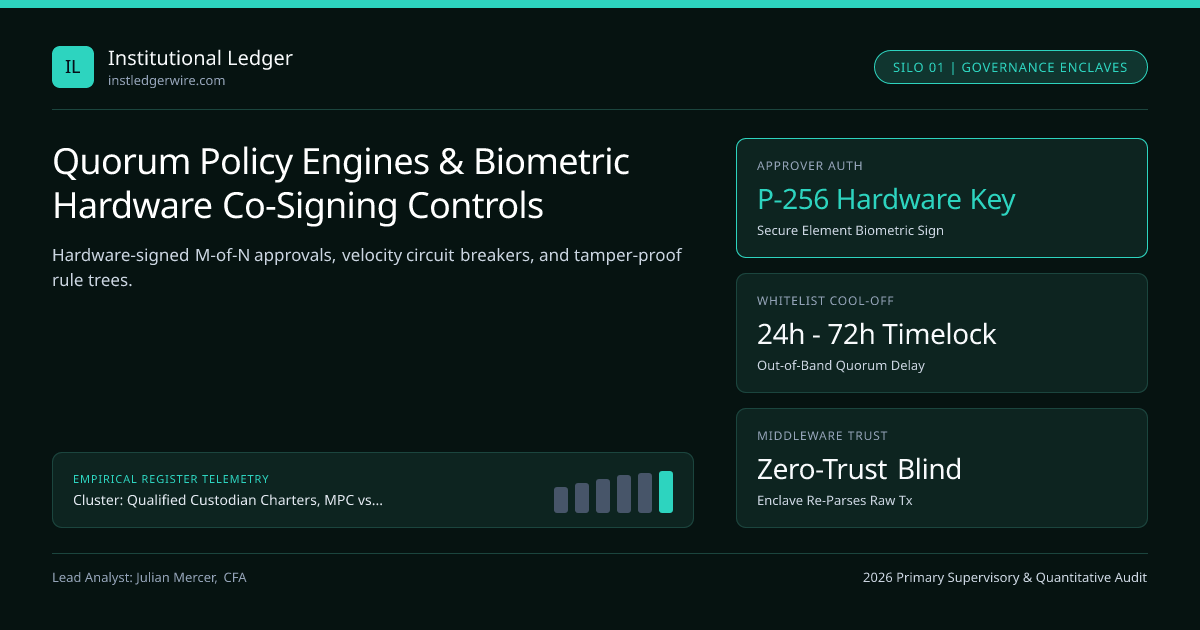
Post-mortem forensics across institutional digital asset breaches between 2023 and 2026 reveal a sobering pattern: attackers almost never crack secp256k1 elliptic-curve math or breach Faraday cages—instead, they hijack web interfaces and orchestration middleware sitting above the cryptographic module. Hardening institutional safekeeping requires moving the quorum policy engine directly inside hardware-attested enclaves and binding every human approval to non-exportable biometric Secure Element keys.
Why Middleware-Resident Policy Engines Fail Under Supply-Chain Attack#
In first-generation enterprise wallets, the policy engine lived inside a standard cloud microservice: a trader clicked "Approve" in a React dashboard, the backend updated a database row, and the orchestrator instructed the HSM or MPC cluster to sign a 32-byte SHA-256 or Keccak-256 digest. If an attacker poisoned a frontend npm dependency or compromised Kubernetes credentials, the orchestrator simply fed a malicious digest to the signing cluster, which dutifully signed away millions.
Under the zero-trust standard detailed in our qualified digital asset custody cornerstone guide, neither threshold MPC enclaves nor FIPS 140-3 Level 3 HSMs trust orchestration servers. Instead, the complete governance rule tree—whitelisted addresses, notional tiers, quorum public keys, and velocity caps—is compiled into an immutable manifest cryptographically signed by the client's Root Governance Quorum and stored inside enclave-sealed memory.
Biometric Secure Elements & Independent Trusted-Display Parsing#
When a treasury analyst initiates a $5 million settlement transfer to Aquanow or Bitstamp, the enclave reconstructs the unsigned raw Bitcoin PSBT or Ethereum RLP transaction from scratch, verifies destination scripts, and pushes the canonical payload to designated quorum officers. Each officer reviews the decoded recipient entity name, chain ID, token contract, and exact decimal amount on an independent trusted display—either a dedicated hardware signing pad or a hardened mobile app backed by Apple Secure Enclave / Android StrongBox hardware attestation.
Unlocking via FaceID/biometric triggers a hardware-bound NIST P-256 signature over the exact transaction bytes plus a monotonic anti-replay counter. Only when the MPC/HSM enclave independently validates M-of-N officer P-256 signatures against its sealed root policy will the secp256k1 or Ed25519 signing shards execute.
| Policy Control Layer | Vulnerable Legacy Implementation | Institutional Enclave Implementation | Mitigated Attack Vector | Audit Verification Reference |
|---|---|---|---|---|
| Transaction Approval Auth | Web session JWT + TOTP 6-digit code | Hardware Secure Element / FIDO2 P-256 signature over raw tx hash | Session hijacking, SIM swap, reverse-proxy phishing | SOC 2 Type II IAM & TSC controls |
| Policy Rule Evaluation | PostgreSQL table queried by Node.js backend | Signed JSON/Protobuf manifest verified inside SGX/Nitro/HSM | Database tampering by rogue cloud DBA or container rootkit | BCBS SCO60 ICT resilience |
| Destination Whitelisting | Instant admin-panel address addition | 4-of-6 Root Quorum + 48h timelock + penny-test verification | Compromised admin swapping Bitstamp deposit address | NYSDFS & MAS custody exams |
| Calldata / Contract Guard | Blind signing of opaque 32-byte digest | Enclave ABI decoder + EIP-712 typed-data guard | Malicious upgradeTo or approve(MAX_UINT) UI spoof | Spot ETFs Benchmark |
Closed-Loop Venue Whitelists & Rolling Velocity Circuit Breakers#
Quantitative funds trading 24/7 cannot wait for three human executives to wake up at 03:00 UTC for every margin rebalance. Institutional policy engines resolve this tension via closed-loop whitelisting and rolling velocity circuit breakers:
- Closed-Loop Exchange Topology: Automated API keys can sweep up to $1 million per transfer (capped at $15 million per rolling 24 hours) strictly to the fund's own corporate sub-accounts at pre-approved venues (Bitfinex, Backpack Exchange), while those exchange accounts enforce hardware-locked withdrawal whitelists pointing solely back to the custodian vault. Even a total API server breach traps funds inside the client's own closed loop.
- 48-Hour Root Timelocks: Modifying any whitelist address or raising a velocity cap triggers a Tier-4 Root Policy Ceremony requiring 4-of-6 executive keys plus a hard-coded 48-hour enclave timelock broadcasting pager alerts to CISO and custodian risk desks.
- Variables & Institutional Policy Calibration ($1.20B Multi-Strategy Digital Asset Fund):
- AUM_warm = $120,000,000 (10% of AUM in threshold MPC warm workspace; 90% in cold HSM)
- PerTx_Cap (Tier 1 API) = $1,000,000 per automated sweep
- Rolling24hVelocity_Cap = $15,000,000 hard enclave-enforced 24-hour outflow ceiling across non-vault destinations
- Whitelist Destinations = Strictly locked (48h timelock) to fund's own KYC-verified sub-accounts at Bitstamp & Aquanow
- Worked Blast-Radius Containment Analysis:
- 1. Scenario A — API Trading Server Compromised (Whitelist Intact, Iwhitelistcompromised = 0 to attacker wallet):
- Attacker can ONLY trigger sweeps up to $15.0M into the fund's own whitelisted Bitstamp/Aquanow exchange accounts (where withdrawals back out are locked to the custodian vault!). Direct external theft = $0.00.
- 2. Scenario B — Simultaneous Compromise of 2 Trader Phones Attempting Unwhitelisted Transfer:
- Blocked 100% at Enclave Gate: unwhitelisted destinations require Tier-4 Root Quorum (4-of-6 C-Suite/Risk/Legal hardware keys) + mandatory 48-hour cool-off alert to SOC SIEM, allowing freeze in <15 minutes -> Net loss = $0.00.
Mapping Policy Engine Controls to CUECs, NYDFS & BCBS SCO60#
Configuring granular policy rules is not optional—it directly satisfies the Complementary User Entity Controls (CUECs) mandated in custodian SOC 1 and SOC 2 Type II audits and operational resilience benchmarks under BCBS SCO60 and NYSDFS supervision. Pairing enclave quorums with EIP-712 smart-contract allowlisting guards closes blind-signing vectors across tokenized RWA and staking workflows.
Quarterly Governance Drill for Treasury & Risk Officers#
Allocators operating inside our Qualified Custody & HSM Controls hub conduct quarterly officer key-revocation drills, audit closed-loop exchange withdrawal locks across all connected venues in our venues directory, and validate counterparty compliance records via our verification portal.
Frequently asked questions
How did attackers bypass multisig and MPC wallets in major 2024-2025 frontend supply-chain exploits?
Attackers compromised web UI JavaScript or orchestration middleware (as seen in third-party wallet UI tampering incidents), displaying a benign transfer on screen while feeding a malicious delegatecall or ownership-transfer hash to hardware signers. Enclave-level raw transaction parsing and trusted-display hardware defeat UI spoofing.
Why must the custody policy engine reside inside the same cryptographic trust boundary as the signing shard?
If an MPC shard trusts an HTTP boolean approved=true from an application database, an SQL injection or Kubernetes container breach can trigger valid signatures. When the MPC enclave independently verifies M-of-N P-256 ECDSA signatures from registered officer Secure Elements over the raw tx bytes, compromised middleware is powerless.
How should institutional treasuries structure whitelist modification quorums differently from transfer quorums?
Adding or editing a destination address carries far higher systemic risk than sending funds to a known venue. Best practice mandates a higher governance quorum (such as 4-of-6 C-suite/Risk officers vs 2-of-4 traders for routine sweeps) plus a mandatory 48-hour cool-off window with out-of-band webhook alerts.
What happens if two executive hardware co-signing devices are lost during travel?
Quorum rosters enroll N+2 redundant officers across Compliance, Treasury, and Legal (for example, 3-of-6 rather than 2-of-2), with device replacement requiring an out-of-band live video identity ceremony and root-policy re-signing by existing active quorum holders.
Publication record
- Published
- November 14, 2026
- Updated
- November 14, 2026
- Author
- Julian Mercer, CFA
- Review
- Review not recorded
- Automated fact check
- Passed in the stored pipeline record
- Source URLs
- 3 recorded
AI assistance recorded: anthropic/claude-opus-4.6. This field does not establish human review or source verification.
Academic & Institutional Attribution
Cite This Research & Embed Live Data Card
Standard academic & institutional research paper citation format.
Julian Mercer, CFA. (2026, November 14). Quorum Policy Engines & Biometric Hardware Co-Signing Controls. Institutional Ledger. https://instledgerwire.com/stories/quorum-policy-engines-biometric-hardware-cosigning-controlsRegulatory Directory Cross-Reference
Referenced Institutions & Regulatory Registries
Mentioned Regulated Institutions
Related Qualified Custody Mpc Hsm Controls & Institutional Briefings
Explore Qualified Custody Mpc Hsm Controls Hub (20) →Qualified Custody Mpc Hsm Controls
Qualified Digital Asset Custody, MPC Signing & FIPS 140-3 HSM Controls: 2026 GuideQualified Custody Mpc Hsm Controls
Disaster Recovery, Shamir Key Sharding & Geographic Custody QuorumsQualified Custody Mpc Hsm Controls
FINMA DLT Custody Segregation & Swiss Art. 242a Bankruptcy PrivilegeQualified Custody Mpc Hsm Controls
MAS Payment Services Act 90% Cold Wallet Mandate & Statutory TrustQualified Custody Mpc Hsm Controls
Hong Kong SFC Virtual Asset Custody: 98% Cold Seed Storage & InsuranceQualified Custody Mpc Hsm Controls
ADGM FSRA, Dubai VARA & DIFC DFSA Qualified Crypto Custody RulebooksQualified Custody Mpc Hsm Controls
FASB ASU 2023-08 (ASC 350-60) Fair-Value Crypto Custody ReportingQualified Custody Mpc Hsm Controls
Smart-Contract Allowlisting & EIP-712 Typed-Data Signing GuardsTokenized Treasuries Rwa Settlement
Project mBridge Multi-CBDC PvP Corridor: Sovereign Settlement & Nostro ReliefTokenized Treasuries Rwa Settlement
24/7 USDC Redemption Liquidity Buffers for Tokenized US Treasury FundsTokenized Treasuries Rwa Settlement
Cross-Chain Burn-and-Mint Interoperability (CCIP) for Tokenized RWATokenized Treasuries Rwa Settlement
G-SIB SLR, LCR & Level 1 HQLA Eligibility of Tokenized Sovereign Debt
Institutional Ledger Data, Benchmarks & Contributor Records
CC BY 4.0 Open Data
Open Institutional Datasets (CSV / JSON) →
Download desk-compiled quantitative series & schemas.
2026 Reference Matrix
2026 Institutional Benchmarks & Thresholds →
Statutory capital, clearing, margin & rate conventions.
Editorial Records
Authors & Review Records →
View named contributors where those records are available.
Complete Index
Master Research & Dossier Archive →
Browse all published briefings by topic pillar & date.