
Qualified Custody Mpc Hsm Controls
Disaster Recovery, Shamir Key Sharding & Geographic Custody Quorums
Institutional digital asset disaster recovery pairs finite-field Shamir Secret Sharing or offline HSM cloning with tri-continental geographic vault dispersion and semi-annual fire drills.
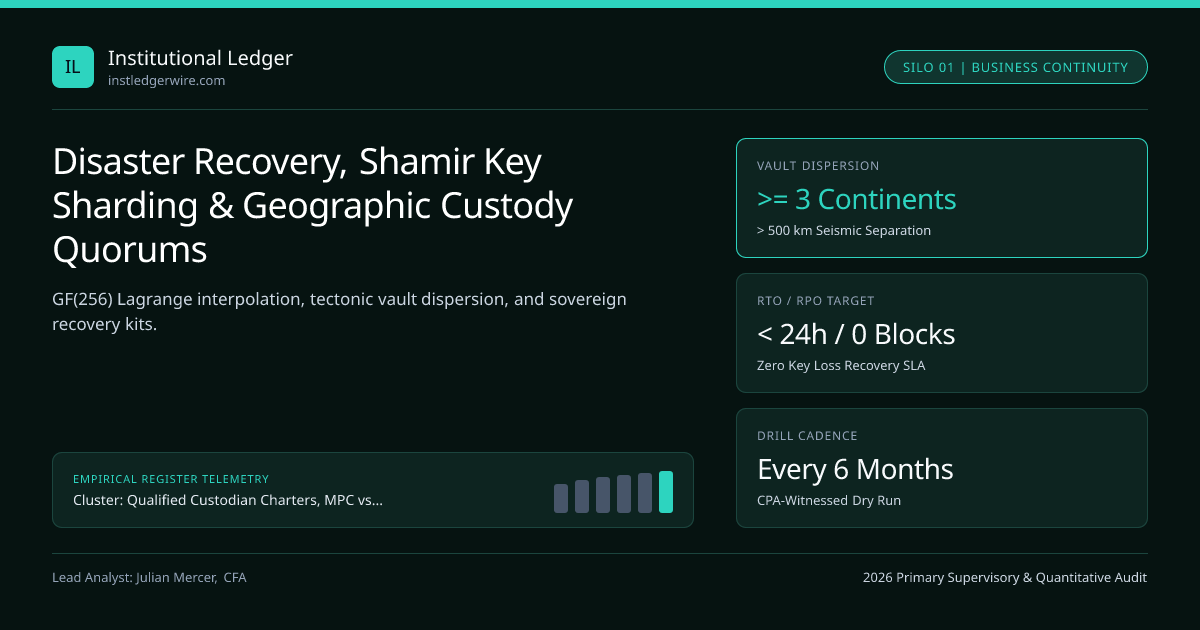
In institutional digital asset safekeeping, an overly rigid security posture that destroys private-key recoverability creates the exact same balance-sheet outcome as a theft: a 100% permanent write-off. Designing catastrophic business continuity under SEC SAB 122, EU DORA, and NYSDFS wind-down mandates requires pairing Verifiable Encrypted Shares (VES) and finite-field Shamir Secret Sharing over $\text{GF}(2^8)$ with tri-continental seismic dispersion and witnessed semi-annual recovery drills.
Polynomial Shamir Sharding Over GF(256) & Verifiable Encryption Proofs#
Classic Shamir Secret Sharing embeds a secret byte $S$ as the constant term $a0$ of a random degree-$(t-1)$ polynomial over the Galois Field $\text{GF}(2^8)$: $P(x) = S + a1 x + \dots + a_{t-1} x^{t-1}$. Evaluating $P(x)$ at $n$ distinct non-zero coordinates produces $n$ shares. By Lagrange interpolation, any $t$ valid shares deterministically recover $S$, while $t-1$ shares leave every possible 256-bit key equally probable—achieving information-theoretic perfection without relying on computational hardness assumptions.
When custodians operate threshold ECDSA and EdDSA MPC enclaves where the full private key never exists even at genesis, how can a client verify its offline disaster-recovery kit works without assembling the key? Modern cryptographic protocols documented in our qualified digital asset custody cornerstone guide solve this via Zero-Knowledge Verifiable Encrypted Shares (VES): each MPC node encrypts its shard to the offline recovery public key and emits a non-interactive zero-knowledge proof mathematically confirming that the encrypted backup corresponds to the exact on-chain public key $Q = xG$.
Hierarchical Two-Tier Quorums vs Insider Collusion#
Flat 3-of-5 sharding breaks down if three shards sit under the administrative control of the same organization. Institutional governance deploys hierarchical two-level secret sharing (standardized in SLIP-39 or nested HSM key-wrapping hierarchies). At Level 1, reconstruction requires 2-of-3 independent institutional fiduciaries: Group A (the Beneficial Client's Treasury Board), Group B (the Regulated Trust Custodian), and Group C (an independent Big-Four or Magic-Circle Law Firm Escrow Agent). Within each group, Level 2 enforces an internal 2-of-3 or 3-of-5 officer threshold.
Under this topology:
- If the custodian suffers total corporate extinction or cloud lockout, Client + Escrow Law Firm reconstruct keys via an air-gapped, open-source C/Rust CLI binary (verified by SHA-256 hash) and sweep funds to a backup custodian.
- Neither the custodian's employees nor the escrow firm's partners can ever collude unilaterally without the other independent fiduciary.
| Backup & Recovery Mechanism | Cryptographic Primitive | Vendor Extinction Independence | Silent Bit-Rot / Spoof Protection | Regulatory Alignment |
|---|---|---|---|---|
| Verifiable Encrypted MPC Backup (VES) | ECIES / Paillier ZK proof + GF(2^8) Shamir | 100% — open-source offline C/Rust CLI reconstructs raw keys | Mathematical ZK proof guarantees ciphertext decrypts to active Q | NYSDFS wind-down & EU DORA Art. 28 |
| FIPS 140-3 HSM Cloning Tokens | Hardware Key-Wrapping Key (AES-256-GCM) + PED | Requires compatible CMVP HSM model in standby vault | Cryptographic MAC + semi-annual spare HSM load check | Spot Crypto ETFs cold vaults |
| SLIP-39 Hierarchical Mnemonic | Shamir over GF(256) with 30-bit RS1024 checksum | Universal BIP-32/SLIP-39 standard; zero proprietary hardware | Reed-Solomon 1024 checksum catches up to 3 word errors | MAS & FINMA family office/fund vaults |
| Escrow Cloud KMS Split | Cloud KMS envelope encryption | Fails if cloud account suspended or subpoenaed simultaneously | High operational availability; weaker sovereign air-gap | Secondary warm tier only (Aquanow / Bitstamp sweep) |
Tri-Continental Vault Dispersion, BBRAM Decay & 180-Day Audit Drills#
Physical backup artifacts for spot Bitcoin and Ethereum ETF cold vaults are distributed across vaults separated by at least 500 kilometers across independent seismic zones, electrical grids, and legal regimes—commonly combining Delaware/Mountain West US, Swiss alpine facilities under FINMA oversight, and MAS-supervised vaults in Singapore.
Critically, hardware artifacts degrade silently: FIPS 140-3 Level 3/4 HSM cloning tokens rely on flash cells and internal lithium batteries, while paper seed backups char at 233 degrees Celsius. Best-practice custody pairs electronic HSM tokens with laser-etched 316L/Titanium plates rated above 1,600 degrees Celsius inside tamper-evident serialized holographic bags, audited every 180 days as part of SOC 1 and SOC 2 Type II continuity testing.
- Variables & 5-Year Continuity Engineering Model:
- n = 5 independent vaults (Zurich [FINMA], Delaware [US], Singapore [MAS], London [UK], Client Sovereign Vault)
- t = 3 shares required to reconstruct recovery key (survives complete loss of up to n - t = 2 vaults)
- psiteloss = 0.0010 annualized catastrophic site/access unavailability (kinetic disaster, facility seizure, or flood)
- pbitrotuntested = 0.0180 annualized smartcard flash decay / BBRAM battery failure if UNTESTED for 5 years (cumulative ~9.0%)
- pbitrotaudited = 0.0004 annualized residual media failure with 180-day CPA-witnessed health checks + dual Titanium/Token media
- Worked 5-Year Permanent Key-Loss Probability:
- 1. Untested 2-of-3 Single-Region Backup (5-year cumulative pfailper_shard ≈ 0.095):
- P(lose >= 2 of 3 shards) = 3 * (0.095)^2 * (0.905) + (0.095)^3 = 0.0245 + 0.00086 = 2.54% 5-year catastrophic loss risk!
- 2. Audited 3-of-5 Tri-Continental Backup with 180-Day Drills (annual p_fail = 0.0014; refreshed on detection):
- P(simultaneous loss >= 3 of 5 shards in 6-month window, p = 0.0007) = 10 * (0.0007)^3 = 3.43e-9 (0.00000034% risk — >7,400,000x safer)
Regulatory Wind-Down Plans & Pre-Whitelisted Failover Destinations#
Supervisors from NYSDFS to ESMA (under MiCA Article 74 orderly wind-down plans) require custodians to prove client assets can migrate within days if operations cease. Institutional funds pre-establish dormant secondary custody accounts and pre-whitelist failover settlement venues such as Bitstamp and Aquanow so emergency key reconstruction never improvises compliance onboarding under market stress.
Disaster Recovery Due Diligence Checklist for Allocators#
Before finalizing custody agreements inside our Qualified Custody & HSM Controls hub, fund COOs compile the custodian's open-source recovery CLI inside an air-gapped cleanroom, test full reconstruction on a funded canary wallet, and verify escrow and custodian credentials via our verification registry.
Frequently asked questions
Why does Shamir Secret Sharing offer stronger backup guarantees than splitting a seed phrase in half?
Naively splitting a 24-word BIP-39 mnemonic into two 12-word halves reduces brute-force entropy from 2^256 to 2^128 and causes 100% permanent fund loss if either half perishes. Shamir Secret Sharing over GF(256) creates M-of-N polynomial shares where any t-1 shares leak zero mathematical information while surviving n-t destroyed vaults.
How do MPC custodians provide sovereign client disaster recovery without creating a single point of key assembly?
During initial Distributed Key Generation, each MPC enclave encrypts its local share under an offline RSA-4096 or ECIES public recovery key whose private key is itself Shamir-split across client and independent escrow vaults, backed by zero-knowledge verifiable encryption proofs (VES) confirming ciphertext validity without decrypting.
What minimum physical separation do institutional underwriters require between disaster recovery vaults?
Lloyd's specie syndicates and Tier-1 bank continuity standards mandate at least 500 kilometers (310 miles) between primary and secondary vault sites across separate seismic zones, floodplains, and electrical grids—typically pairing North America (NY/Delaware/ Mountain West), Switzerland (Zurich/Alps), and Singapore.
How can an auditor test disaster recovery shards semi-annually without exposing production keys?
Auditors test non-destructively: vault custodians verify tamper-evident holographic seal serials, run cryptographic HMAC/public-key challenge checks on HSM backup tokens, and perform full Lagrange reconstruction exclusively on dedicated canary vaults funded with test balances built from identical ceremony tooling.
Publication record
- Published
- November 14, 2026
- Updated
- November 14, 2026
- Author
- Julian Mercer, CFA
- Review
- Review not recorded
- Automated fact check
- Passed in the stored pipeline record
- Source URLs
- 3 recorded
AI assistance recorded: anthropic/claude-opus-4.6. This field does not establish human review or source verification.
Academic & Institutional Attribution
Cite This Research & Embed Live Data Card
Standard academic & institutional research paper citation format.
Julian Mercer, CFA. (2026, November 14). Disaster Recovery, Shamir Key Sharding & Geographic Custody Quorums. Institutional Ledger. https://instledgerwire.com/stories/disaster-recovery-shamir-key-sharding-geographic-quorumsRegulatory Directory Cross-Reference
Referenced Institutions & Regulatory Registries
Mentioned Regulated Institutions
Referenced Supervisory Authorities
Related Qualified Custody Mpc Hsm Controls & Institutional Briefings
Explore Qualified Custody Mpc Hsm Controls Hub (20) →Qualified Custody Mpc Hsm Controls
Qualified Digital Asset Custody, MPC Signing & FIPS 140-3 HSM Controls: 2026 GuideQualified Custody Mpc Hsm Controls
FINMA DLT Custody Segregation & Swiss Art. 242a Bankruptcy PrivilegeQualified Custody Mpc Hsm Controls
MAS Payment Services Act 90% Cold Wallet Mandate & Statutory TrustQualified Custody Mpc Hsm Controls
Hong Kong SFC Virtual Asset Custody: 98% Cold Seed Storage & InsuranceQualified Custody Mpc Hsm Controls
ADGM FSRA, Dubai VARA & DIFC DFSA Qualified Crypto Custody RulebooksQualified Custody Mpc Hsm Controls
FASB ASU 2023-08 (ASC 350-60) Fair-Value Crypto Custody ReportingQualified Custody Mpc Hsm Controls
Smart-Contract Allowlisting & EIP-712 Typed-Data Signing GuardsQualified Custody Mpc Hsm Controls
Custodian Sub-Custody Delegation & Ancillary Staking Liability LawTokenized Treasuries Rwa Settlement
24/7 USDC Redemption Liquidity Buffers for Tokenized US Treasury FundsTokenized Treasuries Rwa Settlement
Cross-Chain Burn-and-Mint Interoperability (CCIP) for Tokenized RWATokenized Treasuries Rwa Settlement
G-SIB SLR, LCR & Level 1 HQLA Eligibility of Tokenized Sovereign DebtTokenized Treasuries Rwa Settlement
Rebasing ($1.00 Par) vs Accumulating NAV Tokenized Money-Market Funds
Institutional Ledger Data, Benchmarks & Contributor Records
CC BY 4.0 Open Data
Open Institutional Datasets (CSV / JSON) →
Download desk-compiled quantitative series & schemas.
2026 Reference Matrix
2026 Institutional Benchmarks & Thresholds →
Statutory capital, clearing, margin & rate conventions.
Editorial Records
Authors & Review Records →
View named contributors where those records are available.
Complete Index
Master Research & Dossier Archive →
Browse all published briefings by topic pillar & date.