
Qualified Custody Mpc Hsm Controls
Spot Bitcoin & Ether ETF In-Kind Creation Custody SLA Workflows
US spot Bitcoin and Ethereum ETFs managing $118B+ rely on tight T+0/T+1 custodial sweep SLAs, Prime Execution Agent credit buffers, and in-kind AP basket transfers.
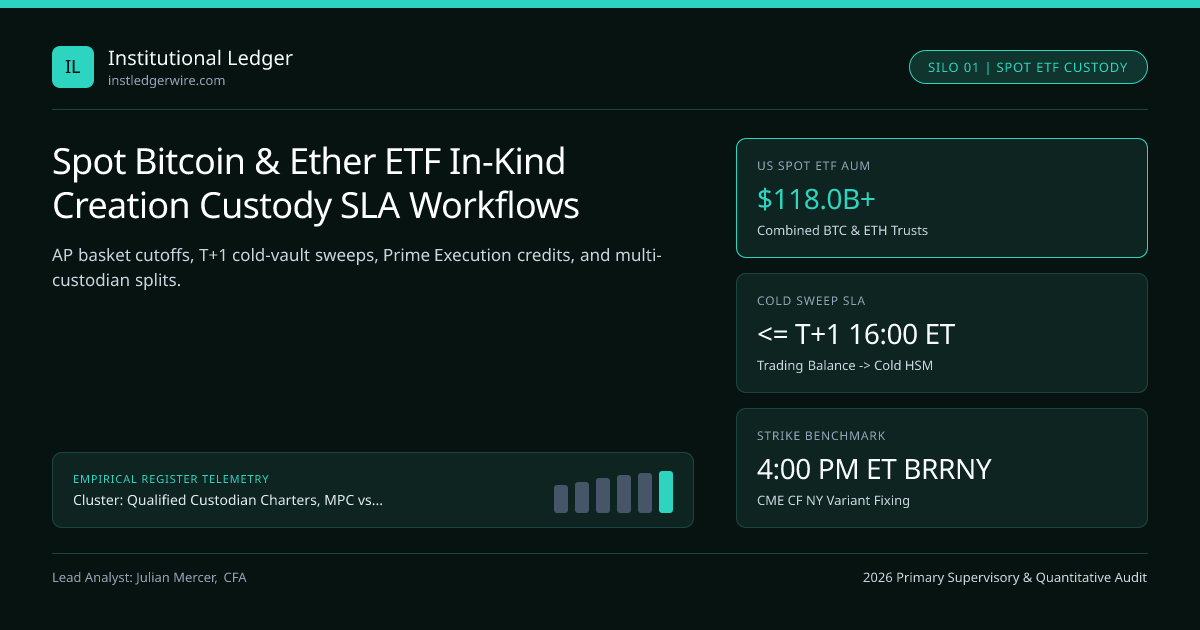
Managing more than $118 billion across the US spot Bitcoin and Ethereum ETF complex requires surgical synchronization between Wall Street's T+1 DTCC/NSCC equity clearing rails and irreversible T+0 Layer-1 blockchain finality. Transitioning ETF custody workflows from cash-only agency execution to in-kind Authorized Participant (AP) basket transfers compresses primary-market creation friction by over 7 basis points while eliminating multi-hundred-million-dollar intraday trade-financing bottlenecks during volatile flow days.
Inside the 3:00–4:00 PM ET CME CF BRRNY Strike & Trade Balance Architecture#
Every US spot Bitcoin ETF prices daily Net Asset Value against six five-minute partitions between 3:00 PM and 4:00 PM Eastern Time using the CME CF Bitcoin Reference Rate — New York Variant (BRRNY), aggregated from regulated constituent spot order books including Bitstamp. Under the architecture outlined in our qualified digital asset custody cornerstone guide, each ETF Trust maintains three segregated account tiers with its NYSDFS or OCC trust custodian:
- Trust Cold Vault Balance: Individually segregated, air-gapped FIPS 140-3 Level 3/4 HSM addresses holding 98%+ of fund AUM.
- Trust Trading Balance: Policy-restricted threshold MPC warm wallets dedicated solely to settling intraday creation and redemption baskets.
- Cash Custodian Account: Held at a Tier-1 G-SIB bank transfer agent (such as BNY Mellon or State Street) managing USD wires and NSCC share instructions.
Cash Creations vs In-Kind AP Delivery: Eliminating T+1 Credit Bottlenecks#
Under the initial January 2024 cash-only structure, when an AP submitted a $250 million creation order at 2:00 PM ET, the AP's USD wire did not settle at the Cash Custodian until T+1. Yet to avoid overnight NAV tracking error against the 4:00 PM ET BRRNY strike, the ETF Trust had to purchase $250 million of spot Bitcoin on T+0. That timing gap forced the digital asset custodian's affiliated Prime Execution Agent to lend $250 million of intraday trade credit at SOFR + 300–400 bps. On peak $1.2 billion inflow days, trade-credit lines strained balance-sheet limits.
Under the Spot Crypto ETFs 2026 Benchmark Standard incorporating SEC-approved in-kind creation/redemption orders, the AP's non-broker-dealer liquidity affiliate sources Bitcoin across CME futures, OTC desks (Aquanow, 8 Blocks Capital), and global spot books throughout the day, then transfers exact native BTC baskets directly into a quarantine staging address at the Trust Custodian. Once KYT forensics verify zero sanctioned UTXO lineage and 6 Bitcoin confirmations finalize, the Cash Custodian/Transfer Agent releases ETF shares via NSCC Continuous Net Settlement—zero Trust-level market slippage and zero Prime Execution borrowing.
| ETF Custody Operational Layer | Cash Creation / Redemption Model | In-Kind Creation / Redemption Model | Custody SLA & Risk Control |
|---|---|---|---|
| Basket Order Cutoff | Early cutoff (12:00 - 14:30 PM ET) for execution | Extended cutoff (up to 16:00 PM ET NAV strike) | Automated order portal synced with Bank Transfer Agent |
| Spot Market Liquidity Sourcing | Prime Execution Agent routes across Bitstamp, Aquanow, OTC | AP crypto affiliate sources via global CME/spot books | Eliminates single-broker 4:00 PM ET market impact |
| Intraday Settlement Credit | Custodian/Prime advances trade credit until T+1 Fedwire | Atomic/escrowed L1 token receipt prior to NSCC share release | Zero unsecured Group 2 bank credit under SEC SAB 122 |
| Cold Vault Allocation | Swept to NYSDFS Cold Vault by T+1 16:00 ET | Verified via KYT screen in staging wallet, swept to Cold HSM | 100% segregated L1 addresses |
| Tax Gain Realization (33 Act) | Trust cash sales can trigger grantor-trust cost-basis events | In-kind redemptions distribute low-basis lots cleanly | Tracked per Spot Crypto ETFs Benchmark |
T+1 Cold Sweep SLAs, Multi-Custodian Splits & SAB 122 Bank Entry#
ETF S-1 filings and Custody Service Level Agreements impose hard dwell-time ceilings on warm wallets: newly received creation coins must sweep into air-gapped Cold Vault partitions by 4:00 PM ET on T+1, and redemptions out of Cold Vaults require dual-officer Faraday ceremonies initiated only upon cryptographically signed instructions from the Fund Administrator—never unilateral sponsor emails.
Furthermore, following SEC SAB 122 balance-sheet relief, ETF boards actively diversify single-custodian concentration by adopting multi-custodian splits (allocating 70% to a primary NYDFS trust and 30% to an OCC or G-SIB bank custodian). Multi-custodian routing doubles independent specie insurance towers and guarantees uninterrupted basket liquidity during scheduled firmware ceremonies.
- Variables & Empirical Calibration ($35.0B Spot Bitcoin ETF with $48.0B Annual Creation/Redemption Gross Turnover):
- SlippageCashvs_BRRNY = 0.00038 (3.8 bps execution dispersion around 15:00-16:00 ET CME CF BRRNY 60-min TWAP)
- Fee_PrimeExec = 0.00025 (2.5 bps agency execution & venue routing fee)
- Financing_T1 = (0.0875 / 360) * 1 day = 0.000243 (2.43 bps 24-hour T+1 trade-credit charge on cash creations)
- CostInKindSweep = 0.00015 (1.5 bps AP affiliate hedging + KYT + L1 cold-sweep custodial fee)
- Worked Annual Savings From In-Kind Custodial Workflow:
- 1. Cash-Only Total Creation/Redemption Friction = 3.8 + 2.5 + 2.43 = 8.73 bps -> $48,000M * 0.000873 = $41,904,000/yr
- 2. In-Kind Custodial Workflow Friction = 1.50 bps -> $48,000M * 0.000150 = $7,200,000/yr
- 3. Net Investor & AP Spread Savings = $34,704,000/yr (7.23 bps tightening across primary-market arbitrage)
Ethereum ETF Staking Sleeves & Unbonding Liquidity Buffers#
For spot Ethereum ETFs incorporating staking yield sleeves, custodians segregate staked validator withdrawal credentials to the Trust's dedicated Cold Vault while maintaining an un-staked 15%-to-25% liquid ETH buffer (or standby credit facility) so T+1 AP redemptions never stall behind Beacon Chain exit queues—a liquidity dynamic modeled further in our SOC 1 Type II ETF audit analysis.
ETF Sponsor & AP Operational Audit Priorities#
Authorized participants and ETF trustees operating inside our Qualified Custody & HSM Controls hub monitor daily published on-chain proof-of-address feeds, test quarterly failover redemptions to backup custodians, and verify active regulatory charters via our institution verification portal and benchmarks directory.
Frequently asked questions
Why does in-kind creation reduce tracking error and secondary spreads for spot Bitcoin ETFs?
Under cash-only creation, the ETF trust must buy or sell BTC in the spot market around the 4:00 PM ET NAV window, passing execution slippage, exchange fees, and Prime Execution financing charges onto the AP. Under in-kind creation, AP affiliates deliver pre-hedged BTC directly to the custodian, eliminating trust-level trading slippage.
Why cannot FINRA-registered broker-dealer APs touch native Bitcoin directly without a rule carving or affiliate?
Traditional SEC Rule 15c3-3 Customer Protection and Rule 15c3-1 Net Capital haircuts restrict general-purpose broker-dealers from holding native non-security crypto on their regulated BD books; APs either route native token legs through a non-BD liquidity affiliate or rely on SEC Exchange Act Section 19(b)(4) rule approvals.
How fast must an ETF custodian sweep newly purchased Bitcoin from trading accounts into cold storage?
Standard spot ETF Trust Custody Agreements require the custodian to transfer creation proceeds from the Trade Balance (warm MPC settlement tier) into individually segregated Vault Balances (air-gapped cold HSM storage) no later than T+1 close of business after trade finality.
Why have major ETF issuers onboarded secondary or backup digital asset custodians?
When single-issuer spot Bitcoin ETFs surpassed $25B to $55B in AUM, single-custodian concentration became a board-level systemic risk. Onboarding a second NYDFS or bank custodian diversifies key-ceremony stacks, doubles independent specie towers, and ensures uninterrupted AP creation if one custodian enters maintenance.
Publication record
- Published
- November 14, 2026
- Updated
- November 14, 2026
- Author
- Julian Mercer, CFA
- Review
- Review not recorded
- Automated fact check
- Passed in the stored pipeline record
- Source URLs
- 3 recorded
AI assistance recorded: anthropic/claude-opus-4.6. This field does not establish human review or source verification.
Academic & Institutional Attribution
Cite This Research & Embed Live Data Card
Standard academic & institutional research paper citation format.
Julian Mercer, CFA. (2026, November 14). Spot Bitcoin & Ether ETF In-Kind Creation Custody SLA Workflows. Institutional Ledger. https://instledgerwire.com/stories/spot-bitcoin-ether-etf-in-kind-creation-custody-sla-workflowsRegulatory Directory Cross-Reference
Referenced Institutions & Regulatory Registries
Mentioned Regulated Institutions
Referenced Supervisory Authorities
Related Qualified Custody Mpc Hsm Controls & Institutional Briefings
Explore Qualified Custody Mpc Hsm Controls Hub (20) →Qualified Custody Mpc Hsm Controls
Qualified Digital Asset Custody, MPC Signing & FIPS 140-3 HSM Controls: 2026 GuideQualified Custody Mpc Hsm Controls
Quorum Policy Engines & Biometric Hardware Co-Signing ControlsQualified Custody Mpc Hsm Controls
Disaster Recovery, Shamir Key Sharding & Geographic Custody QuorumsQualified Custody Mpc Hsm Controls
FINMA DLT Custody Segregation & Swiss Art. 242a Bankruptcy PrivilegeQualified Custody Mpc Hsm Controls
MAS Payment Services Act 90% Cold Wallet Mandate & Statutory TrustQualified Custody Mpc Hsm Controls
Hong Kong SFC Virtual Asset Custody: 98% Cold Seed Storage & InsuranceQualified Custody Mpc Hsm Controls
ADGM FSRA, Dubai VARA & DIFC DFSA Qualified Crypto Custody RulebooksQualified Custody Mpc Hsm Controls
FASB ASU 2023-08 (ASC 350-60) Fair-Value Crypto Custody ReportingTokenized Treasuries Rwa Settlement
MAS Project Guardian & Global Layer One (GL1): Cross-Border RWA RepoTokenized Treasuries Rwa Settlement
Project mBridge Multi-CBDC PvP Corridor: Sovereign Settlement & Nostro ReliefTokenized Treasuries Rwa Settlement
24/7 USDC Redemption Liquidity Buffers for Tokenized US Treasury FundsTokenized Treasuries Rwa Settlement
Cross-Chain Burn-and-Mint Interoperability (CCIP) for Tokenized RWA
Institutional Ledger Data, Benchmarks & Contributor Records
CC BY 4.0 Open Data
Open Institutional Datasets (CSV / JSON) →
Download desk-compiled quantitative series & schemas.
2026 Reference Matrix
2026 Institutional Benchmarks & Thresholds →
Statutory capital, clearing, margin & rate conventions.
Editorial Records
Authors & Review Records →
View named contributors where those records are available.
Complete Index
Master Research & Dossier Archive →
Browse all published briefings by topic pillar & date.