
Qualified Custody Mpc Hsm Controls
SEC SAB 122 & FASB ASC 450-20 Custody Liability Accounting for Banks
SEC Staff Accounting Bulletin No. 122 rescinded SAB 121 balance-sheet gross-ups, restoring FASB ASC 450-20 probable-loss contingency accounting and unlocking G-SIB digital asset custody.
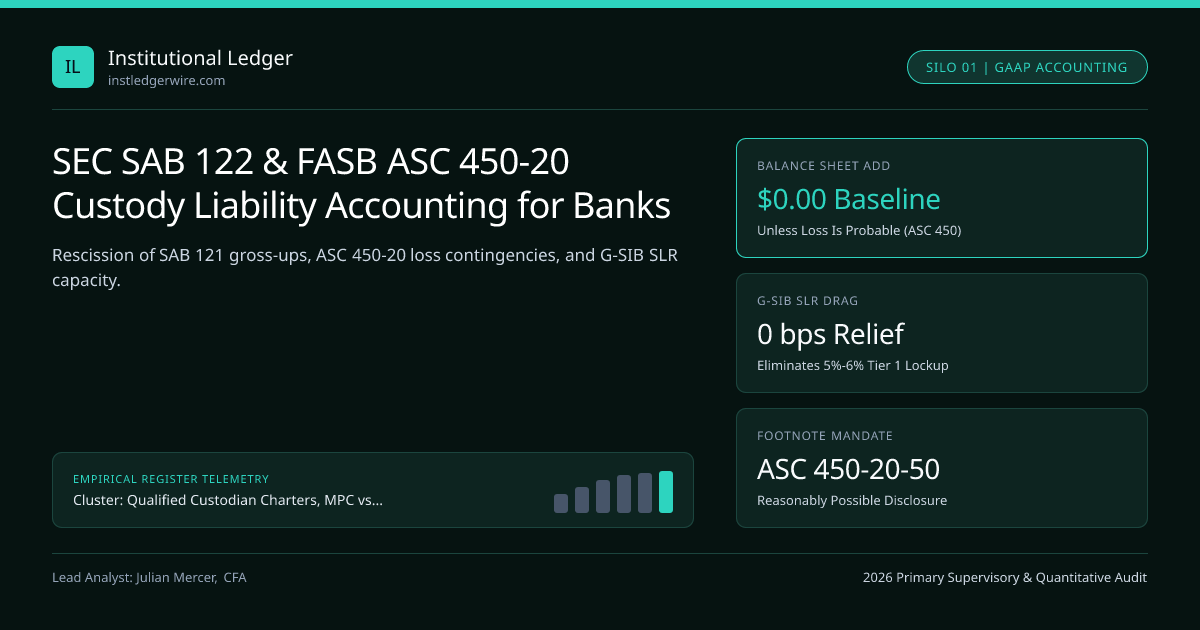
When the SEC Office of the Chief Accountant issued Staff Accounting Bulletin No. 122 (SAB 122) to rescind SAB 121, the minimum breakeven fee required for a US G-SIB to safeguard $50 billion in digital assets plunged from 99.2 basis points down to 7.1 basis points. By replacing mandatory balance-sheet gross-ups with traditional loss-contingency evaluation under FASB ASC 450-20 and IAS 37, SAB 122 aligned digital asset safekeeping with centuries-old securities custody accounting and reopened ETF and pension mandates to Tier-1 banking groups.
Why SAB 121 Distorted Bank Leverage Ratios and Concentrated ETF Risk#
Issued in March 2022 as Topic 5.FF, SAB 121 asserted that unique technological, legal, and regulatory uncertainties surrounding cryptographic keys compelled SEC-reporting custodians to record a safeguarding liability—and a symmetric safeguarding asset—measured at the full fair value of client crypto holdings at every reporting date. While neutral to GAAP net income during normal operations, inflating total assets triggered immediate prudential consequences under the US Supplementary Leverage Ratio (SLR). Because SLR is risk-insensitive, a G-SIB safeguarding $50 billion in client Bitcoin had to post $2.5 billion to $3.0 billion in Tier 1 common equity, even though client property sat inside bankruptcy-remote NYDFS or OCC trust structures.
Ironically, this accounting rule concentrated >85% of early US spot ETF custody inside non-bank custodians rather than diversifying safekeeping across G-SIB custodian banks. Rescinding Topic 5.FF via the SEC SAB 122 2026 Benchmark Standard harmonized US GAAP with Basel III BCBS SCO60 paragraph 129.
Applying FASB ASC 450-20 and IAS 37 to Cryptographic Custody Risks#
Under SAB 122, public banks, broker-dealers, and listed crypto custodians determine balance-sheet recognition through FASB ASC Subtopic 450-20 (Loss Contingencies)—or IAS 37 (Provisions, Contingent Liabilities and Contingent Assets) for foreign private issuers supervised by ESMA or BaFin. Accounting controllers classify safeguarding exposure into three probability tiers at each quarter-end:
- Remote: Client assets reside in bankruptcy-remote statutory trusts backed by air-gapped FIPS 140-3 HSM vaults and clean SOC 1 and SOC 2 Type II audits with zero unresolved security incidents. Zero liability is accrued.
- Reasonably Possible: A newly discovered protocol bug, sub-custodian dispute, or regulatory ambiguity creates more than a remote—but less than probable—chance of loss. Zero balance-sheet accrual occurs, but ASC 450-20-50 mandates quantitative range and risk disclosures in Form 10-Q/10-K footnotes.
- Probable and Estimable: A key shard compromise, slashing event caused by custodian negligence, or frozen sub-custodian account makes client restitution probable (>75% under US GAAP; >50% under IAS 37). The custodian immediately charges P&L and books a balance-sheet liability.
| Accounting Scenario | Governing GAAP / IFRS Clause | Balance Sheet Liability | Income Statement Impact | Insurance Recovery Accounting |
|---|---|---|---|---|
| Normal Fiduciary Custody | SEC SAB 122 / ASC 450-20 | USD 0 (Off-balance-sheet bailment) | Fee revenue recognized under ASC 606 | Policy premium expensed ratably |
| Reasonably Possible Vulnerability | ASC 450-20-50-3 to 50-4 | USD 0 accrued on balance sheet | USD 0 charge | Qualitative & range footnote in 10-Q/10-K |
| Probable Key Compromise / Freeze | ASC 450-20-25-2 (US GAAP) | Full fair value of affected client tokens | Immediate operating loss provision | Separate asset only when recovery is probable (ASC 410-30) |
| IFRS Custodial Breach (>50% odds) | IAS 37 Para 14 & 53 (ESMA / BaFin) | Best estimate of settlement outflow | Immediate P&L provision | Reimbursement asset ONLY when virtually certain |
| Client Beneficial Ownership | FASB ASC 350-60 | Asset on client balance sheet (Level 1/2 FV) | Quarterly unrealized FV gain/loss in NI | N/A (client holds title) |
Gross Presentation Rule: Why Specie Insurance Cannot Offset Liabilities#
A subtle GAAP trap arises if a custodian suffers a probable vault or warm-wallet incident covered by specie or crime insurance policies. Under FASB ASC 410-30 / ASC 450-20 gross-presentation rules, a custodian cannot net expected Lloyd's insurance proceeds against its client restitution liability on the balance sheet. Moreover, while the loss liability is booked as soon as client reimbursement is probable, an offsetting insurance recovery asset can only be recognized up to the loss amount once insurer payout is independently probable (under US GAAP) or virtually certain (under IAS 37.53)—typically requiring written coverage confirmation without reservation of rights.
- Variables & G-SIB Custody Desk Pricing Comparison ($50.0B Spot ETF + Institutional Custody Pool):
- SLR_req = 0.050 (5.0% consolidated G-SIB Supplementary Leverage Ratio; 6.0% at insured bank sub)
- OpRisk_Cap = $18,600,000 Basel III SMA operational risk capital
- ROE_hurdle = 0.14 (14.0% after-tax target return on Tier 1 equity); TaxRate = 0.24 -> Pre-tax hurdle = 18.42%
- DirectOpsCost = $32,000,000/yr (FIPS 140-3 HSM vaults, MPC enclaves, specie insurance, SOC 1/2, NYDFS/OCC exams)
- Worked Pricing Impact of SEC SAB 122:
- 1. Under Rescinded SAB 121 (Ionsheet = 1.0):
- Tier 1 Capital Locked = ($50,000M * 0.05) + $18.6M = $2,518.6M
- Required Pre-Tax Revenue = ($2,518.6M * 0.1842) + $32.0M = $463.93M + $32.0M = $495.93M/yr
- Minimum Breakeven Fee = 99.19 bps (5x above market clearing ETF custody rates of 12-20 bps!)
- 2. Under Current SEC SAB 122 (Ionsheet = 0.0 per ASC 450-20):
- Tier 1 Capital Locked = $0 + $18.6M = $18.6M
- Required Pre-Tax Revenue = ($18.6M * 0.1842) + $32.0M = $3.43M + $32.0M = $35.43M/yr
- Minimum Breakeven Fee = 7.09 bps (enables profitable 12-18 bps institutional G-SIB custody mandates)
Reconciling Custodian SAB 122 Filings with Client ASC 350-60 Books#
Clean separation under our qualified digital asset custody cornerstone framework ensures that digital assets appear on exactly one balance sheet: the beneficial owner's. Corporate treasuries and investment funds holding crypto at NYSDFS-regulated trusts or trading via Bitstamp and Aquanow measure their own holdings at fair value under FASB ASU 2023-08 (ASC 350-60) custody reporting, while inspecting their custodian's 10-K ASC 450-20 footnotes to verify zero undisclosed sub-custody contingencies.
Controller & Risk Committee Quarterly Review Checklist#
Before signing quarterly financial statements inside our Qualified Custody & HSM Controls hub, bank controllers document legal true-bailment opinions per jurisdiction, verify zero unauthorized omnibus commingling, reconcile sub-custodian solvency attestations, and validate entity registrations across our verification registry and methodology hub.
Frequently asked questions
Why did SEC SAB 121 block major global custodian banks from scaling digital asset custody?
SAB 121 forced public banks to record every dollar of custodied client Bitcoin or Ether on their own balance sheets. Under G-SIB Supplementary Leverage Ratio (5% to 6% Tier 1 capital against total assets regardless of risk weight), custodying $100B of ETF assets required $5B to $6B in Tier 1 equity, making 15 bps custody fees uneconomic.
Under SEC SAB 122 and FASB ASC 450-20, when must a custodian actually book a balance-sheet liability?
Under ASC 450-20-25-2, a custodian accrues a loss liability only if available operational or legal evidence indicates it is probable (generally >75%-80% likelihood in US GAAP practice) that a safeguarding loss has occurred as of the balance-sheet date—such as a confirmed key compromise, frozen sub-custodian, or defective bailment—and the amount can be reasonably estimated.
Does SEC SAB 122 eliminate financial statement footnote disclosures regarding crypto custody risks?
No. SAB 122 explicitly reminds SEC registrants that under ASC 450-20-50 and Regulation S-K Item 101/303, entities must disclose the nature, scale, concentration, cryptographic controls, and insurance limits of safeguarded digital assets whenever a material loss is at least reasonably possible.
How does SAB 122 interact with FASB ASU 2023-08 (ASC 350-60) fair-value crypto accounting?
ASC 350-60 governs the beneficial owner (the corporate treasury or fund that owns the crypto asset), requiring quarterly fair-value measurement through net income. SAB 122 and ASC 450-20 govern the custodian safeguarding those assets on behalf of the client, keeping the two balance sheets cleanly separated.
Publication record
- Published
- November 14, 2026
- Updated
- November 14, 2026
- Author
- Julian Mercer, CFA
- Review
- Review not recorded
- Automated fact check
- Passed in the stored pipeline record
- Source URLs
- 3 recorded
AI assistance recorded: anthropic/claude-opus-4.6. This field does not establish human review or source verification.
Academic & Institutional Attribution
Cite This Research & Embed Live Data Card
Standard academic & institutional research paper citation format.
Julian Mercer, CFA. (2026, November 14). SEC SAB 122 & FASB ASC 450-20 Custody Liability Accounting for Banks. Institutional Ledger. https://instledgerwire.com/stories/sec-sab-122-fasb-asc-450-20-custody-liability-accountingRegulatory Directory Cross-Reference
Referenced Institutions & Regulatory Registries
Mentioned Regulated Institutions
Related Qualified Custody Mpc Hsm Controls & Institutional Briefings
Explore Qualified Custody Mpc Hsm Controls Hub (20) →Qualified Custody Mpc Hsm Controls
Qualified Digital Asset Custody, MPC Signing & FIPS 140-3 HSM Controls: 2026 GuideQualified Custody Mpc Hsm Controls
Specie & Crime Insurance Exclusions in Digital Asset Cold VaultsQualified Custody Mpc Hsm Controls
Omnibus vs Segregated On-Chain Wallets: Insolvency & Bailment LawQualified Custody Mpc Hsm Controls
BaFin Krypto-Verwahrgeschaeft vs EU MiCA Article 70 CASP Custody RulesQualified Custody Mpc Hsm Controls
Spot Bitcoin & Ether ETF In-Kind Creation Custody SLA WorkflowsQualified Custody Mpc Hsm Controls
Quorum Policy Engines & Biometric Hardware Co-Signing ControlsQualified Custody Mpc Hsm Controls
Disaster Recovery, Shamir Key Sharding & Geographic Custody QuorumsQualified Custody Mpc Hsm Controls
FINMA DLT Custody Segregation & Swiss Art. 242a Bankruptcy PrivilegeTokenized Treasuries Rwa Settlement
Canton Network & Broadridge DLR Intraday Tokenized Repo ClearingTokenized Treasuries Rwa Settlement
Ondo OUSG & USDY Bankruptcy-Remote SPV Note Structuring AuditTokenized Treasuries Rwa Settlement
BIS Project Agora: Tokenized Commercial Bank Deposits & Wholesale CBDCTokenized Treasuries Rwa Settlement
Eurosystem DLT Trials: Bundesbank Trigger, Pontes & Appia Central Bank DvP
Institutional Ledger Data, Benchmarks & Contributor Records
CC BY 4.0 Open Data
Open Institutional Datasets (CSV / JSON) →
Download desk-compiled quantitative series & schemas.
2026 Reference Matrix
2026 Institutional Benchmarks & Thresholds →
Statutory capital, clearing, margin & rate conventions.
Editorial Records
Authors & Review Records →
View named contributors where those records are available.
Complete Index
Master Research & Dossier Archive →
Browse all published briefings by topic pillar & date.