
Qualified Custody Mpc Hsm Controls
Specie & Crime Insurance Exclusions in Digital Asset Cold Vaults
Headline $500M to $1B digital asset custody insurance towers frequently mask aggregate shared policy pools, per-vault sub-limits, LMA5567 cyber-war exclusions, and hot-wallet carve-outs.
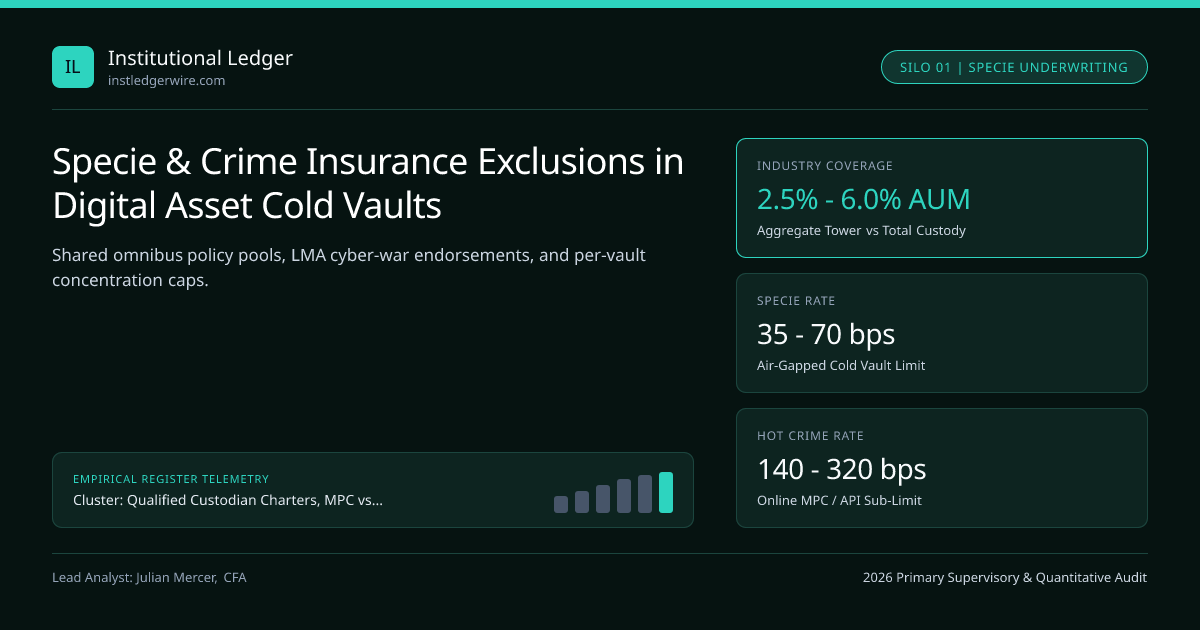
Global digital asset custody AUM exceeds $650 billion, yet cumulative commercial specie and crime underwriting capacity across Lloyd's of London and Bermuda syndicates totals roughly $6 billion to $8 billion—leaving over 98% of industry assets reliant on vault partitioning rather than dollar-for-dollar aggregate limits. Institutional allocators auditing a custodian's advertised "$500 million policy" must inspect the actual Binder of Insurance to verify per-shard key isolation, loss-payee priority, and cyber-war exclusion endorsements.
The Aggregate Tower Illusion vs Per-Shard Key Partitioning#
In marketing decks, regulated and offshore custodians alike highlight nine-figure insurance headlines without disclosing denominator exposure. As demonstrated in our qualified digital asset custody cornerstone guide, a $600 million shared policy covering $24 billion of omnibus deposits offers just 2.5% protection if a correlated software bug or single master key compromise drains the platform. NYSDFS custodial guidance explicitly prohibits misleading insurance representations, requiring custodians to disclose whether coverage is shared across all customers and what specific perils trigger payment.
Sophisticated risk engineers solve the capacity ceiling structurally: if a custodian maintains a $600 million Lloyd's specie tower and enforces strict cryptographic independence across air-gapped FIPS 140-3 Level 3 HSM vaults—where each vault shard uses an independent DKG/TRNG ceremony, separate PED smartcard quorums, and a hard cap of $400 million (leaving a 33% buffer for weekend crypto price spikes)—then no single physical vault compromise can ever exceed the policy limit.
Specie Policies vs Financial Institution Crime Bonds: Peril Gaps#
Underwriters bifurcate digital asset risk along network connectivity lines. Cold Storage Specie syndicates insure tangible physical security: if armed intruders breach a Zurich or Delaware bullion vault, or if seismic/fire damage destroys primary and backup smartcards, specie pays out at annual premiums of 35 to 70 basis points of insured limit. However, specie wordings contain an absolute network connectivity warranty: the moment a signing module connects to a LAN, VPN, or cloud hypervisor—or if malicious code was injected into the offline signing laptop prior to vault commission—specie underwriters deny coverage.
Online warm tiers running threshold ECDSA and EdDSA MPC require a Financial Institution Crime / Electronic Computer Crime Policy, priced 3x to 5x higher (140 to 320 bps) with tight sub-limits of $25 million to $100 million. Consequently, custodians cap warm-wallet balances below their crime sub-limit and enforce deterministic hourly velocity throttles.
| Policy Archetype | Underwriting Market | Covered Loss Perils | Critical Policy Exclusions | Effective Cost (% of Limit) |
|---|---|---|---|---|
| Cold Storage Specie | Lloyd's of London / London Company Market | Vault burglary, armed coercion, fire/flood loss of HSM shards, insider vault collusion | Any network-connected key, firmware backdoor prior to vault entry, protocol bugs | 35 - 70 bps |
| Commercial Crime / FI Bond | Bermuda / US Specialty / London | Employee dishonesty, electronic transfer fraud, warm MPC policy-engine bypass | Social engineering of client staff (CUEC breach), market volatility during freeze | 140 - 320 bps |
| Dedicated Excess Loss Payee | Bespoke Syndicate Placement | Ring-fenced limit exclusively payable to a single ETF or pension trust (Spot ETFs) | Shared omnibus dilution eliminated; subject to per-vault HSM ceremony compliance | 45 - 85 bps (client-paid) |
| Statutory Reserve + Insurance | SFC Hong Kong VATP Regime | >=50% cold + 100% hot via insurance and segregated trust bank deposits | Unapproved tokens or unauthorized external DeFi routing | Embedded in platform fee |
| Validator Slashing Cover | Specialty Parametric / Captive | Double-signing downtime & correlated validator penalties (see staking liability) | Client-operated keys, L1 consensus forks, intentional governance attacks | 65 - 160 bps of staked ETH |
Dissecting Exclusions: LMA Cyber-War, Protocol Bugs & Client CUECs#
Four policy exclusions routinely surprise general counsels reviewing custody binders for spot Bitcoin and Ethereum ETF issuers or corporate treasuries reporting contingencies under SEC SAB 122:
- LMA5564–LMA5567 State-Backed Cyber Exclusions: Mandatory across Lloyd's since 2023; counsels negotiate explicit buy-backs or clarify that financially motivated cyber-theft (even by state-sponsored groups) is not excluded absent kinetic war or major systemic state impairment.
- Underlying Blockchain & Smart-Contract Exclusions: Zero commercial custody policies cover Layer-1 51% consensus attacks, SHA-256/ECDSA mathematical breaks, or ERC-20 issuer contract bugs.
- Client CUEC / Social Engineering Carve-Outs: If an institutional fund's own CFO approves a poisoned destination address because the client failed to implement Complementary User Entity Controls from the custodian's SOC report, custodian insurance does not respond.
- Validator Slashing & Sub-Custody: Standard custody binders exclude staking penalties unless endorsed separately.
- Variables & Stress Test ($250M Pension Allocation in a Custodian Advertising "$600M Insurance"):
- SharedTowerLimit = $600,000,000 aggregate policy shared across $24,000,000,000 custodian AUM
- Deductible = $10,000,000 per occurrence
- Case A (Poor Architecture — Single Master Root / Correlated Firmware Flaw Exposes All $24.0B):
- Pro-Rata Recovery = ($600M - $10M) / $24,000M = 2.458% -> Pension recovers $6.15M, loses $243.85M!
- Case B (Partitioned Architecture — 60 Independent Air-Gapped FIPS 140-3 Vault Shards of $400M Each, PriceSurgeFactor = 1.20):
- Exposed Single-Shard Value after +20% Intraday BTC Rally = $400M * 1.20 = $480.0M <= $590M Net Shared Tower!
- Pro-Rata Recovery on Single Compromised Shard = min(1.0, $590M / $480M) = 100.0% (less pro-rata $6.25M deductible share = 97.5% recovery!)
Dedicated Loss-Payee Towers & Hong Kong SFC Statutory Floors#
Large pension plans and ETF trusts refuse shared-pool subordination and purchase dedicated excess specie policies naming the trust directly as First Loss Payee, ensuring claims bypass custodian insolvency estates. Globally, SFC Hong Kong enforces one of the strictest statutory minimums, requiring licensed platforms to back at least 50% of cold storage and 100% of hot storage via insurance or segregated bank trust reserves—a stark contrast to unregulated offshore venues contrasted alongside regulated peers like Bitstamp and bitFlyer.
Binder Inspection Protocol for Institutional Risk Committees#
Allocators conducting reviews in our Qualified Custody & HSM Controls hub never rely on a one-page Certificate of Insurance (COI); instead, outside insurance counsel reviews the full policy wording, syndicate security ratings (A.M. Best A or S&P A+ minimum), and automated vault-rebalancing triggers alongside our verification portal.
Frequently asked questions
What is the legal difference between a cold-storage specie policy and a financial institution crime bond?
Specie insurance originates in bullion and fine-art underwriting, covering physical theft, armed robbery, natural disaster destruction of key shards, or physical insider collusion inside named offline vaults. Commercial crime / E&O / cyber bonds cover electronic theft, employee infidelity over networks, and API policy bypasses.
How could a nation-state cyber-war exclusion impact a claim following a Lazarus Group exploit?
Since March 2023, Lloyd's mandated LMA5564-LMA5567 state-backed cyber exclusions. While standalone criminal theft by state-affiliated groups often remains covered unless impaired-state thresholds trigger, poorly drafted bespoke war/cyber clauses can delay claim settlement if government attribution links the exploit to sovereign intelligence units.
Why does holding $2 billion in a single cold wallet address break a $500 million specie tower?
If a single BIP-32 root seed or HSM key pair controls $2 billion, one compromised ceremony exposes the entire $2 billion simultaneously, leaving $1.5 billion uninsured. Partitioning $2 billion across five independent $400 million key ceremonies keeps any single-vault incident fully inside the $500 million limit.
Do regulatory regimes like Hong Kong SFC or NYDFS mandate specific custody insurance ratios?
Hong Kong SFC requires licensed virtual asset platforms to maintain compensation coverage over at least 50% of cold-stored client assets and 100% of hot/other storage via insurance or segregated bank trust reserves. NYDFS mandates transparent client disclosure of exact coverage scope and shared-pool limits.
Publication record
- Published
- November 14, 2026
- Updated
- November 15, 2026
- Author
- Julian Mercer, CFA
- Review
- Review not recorded
- Automated fact check
- Passed in the stored pipeline record
- Source URLs
- 3 recorded
AI assistance recorded: anthropic/claude-opus-4.6. This field does not establish human review or source verification.
Academic & Institutional Attribution
Cite This Research & Embed Live Data Card
Standard academic & institutional research paper citation format.
Julian Mercer, CFA. (2026, November 15). Specie & Crime Insurance Exclusions in Digital Asset Cold Vaults. Institutional Ledger. https://instledgerwire.com/stories/specie-crime-insurance-exclusions-digital-asset-cold-vaultsRegulatory Directory Cross-Reference
Referenced Institutions & Regulatory Registries
Mentioned Regulated Institutions
Related Qualified Custody Mpc Hsm Controls & Institutional Briefings
Explore Qualified Custody Mpc Hsm Controls Hub (20) →Qualified Custody Mpc Hsm Controls
Qualified Digital Asset Custody, MPC Signing & FIPS 140-3 HSM Controls: 2026 GuideQualified Custody Mpc Hsm Controls
Omnibus vs Segregated On-Chain Wallets: Insolvency & Bailment LawQualified Custody Mpc Hsm Controls
BaFin Krypto-Verwahrgeschaeft vs EU MiCA Article 70 CASP Custody RulesQualified Custody Mpc Hsm Controls
Spot Bitcoin & Ether ETF In-Kind Creation Custody SLA WorkflowsQualified Custody Mpc Hsm Controls
Quorum Policy Engines & Biometric Hardware Co-Signing ControlsQualified Custody Mpc Hsm Controls
Disaster Recovery, Shamir Key Sharding & Geographic Custody QuorumsQualified Custody Mpc Hsm Controls
FINMA DLT Custody Segregation & Swiss Art. 242a Bankruptcy PrivilegeQualified Custody Mpc Hsm Controls
MAS Payment Services Act 90% Cold Wallet Mandate & Statutory TrustTokenized Treasuries Rwa Settlement
Ondo OUSG & USDY Bankruptcy-Remote SPV Note Structuring AuditTokenized Treasuries Rwa Settlement
BIS Project Agora: Tokenized Commercial Bank Deposits & Wholesale CBDCTokenized Treasuries Rwa Settlement
Eurosystem DLT Trials: Bundesbank Trigger, Pontes & Appia Central Bank DvPTokenized Treasuries Rwa Settlement
MAS Project Guardian & Global Layer One (GL1): Cross-Border RWA Repo
Institutional Ledger Data, Benchmarks & Contributor Records
CC BY 4.0 Open Data
Open Institutional Datasets (CSV / JSON) →
Download desk-compiled quantitative series & schemas.
2026 Reference Matrix
2026 Institutional Benchmarks & Thresholds →
Statutory capital, clearing, margin & rate conventions.
Editorial Records
Authors & Review Records →
View named contributors where those records are available.
Complete Index
Master Research & Dossier Archive →
Browse all published briefings by topic pillar & date.